Key Highlights
Market Trajectory: Hyperloop technology is transitioning from theoretical design to active infrastructure development, aiming to bridge the gap between traditional rail and aviation.
Dominant Segment: Intercity transit currently holds the largest market share, as stakeholders focus on connecting major urban hubs to relieve the burden on existing rail and air corridors.
Infrastructure Imperative: The tube and propulsion systems represent the most significant capital and technological investment areas, establishing the foundation for global deployment.
Strategic Driver: The imperative to decouple economic growth from carbon emissions is positioning hyperloop as a primary candidate for “green corridor” initiatives worldwide.
Logistics Transformation: Cargo and freight applications are emerging as high-stakes opportunities for private enterprises to optimize supply chain speed and efficiency.
Why This Matters Now
The global transportation sector is hitting the physical limits of traditional infrastructure; urban congestion and aviation emissions are no longer sustainable costs of progress. Hyperloop represents the first fundamental disruption in terrestrial travel since the rise of high-speed rail, offering a path to near-supersonic speeds with a fraction of the environmental footprint.
Market Overview
The Hyperloop Market is the frontier of “frictionless” mobility. By operating pods within low-pressure vacuum tubes, these systems eliminate air resistance and mechanical friction, allowing for energy-efficient travel at speeds exceeding 700 miles per hour. While the industry is in its foundational phase, current investments are focused on validating safety, standardizing vacuum-tube architecture, and integrating magnetic levitation (maglev) systems into broader regional transport grids.
Key Trends Driving Growth
The Decarbonization Mandate: Hyperloop’s electric-powered, vacuum-sealed design allows for a near-zero emission profile, making it a powerful tool for governments committed to the Paris Agreement and similar net-zero targets. For fleet operators and transportation authorities, the system offers a way to increase capacity without expanding the physical land footprint, as much of the infrastructure can be elevated or integrated along existing highway rights-of-way.
System Integration: The most significant trend is the shift from “stand-alone” prototypes to “integrated” mobility platforms. Planners are now designing hyperloop corridors that connect directly to existing metro and rail networks, treating the system as the high-speed “backbone” of a larger, interconnected multimodal transport ecosystem.
Segment Insights
Dominant Segment: Intercity Transportation. This segment commands the majority of investment, as governments and private consortia prioritize the connection of dense metropolitan centers to alleviate the pressure on short-haul air travel.
Fastest-Growing Segment: Cargo and Freight Logistics. As global supply chains face increasing demands for speed, the hyperloop model is being rapidly adapted for time-sensitive, high-value freight, offering a competitive advantage in the race for “same-day” global logistics.
Regional Growth Story
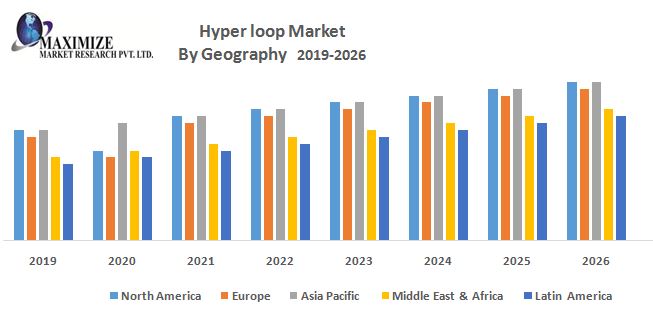
North America remains the epicenter of initial technology validation, with high levels of venture capital and private sector innovation driving the development of prototype tubes. However, Asia-Pacific—specifically China and India—is rapidly scaling infrastructure investment. These regions are prioritizing hyperloop to manage the unprecedented pace of urbanization and the resulting need for massive, efficient, and high-capacity intercity transit solutions. Europe is focusing its regional strategy on interoperability and safety standardization, creating a “plug-and-play” regulatory framework that is essential for a continent-wide network.
Competitive Landscape
The competitive arena for hyperloop is characterized by a “platform war.” Early movers like HyperloopTT and Virgin Hyperloop have set the stage, but the market is now attracting heavy industrial players and engineering giants who bring the manufacturing scale required for large-scale infrastructure projects.
This activity signals a transition from “concept-led” startups to “infrastructure-led” consortia. The companies that are succeeding today are those that can solve the immense civil engineering challenges—such as thermal expansion in vacuum tubes and precision rail alignment—rather than just the software of the pod itself. The competitive inflection point will occur when the first regulatory-approved, multi-kilometer commercial corridor goes live, effectively turning an engineering experiment into a bankable, scalable asset.
Recent Developments
Modular Infrastructure: Development of pre-fabricated tube sections that allow for faster, more cost-effective construction, significantly lowering the barrier to entry for new corridor projects.
Standardization Efforts: International collaborative bodies are beginning to draft safety and technical standards for vacuum transit, which is a critical precursor to global commercialization.
Superconducting Innovation: Integration of new-generation superconducting magnets, which are significantly increasing energy efficiency and reducing the cooling requirements for magnetic levitation.
Strategic Implications
For stakeholders, hyperloop is a long-horizon infrastructure play. The primary strategic value lies in owning the “right-of-way” and the intellectual property related to vacuum-tube safety and propulsion. Investors must look beyond the speed of the pods and focus on the feasibility of the infrastructure; the winning projects will be those that integrate seamlessly with existing urban hubs and offer a clear path to regulatory compliance and operational safety.
Future Outlook
The global hyperloop market is on a collision course with the limits of existing travel modes. Future market leaders will be those who successfully translate prototype performance into industrial-scale reliability, while laggards that remain trapped in the “feasibility study” phase will be bypassed by faster-moving, infrastructure-ready consortia. The final transition will be defined by the shift from expensive, isolated test tracks to a cohesive, continent-spanning transit network that fundamentally alters the economic geography of the 21st century.
Analyst Perspective
“Hyperloop is moving from the realm of science fiction into the era of industrial reality,” says Tejaswini Kakade, Analyst at Maximize Market Research. “As we face the dual pressures of population density and climate change, the ability to move goods and people at supersonic speeds through a vacuum-sealed, zero-emission network is becoming a central imperative for the next generation of global infrastructure.”
About Maximize Market Research
Maximize Market Research Pvt. Ltd. (MMR) is a global market research and consulting company that provides reliable, data-focused, and practical business insights. The firm serves a wide range of industries, including healthcare, pharmaceuticals, technology, automotive, electronics, chemicals, personal care, and consumer goods. Through market forecasts, competitive analysis, strategic consulting, and industry impact assessments, MMR helps organizations understand changing market conditions, identify growth opportunities, and make informed business decisions for long-term success.
2nd Floor, Navale IT Park Phase 3
Pune Banglore Highway, Narhe
Pune, Maharashtra 411041, India
+91 9607365656
sales@maximizemarketresearch.com
