Key Highlights
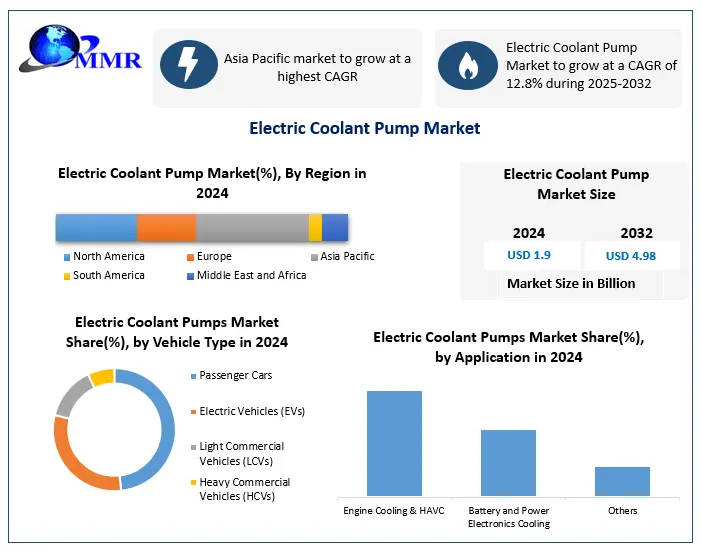
- Global Electric Coolant Pumps Market was valued at USD 1.9 Billion in 2024.
- The market is expected to grow at a CAGR of 12.8% from 2025 to 2032, reaching nearly USD 4.98 Billion by 2032.
- Electrification is transforming thermal management from a supporting function into a core vehicle technology.
- Battery safety, power electronics efficiency, and energy optimization are driving OEM investment in electric coolant pump technologies.
- Tier-1 suppliers are expanding innovation to support next-generation electric, hybrid, and software-defined vehicle platforms.
Why This Matters Now
Thermal management has become one of the defining engineering challenges of the electric mobility era. As batteries become larger, charging speeds increase, and software-defined vehicles introduce greater computing power, maintaining precise operating temperatures is no longer optional—it is essential for performance, safety, and vehicle longevity.
The Global Electric Coolant Pumps Market was valued at USD 1.9 Billion in 2024 and is projected to reach nearly USD 4.98 Billion by 2032, expanding at a 12.8% CAGR from 2025 to 2032. This rapid growth signals a structural shift in automotive engineering. For OEMs, thermal management is becoming a competitive differentiator. For suppliers, it opens a high-value opportunity tied directly to the future of electrified mobility.
Market Overview
Electric coolant pumps are replacing conventional mechanically driven pumps as vehicles transition toward electrified powertrains. Unlike traditional systems that operate according to engine speed, electric pumps provide precise coolant flow based on real-time vehicle requirements, improving efficiency and supporting intelligent thermal management.
The shift extends beyond battery electric vehicles. Hybrid vehicles, plug-in hybrids, fuel cell vehicles, and increasingly sophisticated internal combustion engines all require advanced cooling strategies to improve efficiency, durability, and emissions performance.
Vehicle software is also changing thermal management architecture. Connected control systems continuously monitor battery temperatures, power electronics, cabin climate, and charging conditions. Electric coolant pumps enable these intelligent systems by delivering variable cooling precisely where and when it is needed.
For automotive manufacturers, thermal management is no longer an isolated subsystem. It has become an integrated component of vehicle energy management, affecting driving range, charging performance, battery life, and customer satisfaction.
Key Trends Driving Growth
Electrification remains the strongest catalyst for market expansion. Every new electric vehicle platform increases demand for intelligent cooling systems capable of protecting batteries, electric motors, inverters, and onboard electronics under varying operating conditions.
Fast-charging infrastructure is adding another layer of complexity. Higher charging speeds generate additional heat, making effective thermal management increasingly important for battery safety and charging consistency. Electric coolant pumps enable active cooling during charging cycles, supporting improved vehicle performance.
Software-defined vehicles are also reshaping cooling system requirements. Advanced driver assistance systems, central computing architectures, high-performance processors, and connected services generate additional thermal loads that require intelligent management beyond traditional engine cooling.
Battery innovation continues to influence system design. Higher energy densities require increasingly sophisticated temperature control strategies to maximize battery life while maintaining operational safety.
Sustainability initiatives further reinforce demand. Electric coolant pumps reduce unnecessary energy consumption by operating only when cooling is required, improving overall vehicle efficiency compared with mechanically driven alternatives.
Automotive suppliers are simultaneously investing in lightweight materials, compact packaging, electronic controls, and integrated thermal management modules that improve overall vehicle performance while supporting flexible platform development.
Segment Insights
- Dominant Segment: Information not available in the supplied MMR report.
- Fastest-Growing Segment: Information not available in the supplied MMR report.
- Electric vehicle thermal management remains a primary application area driving market expansion.
- Intelligent cooling systems are becoming increasingly integrated with vehicle software platforms.
- Demand continues expanding across battery electric, hybrid, and advanced powertrain applications.
Regional Growth Story
The United States continues strengthening investment in electric vehicle manufacturing, battery production, and advanced automotive technologies. Thermal management has become an important area of engineering investment as domestic manufacturers expand electrified vehicle portfolios.
Germany remains at the forefront of premium automotive engineering. European manufacturers continue integrating advanced cooling technologies into next-generation electric vehicle platforms while meeting increasingly stringent efficiency and emissions requirements.
China continues leading global electric vehicle production and battery manufacturing. Large-scale EV deployment, combined with strong domestic supply chains, creates substantial opportunities for electric coolant pump manufacturers supporting both domestic and international OEMs.
Japan and South Korea continue driving innovation in electrified powertrains, semiconductor technologies, and automotive electronics. Close collaboration between OEMs and Tier-1 suppliers accelerates development of highly efficient thermal management systems.
India is expanding its automotive manufacturing ecosystem while increasing investments in vehicle electrification and localization. As domestic production grows, demand for advanced automotive components—including electric thermal management systems—is expected to strengthen over the long term.
Across global automotive regions, manufacturing competitiveness increasingly depends on local supply chains capable of supporting rapid production scale-up for electrified vehicle platforms.
Competitive Landscape
Competition has shifted from component manufacturing to complete thermal management solutions. OEMs increasingly seek suppliers capable of integrating pumps, sensors, electronic controls, software, and intelligent cooling strategies into unified vehicle platforms.
Tier-1 suppliers are strengthening engineering partnerships with vehicle manufacturers during platform development. Early collaboration enables optimized cooling architectures that improve efficiency while reducing overall system complexity.
Technology leadership increasingly depends on electronics integration rather than mechanical engineering alone. Companies investing in intelligent control algorithms, electronic pump architectures, and software-enabled thermal optimization strengthen their long-term competitive positioning.
Manufacturing flexibility also plays a decisive role. Suppliers capable of supporting multiple vehicle platforms across conventional, hybrid, and battery-electric architectures reduce development costs for OEMs while strengthening long-term commercial relationships.
As vehicle electrification accelerates, pricing power will increasingly favor companies capable of delivering integrated thermal management expertise instead of standalone hardware products.
Recent Developments
- OEMs continue increasing investment in advanced battery thermal management technologies.
- Electric coolant pumps are becoming integral components of next-generation EV platforms.
- Tier-1 suppliers continue expanding intelligent cooling system capabilities.
- Software-controlled thermal management is gaining greater importance across connected vehicle architectures.
- Vehicle electrification continues driving innovation in cooling efficiency and electronic control systems.
Strategic Implications
For OEM executives, thermal management now directly influences driving range, charging speed, battery durability, and overall customer experience. Investment decisions increasingly prioritize integrated cooling architectures capable of supporting future software-defined vehicle platforms.
Tier-1 suppliers should expand expertise beyond mechanical engineering toward electronics, embedded software, and intelligent thermal management integration. Competitive advantage increasingly depends on complete system capability rather than component manufacturing alone.
Investors should monitor companies positioned within advanced thermal management technologies because these systems support multiple automotive growth themes, including electrification, autonomous driving, connected vehicles, and vehicle computing.
Fleet operators also benefit from improved thermal efficiency through enhanced battery longevity, reduced maintenance requirements, and improved operational reliability.
For regulators, efficient thermal management contributes to broader energy efficiency objectives while supporting safer deployment of high-capacity battery systems across expanding electric vehicle fleets.
Future Outlook
The Global Electric Coolant Pumps Market is expected to grow from USD 1.9 Billion in 2024 to nearly USD 4.98 Billion by 2032, advancing at a 12.8% CAGR from 2025 to 2032. This rapid expansion reflects the increasing strategic importance of intelligent thermal management across electrified transportation. As vehicle architectures continue evolving toward software-defined mobility, cooling technologies will become as essential as batteries, semiconductors, and power electronics.
The next generation of automotive leaders will be defined not only by battery capacity or software capability, but by their ability to master intelligent thermal management—while suppliers that fail to evolve beyond conventional mechanical systems risk becoming obsolete in the electrified mobility ecosystem.
Analyst Perspective
“Electric coolant pumps are emerging as critical enablers of next-generation vehicle performance. As electrification accelerates and software increasingly governs vehicle operation, advanced thermal management will become a defining factor in OEM competitiveness and supplier innovation.” — Tejaswini Kakade, Analyst, Maximize Market Research
About Maximize Market Research
Maximize Market Research Pvt. Ltd. (MMR) is a global market research and consulting company that provides reliable, data-focused, and practical business insights. The firm serves a wide range of industries, including healthcare, pharmaceuticals, technology, automotive, electronics, chemicals, personal care, and consumer goods. Through market forecasts, competitive analysis, strategic consulting, and industry impact assessments, MMR helps organizations understand changing market conditions, identify growth opportunities, and make informed business decisions for long-term success.
2nd Floor, Navale IT Park Phase 3
Pune Banglore Highway, Narhe
Pune, Maharashtra 411041, India
+91 9607365656
sales@maximizemarketresearch.com
