Key Highlights
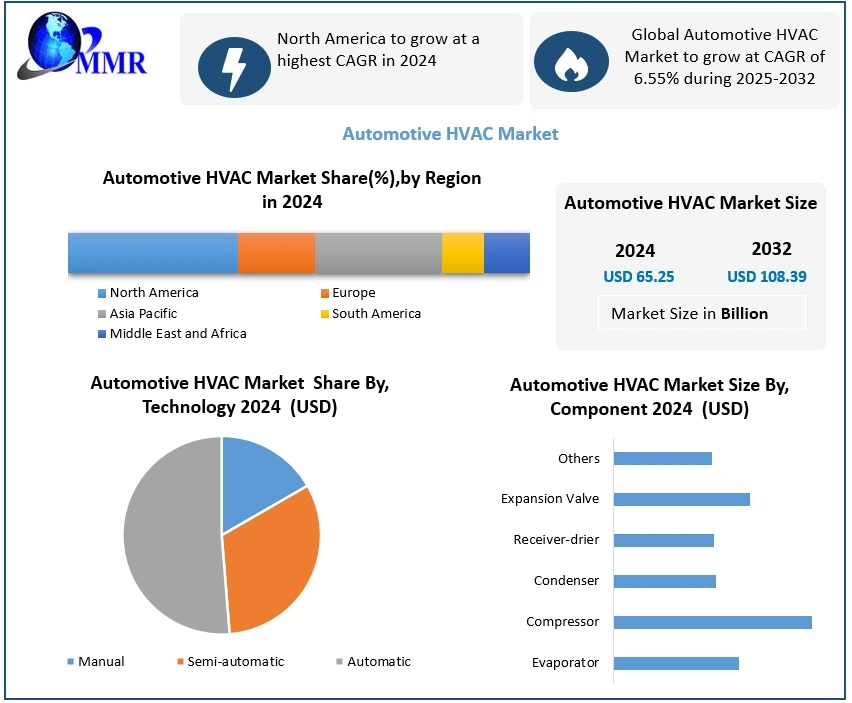
Market Valuation: The global automotive HVAC market was valued at USD 65.25 billion in 2024.
Growth Trajectory: The market is forecast to grow at a CAGR of 6.55% from 2025 to 2032, reaching approximately USD 108.39 billion by 2032.
Dominant Segment: Passenger cars remain the leading application segment, driven by rising disposable incomes and consumer demand for premium comfort features.
Technology Leadership: The automatic HVAC segment currently dominates the market, favored by consumers for its sophisticated temperature and humidity regulation.
Core Component: The compressor segment holds the largest share of component-based revenue, serving as the essential heart of the thermal management cycle.
Why This Matters Now
The automotive interior is being redefined by the transition to electric vehicles (EVs) and software-defined architectures. Thermal management is no longer a luxury comfort feature—it is a critical efficiency driver that directly dictates battery range and vehicle safety.
Market Overview
The Automotive HVAC Market is undergoing a fundamental shift from simple mechanical cooling to integrated, energy-aware thermal ecosystems. With a market value of USD 65.25 billion in 2024, the sector is increasingly focused on reducing the “parasitic load” of climate control systems. As the industry moves toward EVs, the ability to balance cabin comfort with battery thermal performance has become the new benchmark for competitive advantage among OEMs and Tier-1 suppliers.
Key Trends Driving Growth
The Efficiency Imperative: In electric and hybrid vehicles, every joule of energy used for cabin heating or cooling is a joule stolen from driving range. This pressure is accelerating the adoption of high-efficiency components, such as electric compressors and heat pump systems, which provide superior thermal performance with significantly lower power consumption compared to legacy systems.
Intelligence and Automation: Consumers now expect climate control that is predictive and personalized. The integration of AI-driven zonal climate control allows vehicles to adjust temperatures for individual passengers, reducing overall energy usage by not conditioning empty seats. Furthermore, remote access systems enable users to “pre-condition” their vehicle’s cabin while it is still plugged in, preserving battery life for the commute ahead.
Segment Insights
Dominant Segment: Passenger Cars. This segment dominates the market due to high global production volumes and the consistent integration of high-end climate features into entry- and mid-level vehicles.
Fastest-Growing Segment: Automatic HVAC Technology. As sensor prices decrease and telematics adoption rises, automatic climate control systems are moving from premium luxury segments into mainstream vehicle platforms.
Component Leader: Compressors. These remain the most critical hardware in the HVAC loop, with manufacturers prioritizing modular, variable-speed electric compressors that can scale across different powertrain platforms.
Regional Growth Story
The Asia-Pacific region continues to hold the largest revenue share, underpinned by the world’s most robust automotive manufacturing hubs in China, Japan, and South Korea. This region benefits from the dual tailwinds of massive domestic vehicle demand and an export-oriented supply chain. Meanwhile, North America and Europe are emerging as hotspots for high-value R&D, as OEMs in these regions prioritize the development of the next generation of eco-friendly, energy-conscious HVAC technologies to meet stringent emission targets.
Competitive Landscape
The competitive landscape is dominated by industry heavyweights such as Denso Corporation, Mahle Group, Valeo, Hanon Systems, and Sanden Holdings. Their current strategy involves moving away from “black-box” component delivery toward integrated thermal management “platforms.”
This transition signals that OEMs are seeking partners who can supply the entire thermal loop—from the battery cooling plates to the cabin HVAC—rather than fragmented pieces. Acquisitions and partnerships in the space are increasingly focused on acquiring software expertise, specifically for the algorithms that manage the delicate trade-off between cabin comfort and powertrain efficiency. Companies that master this system-level integration are securing the largest share of long-term OEM contracts.
Recent Developments
Eco-Friendly Refrigerants: A global industry push is replacing legacy refrigerants with low-GWP (Global Warming Potential) alternatives like R744 (CO2), improving environmental compliance and energy efficiency.
Remote Climate Intelligence: Rollout of telematics-integrated HVAC systems that allow for real-time diagnostics and user-customized climate profiles via mobile applications.
Integrated Thermal Modules: Development of “all-in-one” thermal units that combine cabin conditioning with battery and e-powertrain cooling to minimize weight and footprint.
Strategic Implications
For stakeholders, the era of standalone HVAC hardware is ending. Success now requires a deep integration into the vehicle’s central electronic architecture. OEMs must prioritize suppliers that can provide modular, lightweight solutions capable of communicating with the vehicle’s energy management system to optimize the total thermal budget. Those that fail to adopt these integrated, software-driven approaches risk being relegated to lower-margin component supply roles.
Future Outlook
The automotive HVAC industry is evolving from a comfort-provisioning sector into a core energy-optimization business. The market will soon be bifurcated between leaders who master “zonal” and “energy-autonomous” thermal systems and laggards who continue to offer resource-heavy, undifferentiated cooling units. Future dominance belongs to those who view the HVAC system not as an accessory to the drive, but as the essential regulator of the vehicle’s energy efficiency.
Analyst Perspective
“Thermal management has become the new frontier of vehicle performance,” says Tejaswini Kakade, Analyst at Maximize Market Research. “The transition to electric powertrains has turned HVAC systems into a mission-critical efficiency gatekeeper, where every degree of comfort must be balanced against the precious capacity of the battery pack.”
About Maximize Market Research
Maximize Market Research Pvt. Ltd. (MMR) is a global market research and consulting company that provides reliable, data-focused, and practical business insights. The firm serves a wide range of industries, including healthcare, pharmaceuticals, technology, automotive, electronics, chemicals, personal care, and consumer goods. Through market forecasts, competitive analysis, strategic consulting, and industry impact assessments, MMR helps organizations understand changing market conditions, identify growth opportunities, and make informed business decisions for long-term success.
2nd Floor, Navale IT Park Phase 3
Pune Banglore Highway, Narhe
Pune, Maharashtra 411041, India
+91 9607365656
sales@maximizemarketresearch.com
