Key Highlights
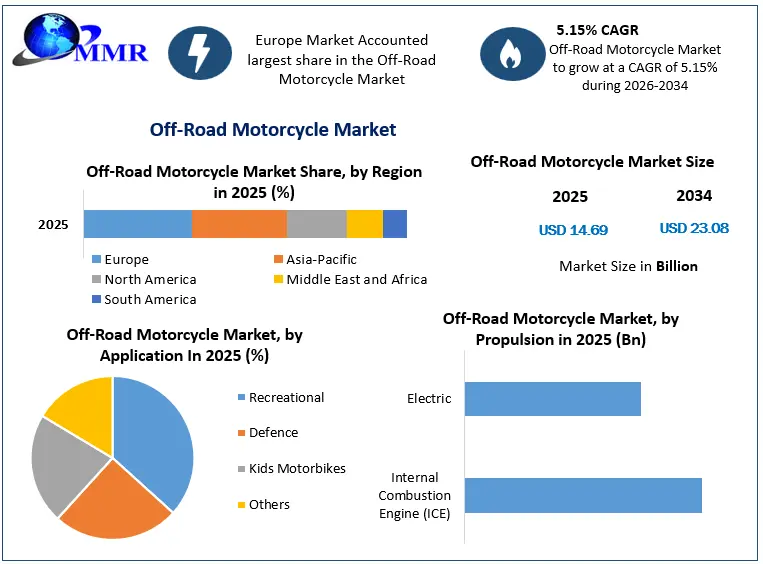
Market Growth: The global off-road motorcycle market is projected to reach USD 20.88 billion by 2032, growing at a CAGR of 5.15% from 2025.
Dominant Segment: Adventure Bikes led the market in 2024, driven by consumer demand for dual-purpose versatility.
Volume Metrics: Over 400,000 off-road units were sold globally in 2024, signaling robust participation in recreational motorsports.
Cost Pressures: Volatility in raw material pricing—specifically steel, aluminum, and rubber—remains a primary constraint on OEM profit margins.
Regional Leadership: Europe serves as the global hub for off-road market development, anchored by a strong motorsports culture and extensive racing event infrastructure.
Why This Matters Now The off-road motorcycle sector is undergoing a critical transition from niche recreational pursuit to a mainstream mobility and lifestyle category. As OEMs face compressed margins due to raw material volatility, the ability to differentiate through advanced suspension systems and integrated technology has become the primary battleground for market share.
Market Overview Valued at USD 13.97 billion in 2024, the global Off-Road Motorcycle Market is entering a phase of steady expansion. This growth is anchored by the versatility of modern machinery—specifically, the rise of dual-purpose bikes that blur the lines between rugged trail capability and street-legal comfort. While historical growth relied on pure competition models, the market now pivots toward multi-utility platforms that satisfy both the professional enduro rider and the weekend adventure enthusiast.
Key Trends Driving Growth Recreational participation is the primary volume driver. As adventure tourism gains momentum, motorcycles are increasingly viewed as essential equipment for exploration rather than strictly for professional racing. This shift is amplified by a strong social media influence, which has successfully rebranded off-road motorcycling as a lifestyle identity for younger demographics.
Technological integration is the secondary catalyst. OEMs are prioritizing performance-enhancing features such as self-adjusting suspension systems, compression damping, and advanced ABS to improve rider safety and machine longevity. By reducing physical stress on both the vehicle and the operator, these innovations open the market to a broader demographic, including casual enthusiasts who might otherwise avoid the rigors of traditional dirt bike riding.
Segment Insights
Dominant Segment: Adventure Bikes. This category secured the market lead in 2024. Its dominance stems from superior versatility, offering a balance of ergonomic comfort for long-distance touring and the structural integrity required for off-road navigation.
Fastest-Growing Segment: While the report highlights the overall segment landscape, the Enduro segment remains a critical growth pillar, fueled by the rising popularity of professional and amateur endurance races across forest and mountainous terrain.
Regional Growth Story Europe currently commands the global off-road motorcycle market. This dominance is not accidental; it is the result of deep-rooted motorsports heritage and a dense calendar of world-class events, including the FIM Grand Prix Motocross World Championship. With 1.1 million total motorcycle registrations across its five largest markets—France, Germany, Italy, Spain, and the UK—in 2024, the region provides the highest density of both professional competition and recreational participation.
North America follows closely, leveraging an expansive network of public lands and a cultural propensity for outdoor adventure sports. Meanwhile, the Asia-Pacific region is experiencing a nascent but rapid surge in interest, as adventure sports become more accessible to an emerging middle class with increasing disposable income for recreational activities.
Competitive Landscape The competitive environment is characterized by a fierce race for technological differentiation. Industry incumbents—specifically Honda, Yamaha, KTM, Husqvarna, and Kawasaki—are shifting from volume-based strategies to high-value positioning.
KTM’s strategic focus on race-proven performance, evidenced by its significant championship record, signals a commitment to maintaining a premium tier within the market. Honda’s role as the world’s largest internal combustion engine manufacturer provides it with significant manufacturing scale and cost-management advantages that competitors find difficult to replicate. The emphasis on proprietary suspension technology—highlighted by partnerships and specialized developments from firms like TFX Suspension Technology and K-Tech—indicates that component-level innovation is now as vital as engine architecture for OEM positioning.
Recent Developments
Performance Engineering: Husqvarna’s 2025 Enduro series integration of optimized braking and engine performance upgrades reflects an industry-wide drive to harmonize safety and power.
Technology Integration: Manufacturers are standardizing GPS integration and traction control systems to modernize the rider experience.
Supplier Partnerships: Collaborative efforts with specialized suspension suppliers are allowing OEMs to offer factory-tuned, high-performance setups that were previously reserved for professional racing teams.
Strategic Implications The fundamental challenge for OEMs is the decoupling of cost and value. With raw material costs for steel, aluminum, and rubber subject to global supply chain volatility, manufacturers are trapped between rising input costs and the consumer’s resistance to higher retail prices. Firms that fail to optimize their manufacturing efficiency or secure long-term raw material contracts will see their margins eroded. Consequently, the winners will be those who can successfully transition to premium, tech-heavy models where consumers are more willing to absorb price increases in exchange for superior performance and connectivity.
Future Outlook The off-road motorcycle market is moving toward a future defined by extreme customization and advanced rider-assistance systems. As manufacturers navigate the pressures of raw material inflation and the necessity for product innovation, the industry will experience a clear bifurcation. Future market leaders will be those who master the integration of software-defined features and high-durability materials to enhance the rider experience, while laggards will remain stuck in a low-margin commodity cycle, increasingly vulnerable to the volatility of global manufacturing costs.
Analyst Perspective “The market is moving beyond simple mechanical performance,” says Tejaswini Kakade, analyst at Maximize Market Research. “OEMs that prioritize advanced suspension integration and rider-centric technology are the ones successfully capturing the expanding demographics of adventure-seekers and modern enthusiasts.”
About Maximize Market Research
Maximize Market Research Pvt. Ltd. (MMR) is a global market research and consulting company that provides reliable, data-focused, and practical business insights. The firm serves a wide range of industries, including healthcare, pharmaceuticals, technology, automotive, electronics, chemicals, personal care, and consumer goods. Through market forecasts, competitive analysis, strategic consulting, and industry impact assessments, MMR helps organizations understand changing market conditions, identify growth opportunities, and make informed business decisions for long-term success.
2nd Floor, Navale IT Park Phase 3
Pune Banglore Highway, Narhe
Pune, Maharashtra 411041, India
+91 9607365656
sales@maximizemarketresearch.com
