Key Highlights
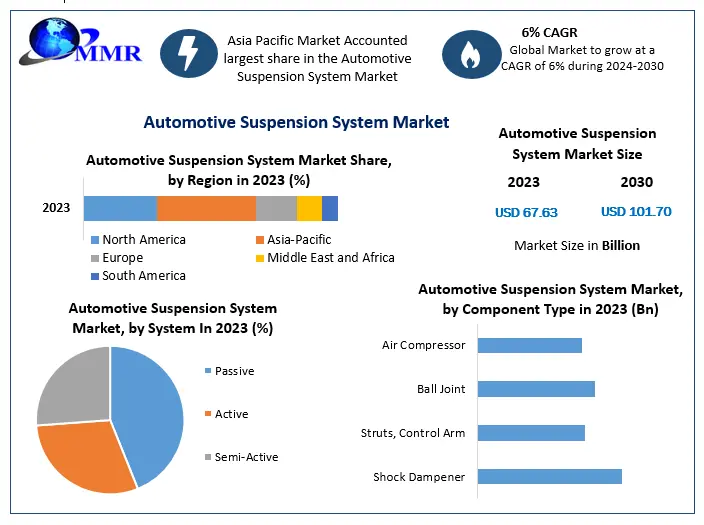
The global automotive suspension system market reached a valuation of USD 67.63 billion in 2023 and is projected to scale to USD 101.70 billion by 2030.
The market operates at a steady compounded annual growth rate of 6% over the 2024 to 2030 forecast timeline.
Passive suspension setups captured the absolute majority of the market in 2023, commanding an 83.73% market share.
Hydraulic systems led the suspension type category, accounting for 36% of the global market share in 2023.
The Asia Pacific region established clear dominance, securing a 24.86% market share and contributing 49.6% of total revenue in 2023.
Active suspension systems are projected to grow at a specific CAGR of 4.3% through the forecast period, driven by luxury car applications.
Why This Matters Now
Global automotive manufacturing is undergoing an aggressive structural shift as logistics networks expand and fleet electrification accelerates across major regions. Original Equipment Manufacturers (OEMs) and Tier-1 suppliers face simultaneous pressures to enhance vehicle ride quality, meet tightening safety regulations, and adapt mechanical systems for new mobility platforms. The suspension architecture dictates the foundational handling, passenger safety, and structural integrity of modern platforms, making it a critical focus for engineering investments.
Urbanization and shifting purchasing behaviors are accelerating the realignments of regional vehicle supply chains. The surge in e-commerce and commercial logistics activities has drastically intensified the operational demand on material transportation fleets, forcing a complete rethink of suspension longevity. For institutional investors and automotive strategists, understanding these technological inflection points is essential for mitigating capital risks and securing design-win pipelines for the next generation of light commercial vehicles and long-haul transport platforms.
Market Overview
The Automotive suspension system market is fundamentally bound to new vehicle production volume and the ongoing technical evolution of modern chassis designs. Valued at USD 67.63 billion in 2023, the global market is on track to achieve a market size of USD 101.70 billion by 2030, maintaining a consistent CAGR of 6%. Structurally, these systems rely on three core pillars—linkages, springs, and shock absorbers—which collectively isolate the vehicle body from road imperfections while ensuring tire contact with the surface.
This mechanical ecosystem is facing immediate disruption as governments implement stricter vehicle safety mandates and incentivize the integration of high-tech components. For specialized emergency applications, such as ambulances, advanced suspension configurations are becoming mandatory to prevent further physiological injury to patients during transit. Furthermore, the integration of lightweight materials within suspension assemblies is creating new avenues for remanufacturing, directly supporting the technical requirements of hybrid and electric vehicle platforms.
Key Trends Driving Growth
The dramatic expansion of global logistics networks serves as a primary macro-economic driver for the suspension sector. Fleet operators are progressively selecting light commercial vehicles, panel vans, and pickup trucks over heavy freight trucks and rail transport for last-mile and regional delivery operations. This rapid transition directly translates into high-volume component sales for Tier-1 suppliers that specialize in durable, load-bearing suspension architectures.
Concurrently, commercial fleet electrification is reshaping suspension design parameters across the Asia Pacific, Europe, and North America. Municipalities and private transport corporations are heavily investing in electric buses and long-haul intercity transport, requiring heavy-duty suspension designs capable of managing altered weight distributions from massive battery packs. Public infrastructure expansions, particularly charging infrastructure networks for intercity transit, are accelerating the commercial validation of these electric platforms.
Automaker electrification roadmaps are introducing massive volume opportunities into the commercial space. In May 2020, BYD Europe executed a strategic expansion by announcing its e-Truck series for the European market, rolling out battery-electric vehicles that span panel vans up to 7.5-ton and 19-ton rigid distribution trucks. The introduction of these diverse electric weight classes requires highly specialized, heavy-duty suspension systems tailored to handle high torque and distinct axle loads.
However, the industry faces real headwinds, notably the shifting customer lifestyles and evolving electric passenger car preferences focused heavily on carbon dioxide reduction targets, which complicate traditional chassis manufacturing. Additionally, declining passenger car sales volumes inside the United States threaten legacy component revenues, while a reduction in motorcycle acceptance across specific regional markets—due to safety perceptions—limits two-wheeler segment expansion.
Segment Insights
Dominant System Segment: Passive suspension systems held the leading position in the market, capturing an 83.73% market share in 2023 due to their presence in almost every conventional, low-range, and mid-range passenger car.
Dominant Suspension Type: Hydraulic suspension systems commanded the largest share of the suspension type category in 2023 at 36%, favored for their rapid reaction times and tight ride characteristics.
Fastest-Growing Segment: Air suspension systems are designated as the fastest-growing technology type, gaining rapid adoption across commercial trucks, buses, military fleets, and luxury passenger vehicles due to their high affordability relative to complex hydraulic designs.
Active Suspension Systems: This advanced architecture is growing at a 4.3% CAGR, engineered specifically to control vertical wheel movements relative to the vehicle frame to enhance driver safety and ride comfort in luxury vehicles.
Regional Growth Story
The Asia Pacific region cemented its position as the engine of the global suspension market, capturing a dominant 24.86% market share in 2023 and generating 49.6% of total global revenue. This leading position is sustained by skyrocketing domestic automotive sales, rising electric vehicle production volumes, and deep regional access to essential raw materials. The regional market is projected to expand at a steady CAGR of 4.2% through the forecast period, supported by established component manufacturing clusters across China, Japan, India, and South Korea.
North America remains a highly lucrative zone for high-margin technology providers, dictated by an intense consumer demand for premium active suspension setups and rapid technological iterations. While declining conventional passenger car sales in the United States present a challenge to mass-market component volumes, the rapid electrification of the light truck and commercial vehicle segments mitigates this contraction. The regional market dynamics highlight a clear bifurcation: volume growth characterizes the expanding Asian manufacturing hubs, whereas premium technology integration defines the North American landscape.
Competitive Landscape
The competitive landscape of the automotive suspension system market is characterized by intense technological competition among established global Tier-1 suppliers. Market leaders like Continental AG, ZF, and Tenneco Inc. are continuously optimizing their portfolios to balance the high-volume demand for passive systems with the high-margin expansion of active and air suspension technologies. The supplier ecosystem is further filled out by specialized manufacturers, including FOX Factory, Inc., Gabriel India Limited, Hendrickson USA, LLC, KYB Corporation, Mando Corporation, Sogefi SpA, WABCO, Thyssenkrupp AG, NHK Spring, Schaeffler AG, and Benteler.
These companies are actively adjusting their production capacities to align with OEM transitions toward electric commercial platforms and light delivery fleets. The continuous shift toward lightweight materials represents a vital arena for technology leadership, as suppliers seek to reduce unsprung mass without sacrificing component durability. Companies that successfully capture design-wins for electric utility vehicle platforms and long-haul electric buses are positioning themselves to capture long-term market share as legacy platforms decline.
Recent Developments
BYD Europe initiated a major commercial vehicle push by launching a full line of battery-electric vehicles, including panel vans and rigid distribution trucks up to 19 tons.
Tier-1 suppliers expanded their remanufacturing programs to address the growing aftermarket demand for hybrid and electric passenger vehicle suspension assemblies.
Public and private entities accelerated the physical deployment of long-haul charging infrastructure, directly clearing the path for high-volume active suspension deployment in intercity electric buses.
Component manufacturers advanced the commercialization of specialized air suspension architectures, intentionally targeting the mid-range commercial truck market to challenge legacy hydraulic systems.
Strategic Implications
For global vehicle manufacturers and tier-structured supply chains, the transformation of suspension architectures demands immediate capital reallocation. OEMs can no longer treat suspension as a static mechanical commodity; it must be integrated into the overarching energy efficiency and safety profile of the vehicle. The rapid expansion of e-commerce requires the deployment of highly durable chassis systems that minimize fleet downtime and handle continuous duty cycles.
Suppliers must rapidly adapt their manufacturing lines to accommodate the simultaneous growth of air suspension in commercial fleets and the sustained volume of passive components in emerging economies. Capital investments must target lightweight material forming and automated assembly to protect margins against shifting regional vehicle sales. Companies that fail to integrate these advanced manufacturing techniques risk losing their cost competitiveness as the market shifts toward modular electric vehicle platforms.
Future Outlook
The global automotive suspension system market is moving toward an era defined by structural divergence between entry-level utility and automated ride control. As commercial fleets complete their transition to electric powertrains, suspension systems will become critical variables in maximizing battery range and securing vehicle safety. The integration of advanced air and active systems will accelerate across premium commercial and luxury passenger segments, while cost-optimized passive systems will continue to anchor mass-market production in developing automotive hubs. The ultimate dividing line in this industry will separate forward-thinking suppliers who successfully commercialize affordable, lightweight air and active architectures from legacy manufacturers trapped in declining conventional passenger car segments.
Analyst Perspective
“The rapid expansion of the global logistics framework and the aggressive push toward commercial fleet electrification are forcing a fundamental reassessment of chassis engineering,” stated Tejaswini kakade, Analyst at Maximize Market Research.
About Maximize Market Research
Maximize Market Research Pvt. Ltd. (MMR) is a global market research and consulting company that provides reliable, data-focused, and practical business insights. The firm serves a wide range of industries, including healthcare, pharmaceuticals, technology, automotive, electronics, chemicals, personal care, and consumer goods. Through market forecasts, competitive analysis, strategic consulting, and industry impact assessments, MMR helps organizations understand changing market conditions, identify growth opportunities, and make informed business decisions for long-term success.
2nd Floor, Navale IT Park Phase 3
Pune Banglore Highway, Narhe
Pune, Maharashtra 411041, India
+91 9607365656
sales@maximizemarketresearch.com
