Key Highlights
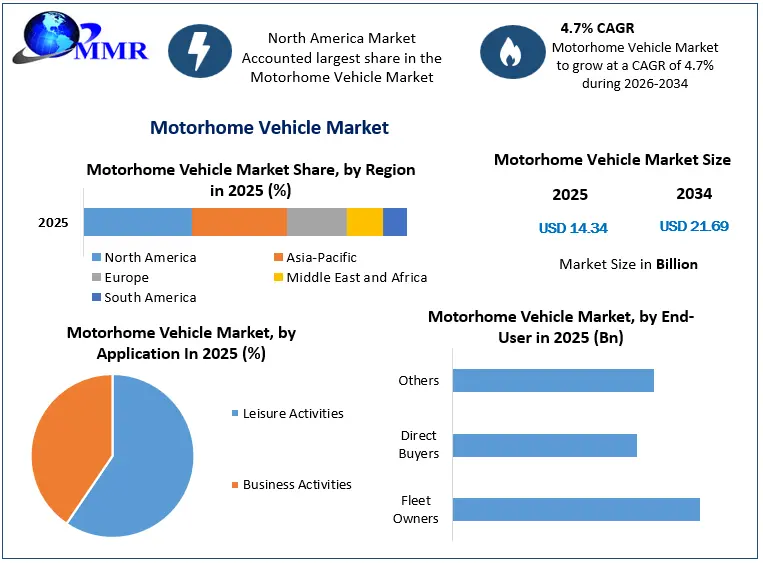
Market Valuation: The global motorhome vehicle market reached USD 13.7 billion in 2024 and is projected to climb to USD 19.78 billion by 2032, growing at a CAGR of 4.7%.
Dominant Segment: Type C motorhomes commanded a 68% market share in 2024, serving as the industry standard due to their balance of affordability and chassis-based manufacturing.
Fastest-Growing Segment: Type B motorhomes (campervans) are currently the fastest-growing segment, propelled by demand for urban maneuverability and lower entry costs.
Regional Leadership: North America maintains global market dominance, while Europe emerges as the fastest-growing region for digital retail and nomadic tourism.
Economic Headwinds: Manufacturers face sustained pressure from raw material cost volatility, specifically in aluminum, steel, and copper, which complicates pricing strategy and long-term margin stability.
Why This Matters Now The motorhome market has pivoted from a niche leisure sector to a central component of the modern mobility and tourism ecosystem. As consumer expectations for luxury, digital connectivity, and environmental sustainability converge, OEMs are being forced to accelerate the transition from mechanical, static living spaces to smart, software-defined mobile environments.
Market Overview Valued at USD 13.7 billion in 2024, the Motorhome Vehicle Market is defined by the integration of manufacturing agility and service-oriented business models. While the core product remains the self-contained mobile living unit, the sector is experiencing a structural shift toward rental-based accessibility and smart technology integration. This evolution is vital for industry stakeholders, as the reliance on traditional sales cycles is being disrupted by the rising popularity of digital rental platforms like RVshare and Outdoorsy, which expand the addressable market to younger, budget-conscious demographics.
Key Trends Driving Growth Road-based tourism has transitioned from a temporary pandemic-era trend to a structural behavioral shift. This demand for flexible, autonomous travel has necessitated a rethinking of vehicle design, with an increased focus on onboard amenities and connectivity. Simultaneously, the push toward sustainability—fueled by global regulatory scrutiny of carbon emissions—is forcing manufacturers to prioritize the development of hybrid and electric powertrains.
Digital retail initiatives are reshaping how these vehicles reach the end user. By integrating IoT, GPS tracking, and infotainment systems directly into the product lifecycle, OEMs are capturing data that informs future R&D, moving from a “build-and-sell” model to a “connected ecosystem” model that supports lifecycle-long customer engagement.
Segment Insights
Dominant Segment: Type C Motorhomes. Accounting for 68% of the 2024 market, these vehicles, built on existing truck chassis, offer an optimal intersection of size, cost, and utility. Their dominance is anchored in their accessibility for families and the manufacturing efficiencies associated with standard chassis utilization.
Fastest-Growing Segment: Type B Motorhomes. Also known as campervans, these vehicles are experiencing rapid adoption due to their maneuverability in traffic-dense urban environments, ease of parking, and lower price points compared to traditional Class A or C units.
Regional Growth Story North America holds the largest market share, bolstered by a deep-rooted cultural appetite for RV ownership and well-developed infrastructure that supports recreational travel. With record-breaking shipments of 600,240 units in 2021, the U.S. manufacturing base serves as the global engine for the sector. Conversely, Europe is currently the fastest-growing region, where demand is fueled by the rise of nomadic tourism and advanced digital retail strategies that allow for seamless vehicle leasing across borders.
Competitive Landscape The competitive hierarchy is defined by vertical integration and the rapid acquisition of digital capabilities. Thor Industries dominates through a multi-brand strategy, utilizing its scale to control the supply chain—a critical advantage as raw material costs fluctuate. Winnebago Industries is positioning itself as the leader in “tech-savvy” travel, investing heavily in EV-ready platforms and advanced safety systems to capture the millennial and Gen Z market share.
Trigano S.A.’s success in the European market signals a shift toward manufacturing agility and design diversity, allowing it to respond quickly to regional demand fluctuations. For Tier-1 suppliers and investors, these movements indicate that the future of the market rests not just on the vehicle, but on the intellectual property embedded within the chassis—specifically, the ability to integrate smart-home technology into a mobile, electric-ready platform.
Recent Developments
Innovative Concepts: AC Future (U.S.) unveiled the AI-THD “transformer” RV concept at CES 2025, highlighting a shift toward expandable, AI-integrated mobile living spaces.
Rental Integration: Significant growth in online rental platforms, such as Indie Campers, has created a new, high-growth revenue stream that bypasses traditional financing barriers for consumers.
Electrification R&D: Major OEMs are shifting R&D capital toward hybrid and full-electric powertrains to align with growing demand for low-emission recreational vehicles.
Strategic Implications The volatility of raw material prices—steel, aluminum, and copper—poses a systemic risk to profit margins. OEMs that fail to implement lean manufacturing or hedge against commodity price swings will be forced to pass these costs to the end consumer, risking significant market share loss in an increasingly price-sensitive environment. To mitigate this, successful manufacturers are doubling down on high-margin, tech-integrated models where the value proposition is defined by performance and connectivity rather than base mechanical utility.
Future Outlook The motorhome industry is approaching a technological inflection point where the vehicle’s “living” components will be as critical as its “driving” components. As the shift toward electric-ready platforms and software-defined living environments accelerates, the gap between traditional manufacturers and next-generation mobility providers will widen. Future market leaders will be those that master the seamless integration of energy management, digital connectivity, and autonomous safety systems, effectively turning the motorhome into a mobile, smart home—while laggards will find themselves stranded, unable to reconcile the cost of high-tech innovation with the traditional price expectations of the RV consumer.
Analyst Perspective “The motorhome market is evolving into a high-tech service segment,” says Tejaswini Kakade, analyst at Maximize Market Research. “OEMs that prioritize digital rental ecosystems and EV-ready innovation will dominate by capturing the next generation of nomadic, tech-oriented travelers.”
About Maximize Market Research
Maximize Market Research Pvt. Ltd. (MMR) is a global market research and consulting company that provides reliable, data-focused, and practical business insights. The firm serves a wide range of industries, including healthcare, pharmaceuticals, technology, automotive, electronics, chemicals, personal care, and consumer goods. Through market forecasts, competitive analysis, strategic consulting, and industry impact assessments, MMR helps organizations understand changing market conditions, identify growth opportunities, and make informed business decisions for long-term success.
2nd Floor, Navale IT Park Phase 3
Pune Banglore Highway, Narhe
Pune, Maharashtra 411041, India
+91 9607365656
sales@maximizemarketresearch.com
