Key Highlights
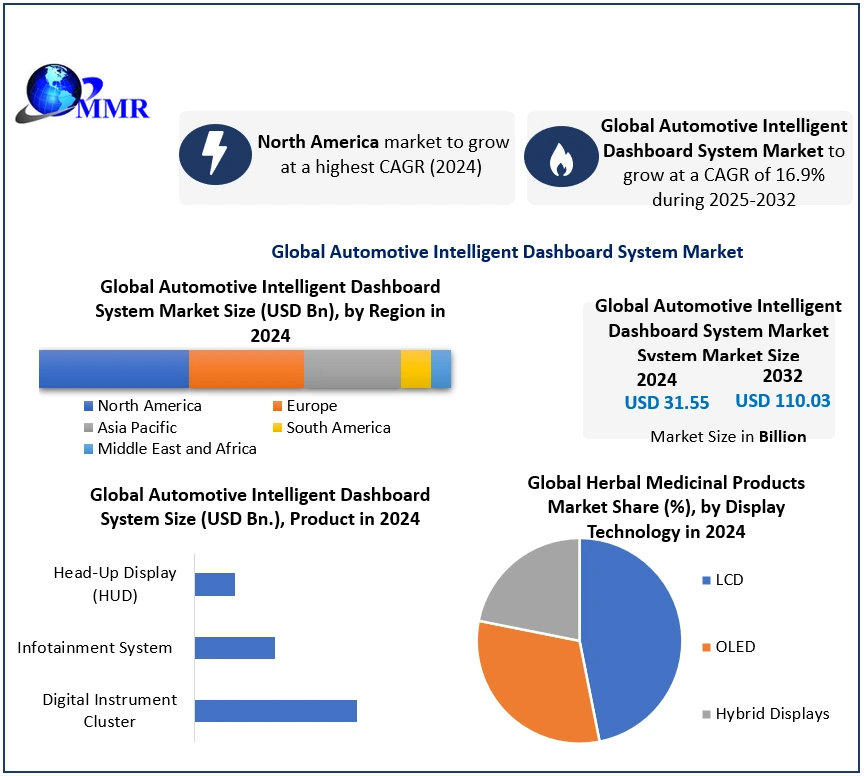
The market was valued at USD 31.55 billion in 2024, signaling a large installed base already shifting from conventional clusters to integrated digital cockpits.
Revenue is expected to grow at a CAGR of 16.9% from 2025 to 2032, reaching nearly USD 110.03 billion, which points to rapid platform replacement rather than incremental upgrades.
Sensors are identified as the dominant component segment, showing that the dashboard is becoming a data fusion layer, not just a display unit.
Passenger vehicles hold two-third of total demand, which means consumer and premium OEM programs remain the main commercialization path.
North America and Europe held the highest share in 2024, while regional demand is being reinforced by safety standards and EV-led cockpit adoption.
Why This Matters Now
The dashboard has moved from a styling element to a strategic control surface for the software-defined vehicle. That shift matters because automakers now compete on data integration, driver experience, and safety functionality, not just on hardware fit and finish.
EVs and connected vehicles are accelerating that change. MMR says new electric vehicles feature advanced electronic hardware, which is pushing rapid integration of intelligent dashboard systems and making digital instrument clusters more valuable than basic displays.
Market Overview
The Automotive Intelligent Dashboard System Market is expanding because vehicle electronics are becoming central to how cars are built, sold, and updated. MMR describes the system as a platform that collects and displays data from gauges, meters, cameras, sensors, and other integrated devices, with IoT, network data, Wi-Fi, connected cars, and AI enabling real-time monitoring of speed, navigation, road view, temperature, and operating status.
That creates a clear business implication: dashboards now sit at the intersection of safety, telematics, infotainment, and energy management. For OEMs, the value lies in using the cockpit to differentiate higher-margin models and lock in software ecosystems. For suppliers, the value lies in control of sensors, display stacks, integration software, and human-machine interface design.
Key Trends Driving Growth
The first major driver is the shift toward technologically advanced vehicles. MMR notes that connected vehicles now share data and knowledge, while new dashboards combine gauges, sensors, climate control, and entertainment systems, giving drivers real-time vehicle and traffic information.
The second driver is electrification. As EV programs grow, the dashboard becomes a critical interface for battery status, range, charging visibility, and energy use, even though the report itself limits its detail to rapid integration in EVs. That makes cockpit design more important in EV purchasing decisions because the interface must reduce range anxiety and improve usability.
The third driver is the move toward safer driving. MMR says intelligent dashboard interfaces are designed to be user-friendly while supporting a safer steering experience, and that the inclusion of warning lights, sensor inputs, and driver alerts improves vehicle protection. This supports ADAS adoption, especially in markets where regulators and consumers increasingly expect active safety features.
Request a Free Sample Copy or View Report Summary: https://www.maximizemarketresearch.com/request-sample/103192/
Segment Insights
Dominant Segment: Sensors are predicted to dominate the market during the forecast period, because they feed visible and invisible vehicle data into the dashboard and enable faster measurement and response.
Fastest-Growing Segment: The report does not explicitly name the fastest-growing segment, so it should not be inferred.
Passenger vehicles hold two-third of total demand, which means OEM cockpit strategies in cars, SUVs, premium models, and EVs will shape market revenue more than commercial fleets in the near term.
By product, the report covers digital instrument clusters, infotainment systems, and head-up displays, which indicates a market moving toward layered user interfaces rather than one-screen solutions.
By display technology, LCD, OLED, and hybrid displays are included, showing the battle is shifting toward higher-resolution, more integrated visual systems.
Regional Growth Story
North America and Europe held the highest share in 2024, and the report links that position to active protection systems, major automakers, and EU safety standards. The implication is straightforward: regulatory pressure and premium vehicle demand are pushing cockpit digitization faster in these markets than in lower-cost segments.
The United States stands out because OEMs are collaborating with Tier 1 and Tier 2 firms to build electric cars, while government support for infrastructure and startup capital is also mentioned in the report. Germany and the wider European market benefit from stronger EV demand, which the report says is helping accelerate intelligent dashboard adoption in electric vehicles.
Asia Pacific is positioned as a major regional market through China, South Korea, Japan, and India, but the report does not quantify which country leads. Even so, the regional structure suggests future competition will be shaped by manufacturing scale, electronics supply chains, and the speed at which local OEMs move to digital cockpits in EV platforms.
Competitive Landscape
The report lists Robert Bosch, Continental, DENSO, Magneti Marelli, Fujitsu, Jabil, Pricol, Visteon, HARMAN, Johnson Controls, Faurecia, ABB, Toyoda Gosei, and LG Innotek among the key players. That roster signals a market where automotive electronics leaders, display integrators, and cockpit specialists all compete for design wins.
The strategic message is more important than the company list. Suppliers that can combine sensors, displays, software, and integration will gain pricing power, because OEMs want fewer interfaces, faster validation cycles, and better support for EV and connected-car features. Companies that remain tied to discrete hardware risk losing relevance as the dashboard becomes a software-led product.
Recent Developments
MMR says recent dashboards now include gauges, sensors, climate control, entertainment systems, tachometer, speedometer, fuel gauge, odometer, gearshift location indicator, turn signs, seat belt alerts, engine-malfunction lights, parking-brake warnings, low-fuel indicators, tire-pressure warnings, airbag failure alerts, low oil pressure alerts, and infotainment functions.
The report says intelligent dashboard interfaces use IoT, network data, Wi-Fi, connected cars, and AI to monitor vehicle speed, navigation, road view, temperature, and time.
MMR highlights that many OEMs in the United States are collaborating with Tier 1 and Tier 2 firms to build electric cars, which signals tighter integration between vehicle electrification and cockpit electronics.
The report says Europe’s safety standards and EV demand are continuing to support market growth, which indicates regulation is acting as a commercial accelerator.
Strategic Implications
OEMs should treat the dashboard as a platform decision, not a trim-level choice. The winners will be the companies that can connect EV systems, safety alerts, and infotainment into one interface without compromising reliability or user experience.
Tier-1 suppliers should focus on integration depth, not just component supply. The report’s emphasis on sensors, connected vehicles, and AI suggests that value will migrate toward system architecture, software integration, and user-interface performance.
Fleet operators and mobility providers will increasingly judge vehicles by uptime, driver visibility, and operational data quality. As dashboards become more intelligent, they will also become more useful for vehicle monitoring, safety compliance, and remote diagnostics, even though the report does not provide fleet-specific numbers.
Future Outlook
The market’s direction is clear: dashboards will keep absorbing functions once spread across separate gauges, telematics units, and infotainment modules. Leaders will use that convergence to control the in-vehicle software layer; laggards will keep selling hardware in a market that is moving toward intelligent cockpit platforms.
Related Reports
Global Motorcycle Chain Sprocket Market https://www.maximizemarketresearch.com/market-report/global-motorcycle-chain-sprocket-market/23069/
Autonomous Vehicle Market Luxury Segment https://www.maximizemarketresearch.com/market-report/autonomous-vehicle-market-luxury-segment/1787/
Automotive Natural Gas Vehicle Market https://www.maximizemarketresearch.com/market-report/automotive-natural-gas-vehicle-market/11140/
Analyst Perspective
“Automotive intelligent dashboard systems are moving into the center of vehicle strategy as connected cars, EVs, and safety expectations force OEMs to redesign the driver interface around data, software, and real-time control,” said Tejaswini Kakade, Analyst.
About Maximize Market Research
Maximize Market Research Pvt. Ltd. (MMR) is a global market research and consulting company that provides reliable, data-focused, and practical business insights. The firm serves a wide range of industries, including healthcare, pharmaceuticals, technology, automotive, electronics, chemicals, personal care, and consumer goods. Through market forecasts, competitive analysis, strategic consulting, and industry impact assessments, MMR helps organizations understand changing market conditions, identify growth opportunities, and make informed business decisions for long-term success.
2nd Floor, Navale IT Park Phase 3
Pune Banglore Highway, Narhe
Pune, Maharashtra 411041, India
+91 9607365656
sales@maximizemarketresearch.com
