Key Highlights
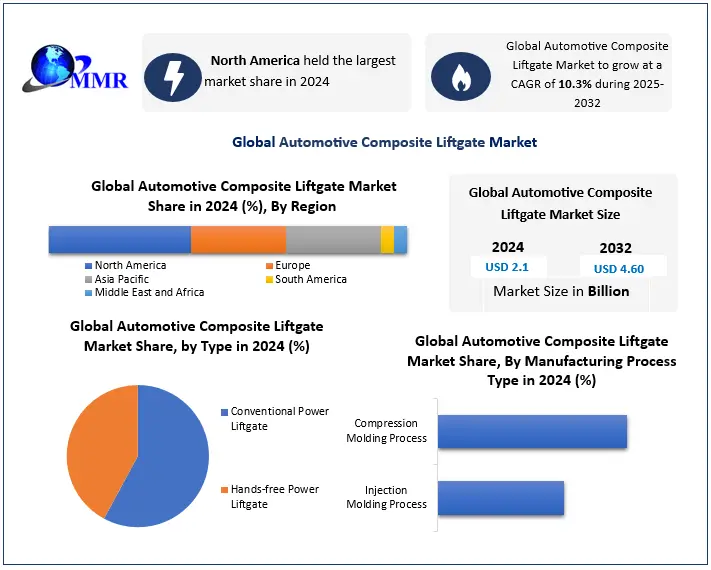
Automotive Composite Liftgate Market size was valued at USD 2.1 billion in 2024, indicating that lightweight rear closures are already a mainstream design choice, not a niche option.
Total market revenue is expected to grow by 10.3% from 2025 to 2032, reaching nearly USD 4.60 billion, signaling sustained investment in material innovation and power liftgate features.
North America dominated the market in 2023, driven by stringent U.S. fuel-efficiency regulations and surging SUV and crossover sales, which forces OEMs to strip weight out of the rear body structure.
Hatchback vehicles hold the largest share by vehicle type, showing that compact, urban-focused platforms are using composite liftgates to combine style, practicality, and efficiency.
Key players such as Magna, BMW, Audi, Toyota, Nissan, Volvo, and Plastic Omnium are actively integrating sensors, electric opening mechanisms, and advanced composites into liftgates, intensifying technology competition at the rear of the vehicle.
Why This Matters Now
OEMs face simultaneous pressure from emissions rules, EV range expectations, and SUV demand, and the liftgate sits at the intersection of all three. Composite liftgates cut weight, enable more aggressive styling, and integrate sensors, cameras, and electric actuators, turning a once-simple panel into a multi-function performance and usability feature.
For Tier-1 suppliers, this is a chance to move up the value chain from metal stampings to engineered composite modules with embedded electronics. The market’s 10.3% revenue growth through 2032 signals a shift where material science and integrated functionality at the rear of the vehicle can secure long-term supply contracts and margin.
Market Overview
MMR’s analysis frames the automotive composite liftgate market around manufacturing, distribution, and sales of lightweight, durable liftgates used mainly in SUVs and hatchbacks. These liftgates provide structural support, access to cargo areas, and contribute to the vehicle’s aesthetic appeal.
Growth drivers include increasing global SUV demand, environmental concerns, safety requirements, consumer preference for stylish designs, and ongoing innovations in composite materials and manufacturing processes. This means rear systems now influence fuel-efficiency compliance, crash performance, and customer perception as much as traditional powertrain choices.
The report notes that key players invest in R&D to enhance liftgate materials, safety, and cost reduction, citing Magna International’s reimagined liftgate with integrated lighting and sensor technology that reduces weight and carbon footprint. That example shows how rear modules are becoming branded technology showcases, not just body-in-white components.
Key Trends Driving Growth
The first major trend is technology integration. MMR highlights liftgates with sensors, cameras, gesture sensors, hands-free functions, and electric opening mechanisms in models like the Audi Q5 and Ford Escape, which turn the liftgate into a convenience and safety feature rather than just a door. For OEMs, this justifies higher transaction prices and strengthens differentiation in crowded SUV segments.
The second trend is the “lightweight revolution.” The report points to carbon fiber liftgates as seen in the Tesla Model S and notes that EVs require lightweight, aerodynamic components to extend range, with composite liftgates used on vehicles such as the Chevrolet Bolt and Nissan Leaf. This ties rear-end design directly to EV efficiency and regulatory carbon targets.
A third trend is design and personalization. MMR notes innovative designs in vehicles like the BMW i3 and rising demand for bespoke aesthetics, including premium composite solutions for brands like Rolls-Royce and Lamborghini. This creates a high-margin subsegment where design studios work hand-in-hand with composite specialists.
Emerging opportunities include graphene-reinforced composites, composite liftgates for self-driving cars with advanced sensors, retrofitting existing vehicles, and applications in off-road, military, and electric SUVs such as the Ford Mustang Mach-E. For investors, these niches indicate new product lines and IP creation beyond basic liftgate panels.
Request a Free Sample Copy or View Report Summary: https://www.maximizemarketresearch.com/request-sample/30975/
Segment Insights
Dominant Segment: Hatchback is the largest vehicle-type segment in the global automotive composite liftgate market. MMR explains that sleek exterior features and strong consumer attention to visual appeal are driving composite liftgate adoption in hatchbacks, giving OEMs a styling-driven edge in compact car segments.
Fastest-Growing Segment: The report does not explicitly state which segment is fastest-growing, so no claim can be made.
By type, the market covers conventional, power liftgate, and hands-free power liftgate systems, indicating a clear migration from purely manual operation to electric and gesture-based solutions.
By manufacturing process, compression molding and injection molding are key processes, which has implications for plant investment, cycle times, and scalability in mass-production programs.
For OEM product planners, this segmentation means that future revenue depends not just on vehicle type, but on how quickly models move to power and hands-free liftgates, and which manufacturing process best aligns with platform volume and cost targets.
Regional Growth Story
North America dominated the market in 2023 and is expected to maintain its lead, with the United States and Canada driving adoption of composite materials due to their lightweight attributes and fuel-efficiency benefits. MMR links this directly to stringent U.S. fuel-efficiency regulations, which push automakers to adopt composite liftgates to meet standards without sacrificing SUV and crossover performance.
Europe is another significant region, with Germany, France, and the United Kingdom highlighted for robust automotive manufacturing and strict emissions reduction targets. Luxury vehicles in Europe show particular interest in composite liftgates because they combine premium aesthetics with weight savings, which helps both performance and compliance.
Asia Pacific, led by China, Japan, and South Korea, is described as a rapidly growing market driven by thriving automotive production and rising demand for fuel-efficient vehicles. China has emerged as a pivotal manufacturing hub for composite automotive components, including liftgates, leveraging cost-effective production capabilities that influence the global supply chain.
South America (Brazil and Mexico) and the Middle East & Africa are in earlier stages but show gradual growth driven by automotive sector development and urbanization. For global suppliers, these regions offer expansion potential once composite solutions become more cost-competitive relative to traditional metal liftgates.
Competitive Landscape
MMR lists a broad set of key players: Audi, BMW, Brose, Faurecia, Fiat Chrysler, Ford, General Motors, PSA, Renault, HIAB, HI-LEX, Honda, Huf, Magna International, Nissan, Pal Finger, Peugeot, Plastic Omnium, Strattec, Volvo, Toyota, and Trinseo S.A. This mix of OEMs and Tier-1 suppliers shows that competition spans both branded vehicle programmes and component innovation.
The report notes that Magna has been a key player in composite liftgate development, while BMW focuses on sustainable composite solutions and Audi pushes design and technology integration. That signals a race for technology leadership where suppliers who master composite design, integration of smart features, and cost reduction will gain pricing power and long-term contracts.
For OEMs like Toyota, Nissan, Ford, and Volvo, their investments and partnerships in composite liftgates indicate a strategy to meet fuel-efficiency and emissions targets without sacrificing SUV volume. The presence of material specialists such as Trinseo and Plastic Omnium also implies that resin formulation and composite chemistry will be core to future differentiation.
Recent Developments
MMR highlights Magna’s liftgate designs with integrated lighting and sensor technology that reduce weight and carbon footprint, indicating a shift toward multi-function rear modules.
The report notes growing use of metalized paint for chrome-like appearance without added metal weight, improving efficiency and reducing costs.
It points to advancements in aerodynamics, including active rear and side spoilers integrated with liftgates to reduce drag and CO2 emissions.
MMR discusses graphene-reinforced composites and smart features such as hands-free opening and integrated cameras as emerging innovation areas.
Strategic Implications
For OEMs, composite liftgates have moved from optional styling upgrades to structural levers for regulatory compliance, EV efficiency, and SUV competitiveness. Companies that standardize composite liftgates across high-volume platforms will lock in weight reductions and design flexibility that competitors struggle to match.
Tier-1 suppliers must decide whether to double down on composite expertise or remain in traditional metal systems. MMR’s emphasis on carbon fiber, graphene composites, smart features, and integration with autonomous sensors suggests that future profit pools sit in engineered composite modules, not commodity stampings.
Fleet operators and mobility providers stand to gain from lighter, more durable liftgates with improved access and safety features, especially in crossover-based fleet vehicles, even though the report does not quantify fleet-specific adoption. As EV crossovers and electric SUVs grow, rear system performance will affect total cost of ownership through range, maintenance, and user experience.
Future Outlook
MMR’s outlook points to steady demand growth and broader adoption of composite liftgates across hatchbacks, SUVs, electric vehicles, luxury brands, off-road models, and even military applications. Emerging technologies like graphene-reinforced composites, smart sensors, and connectivity features suggest the liftgate will become a key integration point for future autonomous and connected vehicles.
The high-stakes question is who moves fastest. Future market leaders will use composite liftgates as strategic tools to meet fuel rules, extend EV range, and deliver smart rear functionality at scale, while laggards will treat them as optional design add-ons and watch their cost, compliance, and technology position erode.
Related Reports
Global Automotive Chassis Market https://www.maximizemarketresearch.com/market-report/global-automotive-chassis-market/1611/
Global Emergency Locking Retractor Seatbelt Market https://www.maximizemarketresearch.com/market-report/global-emergency-locking-retractor-seatbelt-market/92021/
Global Automotive Intelligence Park Assist System Market https://www.maximizemarketresearch.com/market-report/global-automotive-intelligence-park-assist-system-market/21230/
Analyst Perspective
“Composite liftgates have shifted from cosmetic upgrades to structural enablers of fuel efficiency, EV performance, and SUV competitiveness, making lightweight rear systems a core element of global vehicle strategy,” said Tejaswini Kakade, Analyst.
About Maximize Market Research
Maximize Market Research Pvt. Ltd. (MMR) is a global market research and consulting company that provides reliable, data-focused, and practical business insights. The firm serves a wide range of industries, including healthcare, pharmaceuticals, technology, automotive, electronics, chemicals, personal care, and consumer goods. Through market forecasts, competitive analysis, strategic consulting, and industry impact assessments, MMR helps organizations understand changing market conditions, identify growth opportunities, and make informed business decisions for long-term success.
2nd Floor, Navale IT Park Phase 3
Pune Banglore Highway, Narhe
Pune, Maharashtra 411041, India
+91 9607365656
sales@maximizemarketresearch.com
