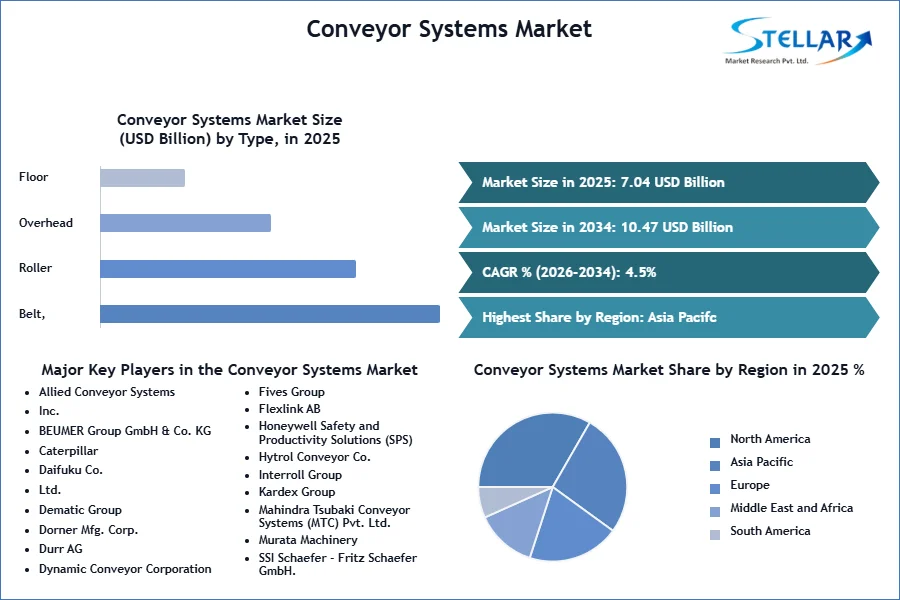
The Conveyor Systems Market is witnessing robust growth as industries increasingly adopt automated material handling solutions to enhance productivity, reduce operational costs, and improve workflow efficiency. Conveyor systems are essential components in manufacturing, warehousing, logistics, and packaging, enabling the seamless movement of goods across facilities.
Conveyor Systems Market was valued nearly USD 7.03 Bn. in 2025. Global Conveyor Systems Market size is estimated to grow at a CAGR of 4.5% and is expected to reach at USD 10.45 Bn. by 2034.
With the rise of industrial automation and e-commerce, conveyor systems are becoming a cornerstone of modern supply chain infrastructure.
A Market Driven by Automation and Operational Efficiency
A defining trend in the conveyor systems market is the growing demand for automated and high-speed material handling solutions. Businesses are investing in conveyor systems to streamline production processes, reduce manual labor, and ensure consistent operations.
Automation is transforming how materials are transported and managed within industrial environments.
Key Market Insights
- Conveyor systems enhance efficiency in material handling.
- Automated conveyors are gaining widespread adoption.
- E-commerce and logistics sectors drive demand.
- Manufacturing industries rely heavily on conveyor systems.
- Smart warehouses are adopting advanced conveyor technologies.
- North America leads the market.
- Asia-Pacific is a fast-growing region.
𝐃𝐨𝐰𝐧𝐥𝐨𝐚𝐝 𝐅𝐫𝐞𝐞 𝐏𝐃𝐅 𝐁𝐫𝐨𝐜𝐡𝐮𝐫𝐞: https://www.stellarmr.com/report/req_sample/Conveyor-Systems-Market/486
Market Drivers Accelerating Growth
1. Increasing Industrial Automation
Automation improves productivity and reduces labor dependency.
2. Growth of E-Commerce and Logistics
Efficient material movement is critical for fast delivery systems.
3. Rising Demand for Operational Efficiency
Conveyor systems optimize workflows and reduce downtime.
Market Challenges and Restraints
1. High Initial Installation Costs
Advanced conveyor systems require significant investment.
2. Maintenance and System Integration Complexity
Ensuring smooth operation and integration can be challenging.
Technology and Innovation Trends
Innovation in the conveyor systems market is driven by advancements in IoT, AI, robotics, and smart control systems. Modern conveyors are equipped with sensors and connectivity features that enable real-time monitoring and predictive maintenance.
Automated guided vehicles (AGVs) and robotic systems are being integrated with conveyor systems to enhance flexibility and efficiency. AI-powered analytics are optimizing material flow and reducing bottlenecks.
Energy-efficient conveyor designs are gaining popularity, reducing operational costs and environmental impact. Modular conveyor systems are enabling scalability and easy customization.
Integration with warehouse management systems (WMS) and enterprise resource planning (ERP) platforms is improving overall supply chain visibility and performance.
Visual Snapshot: Conveyor Systems in Action
Regional Insights: North America Leads, Asia-Pacific Expands
North America dominates the conveyor systems market, driven by advanced manufacturing infrastructure, high adoption of automation technologies, and strong demand from logistics and e-commerce sectors.
Europe is also a significant market, focusing on efficiency and sustainability in industrial operations.
Asia-Pacific is the fastest-growing region, supported by rapid industrialization, expanding manufacturing industries, and increasing adoption of automation in countries like China and India.
Emerging markets are adopting conveyor systems to improve efficiency and productivity.
Recent Industry Developments
- Daifuku (2025): Advanced automated conveyor solutions.
- Siemens (2024): Enhanced smart conveyor systems.
- Honeywell (2025): Developed logistics automation solutions.
- Dematic (2024): Expanded warehouse conveyor systems.
- International Federation of Robotics (2025): Highlighted automation trends.
Competitive Landscape
The conveyor systems market is highly competitive, with global automation companies and regional players offering a wide range of solutions. Companies are focusing on efficiency, flexibility, and integration capabilities to strengthen their market position.
Strategic partnerships and investments in advanced technologies are key drivers of competition.
Analyst Perspective
A senior market analyst notes:
“The conveyor systems market is evolving rapidly with the adoption of smart technologies and automation. It plays a crucial role in modern industrial operations.”
Future Outlook
The Conveyor Systems Market is expected to witness strong growth in the coming years, supported by increasing industrial automation, expansion of e-commerce, and advancements in smart technologies.
The development of cost-effective and scalable solutions will further enhance market potential. Integration with digital platforms and robotics will drive efficiency and productivity.
As industries continue to modernize, conveyor systems will remain a vital component of efficient material handling and supply chain management.
Overall, the market presents significant opportunities for automation providers, manufacturers, and investors aiming to optimize industrial and logistics operations.
