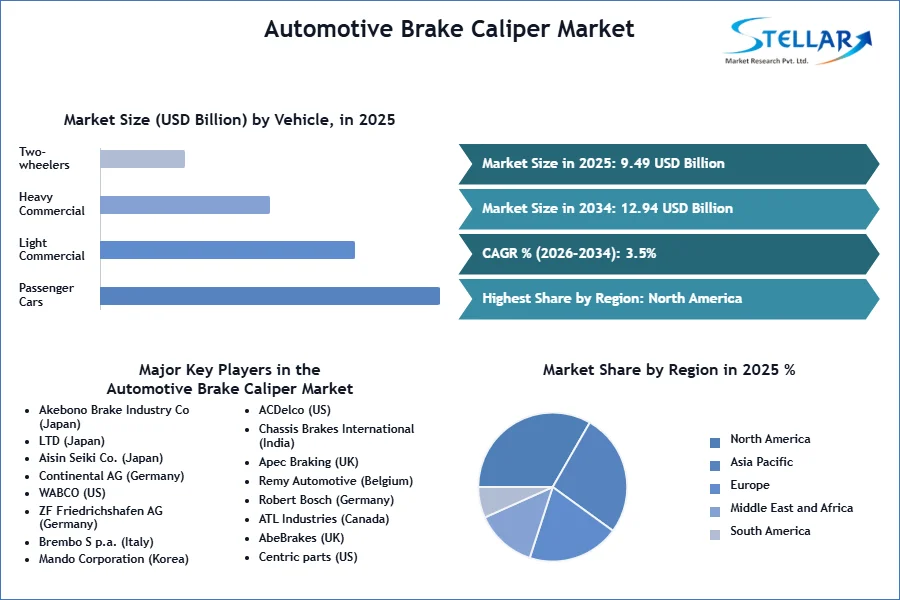
The Automotive Brake Caliper Market is a critical segment of the global automotive components industry, playing a vital role in vehicle safety and braking performance. Brake calipers are responsible for applying pressure to brake pads, enabling vehicles to slow down or stop effectively.
Automotive Brake Caliper Market is expected to grow at a CAGR of 3.5% during the forecast period. The Automotive Brake Caliper Market is expected to reach USD 9.49 Bn. in 2034 from USD 9.17 Bn. in 2025.
With increasing vehicle production, stringent safety regulations, and the rise of electric vehicles (EVs), the demand for high-performance and durable brake calipers is steadily growing.
A Market Driven by Safety and Performance
A defining trend in the automotive brake caliper market is the increasing focus on vehicle safety and braking efficiency. Governments and regulatory bodies across the globe are enforcing strict safety standards, compelling automakers to adopt advanced braking systems.
Brake calipers are evolving to provide better heat dissipation, improved durability, and enhanced braking response.
Key Market Insights
- Disc brake systems dominate modern vehicles.
- Aluminum calipers are gaining popularity due to lightweight benefits.
- Passenger vehicles account for the largest market share.
- Electric vehicles are driving innovation in braking systems.
- Performance and safety improvements are key priorities.
- Asia-Pacific leads vehicle production.
- North America and Europe focus on advanced technologies.
𝐃𝐨𝐰𝐧𝐥𝐨𝐚𝐝 𝐅𝐫𝐞𝐞 𝐏𝐃𝐅 𝐁𝐫𝐨𝐜𝐡𝐮𝐫𝐞: https://www.stellarmr.com/report/req_sample/Automotive-Brake-Caliper-Market/554
Market Drivers Accelerating Growth
1. Increasing Vehicle Production and Sales
Growing demand for passenger and commercial vehicles is boosting component demand.
2. Stringent Safety Regulations
Regulatory requirements are driving the adoption of advanced braking systems.
3. Growth of Electric and Hybrid Vehicles
EVs require specialized braking systems, including regenerative braking integration.
Market Challenges and Restraints
1. High Manufacturing Costs for Advanced Materials
Lightweight and high-performance materials can increase production expenses.
2. Maintenance and Replacement Costs
Brake components require regular servicing, impacting overall ownership cost.
Technology and Innovation Trends
Innovation in the automotive brake caliper market is driven by advancements in material science, braking technologies, and system integration.
Manufacturers are increasingly adopting aluminum and composite materials to reduce weight and improve fuel efficiency. Lightweight calipers enhance overall vehicle performance while maintaining structural strength.
Advanced braking technologies, including electronic braking systems and regenerative braking integration in EVs, are influencing caliper design. Multi-piston calipers are gaining popularity in high-performance vehicles due to improved braking force distribution.
Automation and precision manufacturing techniques are improving product quality and consistency. Smart braking systems equipped with sensors are enhancing safety and enabling real-time monitoring.
Sustainability is also becoming a focus area, with manufacturers working to reduce emissions during production and improve recyclability of materials.
Visual Snapshot: Automotive Brake Caliper Applications
Regional Insights: Asia-Pacific Leads, Europe Innovates
Asia-Pacific dominates the automotive brake caliper market due to high vehicle production volumes in countries such as China, Japan, and India.
Europe is a key region for innovation, driven by advanced automotive engineering and strict safety regulations.
North America represents a significant market with strong demand for high-performance and technologically advanced vehicles.
Emerging markets are contributing to growth through increasing vehicle ownership and industrial expansion.
Recent Industry Developments
- Brembo (2025): Introduced advanced high-performance braking solutions.
- ZF Friedrichshafen (2024): Expanded braking system technologies.
- Continental AG (2025): Focused on integrated braking systems.
- Aisin Corporation (2024): Enhanced brake component portfolio.
- Akebono Brake Industry (2025): Developed eco-friendly braking solutions.
Competitive Landscape
The automotive brake caliper market is highly competitive, with global automotive suppliers and component manufacturers focusing on innovation and quality.
Companies are emphasizing lightweight materials, advanced braking technologies, cost optimization, and sustainability to maintain competitive advantage. Strategic collaborations with automakers are driving product development.
Analyst Perspective
A senior market analyst notes:
“The automotive brake caliper market is evolving with advancements in vehicle safety and electrification. Lightweight materials and smart braking systems will shape future growth.”
Future Outlook
The Automotive Brake Caliper Market is expected to witness steady growth in the coming years, driven by increasing vehicle production, rising safety standards, and advancements in braking technologies.
The integration of electronic braking systems, lightweight materials, and EV-specific solutions will further enhance market potential.
As the automotive industry continues to prioritize safety and efficiency, brake calipers will remain a critical component in ensuring reliable and high-performance braking systems.
Overall, the market presents significant opportunities for automotive suppliers, manufacturers, and investors aiming to support the future of safe and efficient mobility.
