North America Transportation Composites Market: Lightweight Materials Driving the Future of Mobility
The transportation industry across North America is undergoing a major transformation as manufacturers focus on lightweight, durable, and fuel-efficient materials. Transportation composites have emerged as one of the most important innovations supporting this transition, enabling automakers, aerospace companies, rail manufacturers, and marine industries to improve performance while reducing emissions and operating costs.
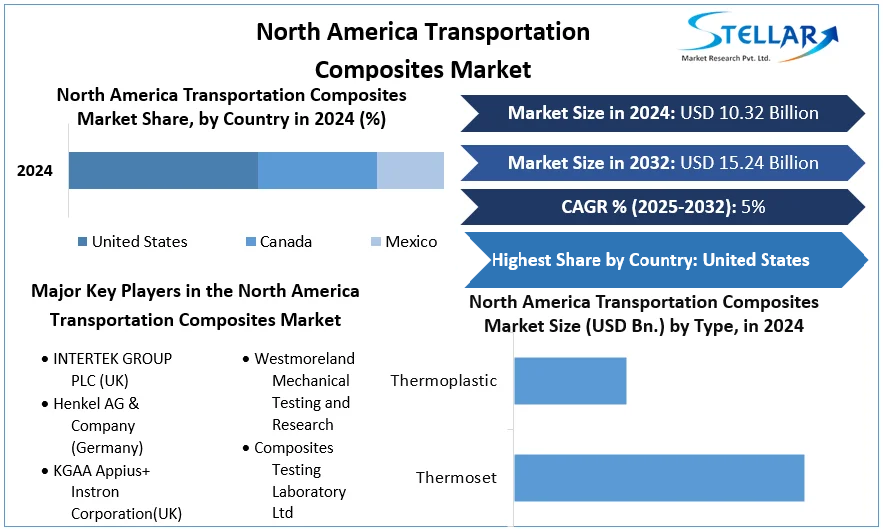
According to the latest market analysis, the North America Transportation Composites Market was valued at USD 10.32 billion in 2024 and is projected to reach USD 15.24 billion by 2032, growing at a CAGR of 5% during the forecast period. The increasing demand for electric vehicles, fuel-efficient aircraft, and sustainable transportation solutions continues to create significant opportunities for composite material manufacturers.
What Are Transportation Composites?
Transportation composites are advanced materials made by combining reinforcing fibers such as glass or carbon fiber with polymer resins. These materials offer exceptional strength while being significantly lighter than traditional metals.
Key advantages include:
High strength-to-weight ratio
Excellent corrosion resistance
Improved fuel efficiency
Better impact resistance
Enhanced design flexibility
Lower maintenance requirements
Superior thermal and chemical resistance
These characteristics make composites ideal for automotive components, aircraft structures, railway interiors, commercial vehicles, marine applications, and other transportation systems.
𝐃𝐨𝐰𝐧𝐥𝐨𝐚𝐝 𝐅𝐫𝐞𝐞 𝐏𝐃𝐅 𝐁𝐫𝐨𝐜𝐡𝐮𝐫𝐞: https://www.stellarmr.com/report/req_sample/North-America-Transportation-Composites-Market/831
Market Growth Drivers
Rising Demand for Lightweight Vehicles
Reducing vehicle weight has become a top priority for manufacturers as governments continue introducing stricter fuel economy and emission standards. Lightweight composite materials help manufacturers lower fuel consumption while improving overall vehicle performance.
Electric vehicle manufacturers particularly benefit from composites because reducing vehicle weight directly improves battery efficiency and driving range.
Expanding Aerospace Industry
Aircraft manufacturers continue to replace conventional metal components with composite materials to reduce aircraft weight and improve fuel efficiency. Carbon fiber composites are increasingly used in fuselage sections, wings, interiors, and structural components due to their superior mechanical properties.
Growth in Commercial Transportation
Commercial trucks, buses, and logistics fleets are adopting composite components to increase payload capacity while lowering fuel costs. Composite body panels, roofs, and structural components offer longer service life and reduced maintenance compared to traditional materials.
Thermoset vs. Thermoplastic Composites
The North American transportation composites market is primarily segmented into thermoset and thermoplastic composites.
Thermoset composites continue to dominate applications requiring excellent heat resistance, structural integrity, and chemical stability. These materials are widely used in aerospace, heavy vehicles, and industrial transportation systems.
Thermoplastic composites are gaining popularity due to their recyclability, faster manufacturing processes, and ability to be reshaped. Their growing use supports the industry’s sustainability initiatives while reducing production costs.
Road Transportation Leads Market Demand
Among transportation modes, roadways account for the largest share of composite consumption. Passenger vehicles, commercial trucks, buses, motorsports vehicles, and military transport increasingly rely on composite materials to improve fuel efficiency and structural performance.
Automotive manufacturers use glass fiber and carbon fiber composites in:
Exterior body panels
Interior components
Chassis structures
Engine compartments
Battery enclosures for electric vehicles
Commercial vehicle cabins
The rapid growth of electric mobility further strengthens demand for lightweight composite solutions.
Challenges Facing the Industry
Despite strong growth prospects, the industry faces several challenges.
Environmental regulations surrounding composite waste disposal remain a significant concern because many traditional composites are difficult to recycle. Manufacturers are investing in recyclable thermoplastic composites and sustainable manufacturing technologies to address these issues.
Another challenge is the lack of standardized manufacturing processes and the shortage of skilled professionals experienced in composite design and production. These factors can increase production costs and slow wider adoption across transportation sectors.
Technological Innovation Creating New Opportunities
Leading companies continue investing heavily in research and development to improve composite performance and manufacturing efficiency.
Recent advancements include:
High-performance carbon fiber composites
Advanced thermoplastic materials
Automated composite manufacturing
Improved recycling technologies
Lightweight structural components for electric vehicles
Faster production methods for aerospace applications
Automation and advanced manufacturing techniques are making composites more affordable while expanding their applications across multiple transportation industries.
Regional Outlook
The United States remains the largest market for transportation composites in North America due to its strong automotive and aerospace manufacturing industries. Canada and Mexico are also witnessing increasing adoption as vehicle production and industrial investments continue to expand.
Government support for electric vehicles, clean transportation technologies, and sustainable manufacturing further strengthens regional market growth.
Competitive Landscape
The market features several established global players investing in innovation, partnerships, and product development to strengthen their market positions. Companies continue expanding production capabilities while developing advanced composite materials that meet evolving performance and sustainability requirements.
𝐃𝐨𝐰𝐧𝐥𝐨𝐚𝐝 𝐅𝐫𝐞𝐞 𝐏𝐃𝐅 𝐁𝐫𝐨𝐜𝐡𝐮𝐫𝐞: https://www.stellarmr.com/report/req_sample/North-America-Transportation-Composites-Market/831
Future Outlook
The future of the North America Transportation Composites Market remains highly promising. Growing electric vehicle production, increasing aircraft manufacturing, stricter environmental regulations, and ongoing material innovation are expected to drive long-term demand.
As manufacturers continue seeking lighter, stronger, and more sustainable materials, transportation composites will play a critical role in shaping the next generation of mobility solutions across North America.
With continuous technological advancements and rising investments in advanced manufacturing, the market is well-positioned for steady growth through 2032.
