Asia Pacific Feed Mixer Market: Modern Livestock Farming and Feed Quality Drive Market Growth
The Asia Pacific Feed Mixer Market is witnessing steady growth as the region’s livestock industry continues to modernize and demand for high-quality animal feed rises. Feed mixers play a crucial role in producing nutritionally balanced feed by ensuring the uniform mixing of feed ingredients, vitamins, minerals, and supplements. As meat consumption, dairy production, and commercial farming expand across Asia Pacific, the adoption of efficient feed mixing equipment is expected to increase significantly.
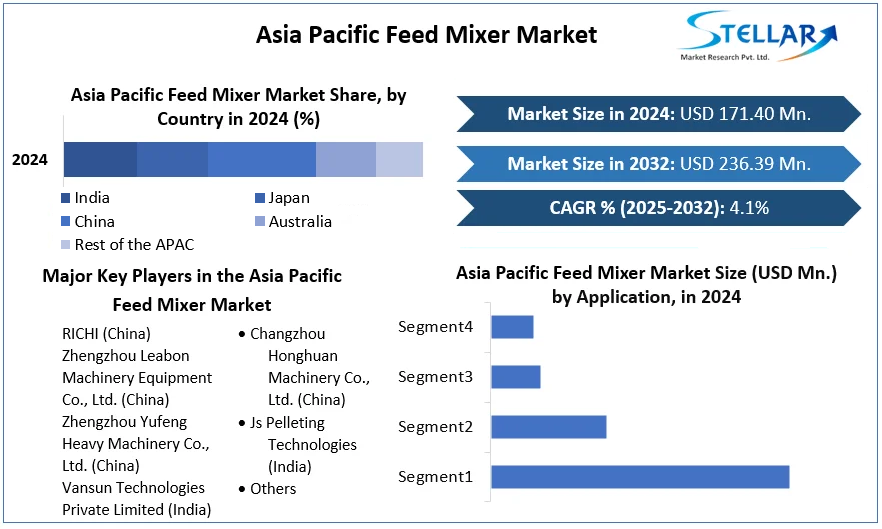
According to the latest market analysis, the Asia Pacific Feed Mixer Market was valued at USD 171.40 million in 2024 and is projected to reach USD 236.39 million by 2032, growing at a CAGR of 4.1% during the forecast period. Rising meat production, increasing awareness of animal nutrition, and technological advancements in feed processing equipment are the primary drivers supporting market growth.
What Is a Feed Mixer?
A feed mixer is an agricultural machine used to blend different feed ingredients into a homogeneous mixture for livestock. Proper mixing ensures that every animal receives a balanced diet, improving health, productivity, and feed efficiency.
Feed mixers are widely used in:
Dairy farms
Poultry farms
Pig farming
Cattle farming
Feed manufacturing plants
Commercial livestock operations
Available in vertical and horizontal designs, feed mixers can process dry, wet, or total mixed ration (TMR) feed depending on operational requirements.
𝐃𝐨𝐰𝐧𝐥𝐨𝐚𝐝 𝐅𝐫𝐞𝐞 𝐏𝐃𝐅 𝐁𝐫𝐨𝐜𝐡𝐮𝐫𝐞: https://www.stellarmr.com/report/req_sample/Asia-Pacific-Feed-Mixer-Market/850
Key Market Drivers
Rising Meat and Dairy Production
Asia Pacific is home to some of the world’s largest livestock-producing countries, including China, India, Australia, and Japan. Growing demand for meat, milk, and poultry products is encouraging farmers to improve feed quality and efficiency.
Feed mixers help produce nutritionally balanced feed, improving animal growth, milk yield, and meat quality while reducing feed wastage. This makes them an essential investment for modern livestock operations.
Increasing Awareness of Animal Nutrition
Livestock producers are becoming more aware of the relationship between proper nutrition and animal productivity. Balanced feed improves animal health, reduces disease risks, and enhances farm profitability.
As commercial farming expands across the region, demand for advanced feed mixing equipment continues to grow.
Growth of Commercial Feed Manufacturing
The expansion of organized feed mills and commercial feed factories is creating strong demand for automated feed mixing systems. Manufacturers are investing in high-capacity mixers capable of delivering consistent feed quality while improving production efficiency.
Horizontal Feed Mixers Dominate the Market
Based on product type, horizontal feed mixers account for the largest share of the Asia Pacific Feed Mixer Market due to their superior mixing performance and ability to handle both dry and moist feed ingredients.
Key advantages include:
Faster mixing cycles
Excellent feed uniformity
High production efficiency
Suitable for large-scale operations
Better handling of wet feed materials
Vertical feed mixers remain popular among smaller farms because of their compact design and lower investment costs.
Self-Propelled Feed Mixers Gain Popularity
Among portability types, self-propelled feed mixers lead the market as they combine loading, mixing, transportation, and feed distribution into a single machine.
Benefits include:
Reduced labor requirements
Faster feeding operations
Improved feed accuracy
Higher operational efficiency
Lower fuel consumption compared with multiple machines
These machines are increasingly adopted by large dairy and livestock farms seeking greater productivity.
Farms Represent the Largest Application Segment
Farms account for the largest share of market demand as livestock producers increasingly invest in advanced feeding systems.
Major application areas include:
Dairy farming
Beef cattle production
Poultry farming
Sheep and goat farming
Pig farming
Commercial feed production
Growing livestock populations and rising demand for quality animal products continue to support equipment adoption across the region.
𝐃𝐨𝐰𝐧𝐥𝐨𝐚𝐝 𝐅𝐫𝐞𝐞 𝐏𝐃𝐅 𝐁𝐫𝐨𝐜𝐡𝐮𝐫𝐞: https://www.stellarmr.com/report/req_sample/Asia-Pacific-Feed-Mixer-Market/850
Regional Outlook
China remains the largest market due to its extensive livestock sector and strong agricultural mechanization.
India is witnessing significant growth as dairy farming, poultry production, and commercial feed manufacturing continue to expand.
Other major markets include Japan, Australia, South Korea, and ASEAN countries, where increasing investments in modern farming equipment and livestock productivity are driving demand.
Market Challenges
Despite favorable growth prospects, the market faces several challenges:
High initial equipment costs
Limited affordability for small-scale farmers
Need for skilled operators
Compatibility issues with certain feed materials
Maintenance and servicing requirements
Manufacturers are addressing these challenges by developing cost-effective, user-friendly, and multi-purpose feed mixers suitable for farms of different sizes.
Emerging Opportunities
Several trends are expected to create new growth opportunities:
Expansion of commercial livestock farming
Increasing automation in feed production
Rising demand for precision livestock farming
Development of multi-functional feed mixers
Government support for agricultural mechanization
Growth in animal feed manufacturing
These developments are encouraging equipment manufacturers to introduce advanced, energy-efficient, and digitally controlled feed mixing solutions.
Competitive Landscape
The Asia Pacific Feed Mixer Market includes regional and international manufacturers competing through product innovation, automation, and improved equipment efficiency. Companies are focusing on developing feed mixers with higher capacity, lower operating costs, and better compatibility with different feed formulations. Strategic investments in agricultural machinery and expanding distribution networks are expected to strengthen competition across the region.
Future Outlook
The future of the Asia Pacific Feed Mixer Market remains promising through 2032. Continued growth in livestock production, rising demand for balanced animal nutrition, and increasing adoption of mechanized farming practices are expected to support sustained market expansion.
As farmers focus on improving feed quality, maximizing productivity, and reducing operational costs, advanced feed mixers will continue to play a vital role in the modernization of livestock farming across the Asia Pacific region.
