North America Agriculture Variable Rate Technology Market: Transforming Farming Through Precision Agriculture
The agricultural sector in North America is undergoing a major transformation with the increasing adoption of precision farming technologies. Agriculture Variable Rate Technology (VRT) has emerged as a powerful solution that enables farmers to apply seeds, fertilizers, pesticides, and irrigation resources at optimized rates based on field conditions.
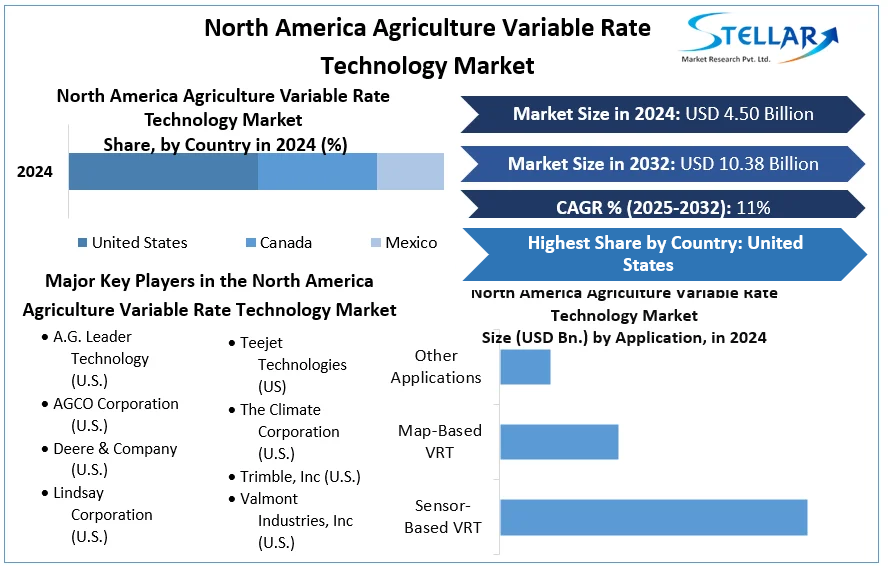
By improving input efficiency, reducing operational costs, and increasing crop productivity, VRT is becoming an essential technology for modern farming operations. The growing adoption of GPS-based systems, IoT sensors, artificial intelligence, and data-driven agriculture practices is expected to accelerate market growth across North America. According to Stellar Market Research, the North America Agriculture Variable Rate Technology Market was valued at USD 4.50 billion in 2024 and is projected to reach USD 10.38 billion by 2032, growing at a CAGR of 11% during 2025–2032.
What Is Agriculture Variable Rate Technology?
Agriculture Variable Rate Technology is a precision farming technique that allows farmers to apply agricultural inputs at different rates within the same field based on soil conditions, crop requirements, and environmental factors.
Unlike traditional uniform farming methods, VRT uses real-time data from:
- GPS systems
- Soil sensors
- Satellite imagery
- Yield monitoring systems
- Field mapping technologies
to optimize farming decisions.
VRT helps farmers improve resource utilization while maximizing crop yields and profitability.
𝐃𝐨𝐰𝐧𝐥𝐨𝐚𝐝 𝐅𝐫𝐞𝐞 𝐏𝐃𝐅 𝐁𝐫𝐨𝐜𝐡𝐮𝐫𝐞: https://www.stellarmr.com/report/req_sample/North-America-Agriculture-Variable-Rate-Technology-Market/898
Key Market Drivers
Increasing Adoption of Precision Agriculture
The growing need to improve agricultural productivity while reducing resource consumption is driving the adoption of precision farming technologies across North America.
Farmers are increasingly using digital agriculture solutions to manage:
- Fertilizer application
- Crop protection chemicals
- Seed placement
- Irrigation requirements
- Soil health monitoring
Variable Rate Technology enables site-specific farming practices, helping producers achieve better yields with lower input costs.
Rising Demand for Sustainable Farming Practices
Sustainability has become a major focus in agriculture due to environmental concerns and increasing regulatory pressure. VRT supports sustainable farming by reducing excessive use of:
- Fertilizers
- Water
- Chemicals
- Seeds
By applying inputs only where needed, farmers can minimize environmental impact while maintaining productivity.
Labor Shortages and Farm Automation
Agricultural labor shortages across North America are encouraging farmers to adopt automated technologies. VRT systems integrated with advanced machinery help reduce manual operations and improve farm efficiency.
The combination of autonomous equipment, sensors, and data analytics is accelerating the development of smart farming ecosystems.
Technology Trends Shaping the Market
Integration of Artificial Intelligence and Data Analytics
Artificial intelligence and machine learning are improving agricultural decision-making by analyzing large volumes of farm data.
AI-powered VRT systems help farmers:
- Predict crop performance
- Identify nutrient deficiencies
- Optimize input usage
- Improve yield forecasting
Growth of IoT-Based Farming Solutions
Internet of Things (IoT) technologies are enabling real-time monitoring of agricultural conditions through connected sensors.
IoT-enabled systems collect information related to:
- Soil moisture
- Temperature
- Nutrient levels
- Crop health
This data allows farmers to make accurate and timely decisions.
Development of Smart Agricultural Machinery
Modern farming equipment is increasingly being equipped with VRT capabilities. Tractors, seeders, sprayers, and harvesters are integrating GPS and automated control systems to improve operational accuracy.
𝐃𝐨𝐰𝐧𝐥𝐨𝐚𝐝 𝐅𝐫𝐞𝐞 𝐏𝐃𝐅 𝐁𝐫𝐨𝐜𝐡𝐮𝐫𝐞: https://www.stellarmr.com/report/req_sample/North-America-Agriculture-Variable-Rate-Technology-Market/898
Market Segmentation
The North America Agriculture Variable Rate Technology Market is segmented based on:
By Product Type
Soil Sensing
Soil sensing technology helps farmers analyze field conditions and determine the appropriate application of nutrients and resources.
Fertilizer Variable Rate Technology
Fertilizer VRT is widely adopted because it helps optimize nutrient application and reduce unnecessary fertilizer usage.
Crop Protection Chemical VRT
This technology enables precise pesticide and chemical application, improving crop protection efficiency.
Seeding VRT
Variable-rate seeding allows farmers to adjust seed quantity according to soil quality, field conditions, and crop requirements.
Yield Monitoring
Yield monitoring systems collect production data to support better farm management decisions.
Irrigation VRT
Variable-rate irrigation improves water efficiency by applying water according to crop and soil requirements.
By Application
Sensor-Based VRT
Sensor-based systems use real-time field information to adjust agricultural inputs automatically. These systems are becoming increasingly popular due to improved accuracy.
Map-Based VRT
Map-based VRT uses field maps created from soil tests, satellite images, and historical yield data to guide input application.
Other Applications
Other applications include advanced farm analytics, automated equipment control, and integrated precision farming solutions.
By Services
Hardware
Hardware components include:
- GPS devices
- Sensors
- Controllers
- Agricultural machinery systems
Software
Software platforms help farmers analyze data, generate field maps, and manage precision farming operations.
Other Services
Additional services include consulting, maintenance, data management, and technology support.
Regional Outlook
United States
The United States represents the largest market in North America due to its advanced agricultural sector, large-scale farming operations, and strong adoption of precision agriculture technologies.
Major crops such as corn, wheat, and soybeans are driving demand for VRT solutions as farmers focus on increasing productivity and reducing input costs.
Canada
Canada’s agriculture industry is adopting advanced technologies to improve efficiency and sustainability. The country’s large-scale farms and focus on agricultural innovation are supporting VRT adoption.
The agriculture and agri-food sector plays an important role in Canada’s economy, creating opportunities for smart farming technologies.
Mexico
Mexico is witnessing increasing adoption of agricultural technology solutions due to growing demand for improved crop productivity and efficient resource management.
Market Challenges
High Initial Investment Costs
Advanced VRT systems require significant investment in hardware, software, and compatible agricultural machinery, which may limit adoption among smaller farmers.
Lack of Technical Knowledge
Some farmers require training to effectively operate and interpret data from precision agriculture systems.
Data Management Issues
Managing large amounts of agricultural data and ensuring compatibility between different farming technologies remain challenges for widespread adoption.
Competitive Landscape
The North America Agriculture Variable Rate Technology Market includes leading agricultural technology companies focusing on innovation, automation, and digital farming solutions.
Major companies operating in the market include:
- A.G. Leader Technology
- AGCO Corporation
- Deere & Company
- Lindsay Corporation
- TeeJet Technologies
- The Climate Corporation
- Trimble Inc.
- Valmont Industries
Companies are focusing on:
- Advanced precision farming solutions
- AI-powered agricultural platforms
- Smart machinery integration
- Strategic partnerships
- Digital agriculture expansion
Future Outlook
The North America Agriculture Variable Rate Technology Market is expected to witness strong growth as farmers increasingly adopt data-driven farming practices. Rising demand for sustainable agriculture, increasing automation, and technological advancements will continue driving market expansion.
The integration of artificial intelligence, IoT, autonomous machinery, and advanced analytics will further enhance the capabilities of VRT systems and support the evolution of smart farming.
Conclusion
The North America Agriculture Variable Rate Technology Market is playing a crucial role in modernizing agricultural practices by improving efficiency, reducing resource waste, and increasing crop productivity.
With growing investments in precision agriculture and increasing adoption of digital farming technologies, Variable Rate Technology is expected to become a fundamental component of the future agricultural ecosystem across North America.
