North America Cell Culture Media Market: Accelerating Biopharmaceutical Innovation Through Advanced Cell-Based Research
The biotechnology and pharmaceutical industries in North America are experiencing rapid transformation due to increasing investments in biologics, cell-based therapies, vaccine development, and regenerative medicine. Cell culture media has become a critical component in laboratory research and biopharmaceutical manufacturing by providing essential nutrients and environmental conditions required for cell growth and maintenance.
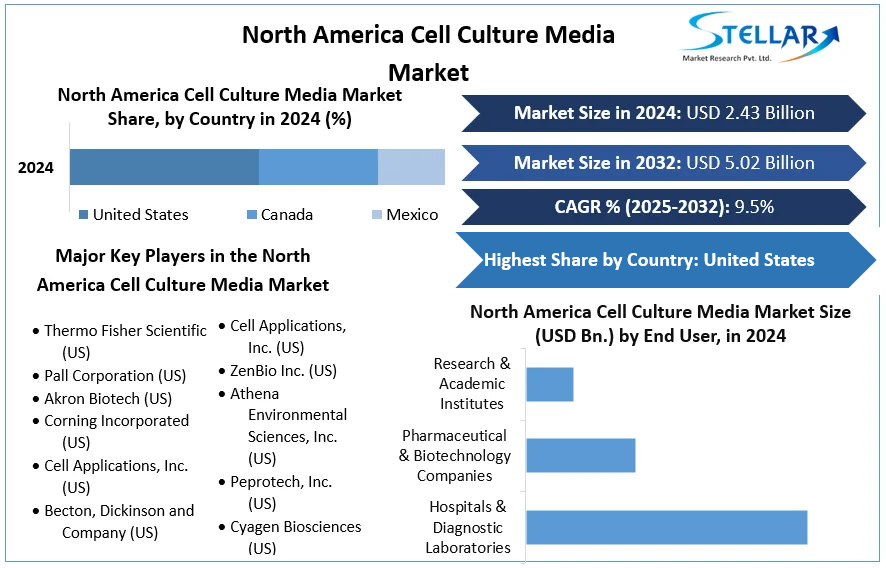
The rising demand for monoclonal antibodies, vaccines, biosimilars, gene therapies, and advanced therapeutic solutions is driving the adoption of specialized cell culture media across research institutions and healthcare organizations. According to Stellar Market Research, the North America Cell Culture Media Market was valued at USD 2.43 billion in 2024 and is projected to reach USD 5.02 billion by 2032, growing at a CAGR of 9.5% during 2025–2032.
What Is Cell Culture Media?
Cell culture media are specially formulated nutrient solutions used to support the growth, maintenance, and reproduction of cells outside their natural biological environment.
These media provide essential components such as:
- Amino acids
- Vitamins
- Minerals
- Proteins
- Growth factors
- Hormones
- Energy sources
Cell culture media are widely used in:
- Pharmaceutical research
- Biotechnology development
- Vaccine manufacturing
- Drug discovery
- Cell and gene therapy
- Tissue engineering
The quality and composition of cell culture media directly influence cell productivity, consistency, and therapeutic manufacturing efficiency.
𝐃𝐨𝐰𝐧𝐥𝐨𝐚𝐝 𝐅𝐫𝐞𝐞 𝐏𝐃𝐅 𝐁𝐫𝐨𝐜𝐡𝐮𝐫𝐞: https://www.stellarmr.com/report/req_sample/North-America-Cell-Culture-Media-Market/909
Key Market Drivers
Rising Demand for Biopharmaceutical Production
The growing production of biologics and advanced therapies is one of the major factors driving the North America cell culture media market.
Biopharmaceutical products such as:
- Monoclonal antibodies
- Recombinant proteins
- Vaccines
- Biosimilars
require highly optimized cell culture systems for efficient manufacturing.
The expansion of pharmaceutical and biotechnology companies across North America is increasing demand for advanced media formulations that improve cell growth and production yields.
Growth of Cell and Gene Therapy Research
Cell and gene therapies are emerging as innovative treatment approaches for complex diseases. These therapies depend heavily on reliable cell culture processes for developing and manufacturing therapeutic products.
Increasing investments in:
- Stem cell research
- CAR-T cell therapies
- Regenerative medicine
- Personalized medicine
are creating new opportunities for specialized cell culture media solutions.
Increasing Vaccine Development Activities
The demand for vaccine production capabilities has strengthened the need for high-quality cell culture media. Advanced media formulations enable efficient cell expansion and improve manufacturing scalability.
Growing focus on infectious disease preparedness and next-generation vaccines continues supporting market growth.
Technology Trends Shaping the Market
Shift Toward Serum-Free and Chemically Defined Media
Researchers and manufacturers are increasingly adopting serum-free and chemically defined media because they provide:
- Better consistency
- Reduced contamination risks
- Improved process control
- Enhanced scalability
These advanced formulations are becoming increasingly important in commercial biomanufacturing.
Growth of Personalized Medicine
Personalized medicine requires advanced biological research platforms capable of developing patient-specific treatments.
Cell culture media technologies are supporting advancements in:
- Precision therapies
- Patient-derived cell models
- Drug response testing
Automation in Cell Culture Processes
Automation is improving efficiency in cell culture operations by reducing manual errors and increasing production consistency.
Modern systems integrate:
- Automated bioreactors
- Digital monitoring
- Data analytics
- Process optimization tools
These technologies are helping pharmaceutical companies scale cell-based production.
𝐃𝐨𝐰𝐧𝐥𝐨𝐚𝐝 𝐅𝐫𝐞𝐞 𝐏𝐃𝐅 𝐁𝐫𝐨𝐜𝐡𝐮𝐫𝐞: https://www.stellarmr.com/report/req_sample/North-America-Cell-Culture-Media-Market/909
Market Segmentation
The North America Cell Culture Media Market is segmented based on product type, application, end user, and country.
By Product Type
Classical Media & Salts
Classical media remain widely used in research laboratories due to their established formulations and broad compatibility with different cell types.
They support basic cell growth and are commonly used in academic and research applications.
Serum-Free Media
Serum-free media are gaining popularity due to increasing demand for controlled and reproducible cell culture environments.
Advantages include:
- Reduced variability
- Improved safety
- Better regulatory compliance
Specialty Media
Specialty media are designed for specific applications such as stem cell research, cancer research, and advanced therapeutic development.
Stem Cell Culture Media
Stem cell culture media support the maintenance and differentiation of stem cells for research and therapeutic applications.
CAR-T Cell Media
CAR-T cell media are designed specifically for immune cell expansion and cellular therapy manufacturing.
Chemically Defined Media
Chemically defined media provide precise control over nutrient composition and are increasingly used in regulated biopharmaceutical production.
By Application
Biopharmaceutical Production
Biopharmaceutical manufacturing represents a major application segment due to increasing demand for biologics and therapeutic proteins.
Vaccine Production
Cell culture media are essential in vaccine manufacturing by supporting the growth of production cells.
Monoclonal Antibodies
Monoclonal antibody production requires optimized cell culture environments to achieve high productivity and quality.
Drug Screening and Development
Researchers use cell culture media for testing drug candidates and evaluating biological responses.
Cell and Gene Therapy
The growth of advanced therapies is increasing demand for specialized media formulations.
Tissue Engineering and Regenerative Medicine
Cell culture technologies support research focused on tissue repair and replacement therapies.
By End User
Pharmaceutical and Biotechnology Companies
Pharmaceutical and biotechnology companies represent a significant market segment due to extensive use of cell culture technologies in drug development and manufacturing.
Research and Academic Institutes
Universities and research organizations use cell culture media for biological studies, disease research, and innovation.
Hospitals and Diagnostic Laboratories
Healthcare institutions utilize cell culture technologies for diagnostics, research, and clinical applications.
Regional Outlook
United States
The United States dominates the North America cell culture media market due to its strong biotechnology ecosystem, pharmaceutical manufacturing capabilities, and high research investment.
Major growth areas include:
- Biologics manufacturing
- Cancer research
- Cell therapy development
- Vaccine production
The presence of leading biotechnology companies and research institutions continues strengthening market expansion.
Canada
Canada is witnessing increasing adoption of cell culture technologies due to expanding biotechnology research, academic collaborations, and investments in life sciences.
Mexico
Mexico’s growing pharmaceutical and healthcare sectors are creating new opportunities for cell culture media suppliers.
Market Challenges
High Cost of Advanced Media Products
Specialized cell culture media require complex manufacturing processes, increasing production costs and limiting adoption among smaller research organizations.
Strict Regulatory Requirements
Biopharmaceutical manufacturing requires compliance with strict quality and safety standards, increasing operational complexity.
Technical Complexity
Developing and optimizing cell culture systems requires specialized expertise and advanced laboratory infrastructure.
Competitive Landscape
The North America cell culture media market includes major biotechnology and life science companies focusing on innovation, product development, and advanced manufacturing solutions.
Key players include:
- Thermo Fisher Scientific
- Pall Corporation
- Akron Biotech
- Corning Incorporated
- Becton, Dickinson and Company
- Cell Applications Inc.
- ZenBio Inc.
- Athena Environmental Sciences
- PeproTech
- Cyagen Biosciences
Companies are focusing on:
- Serum-free media development
- Advanced cell therapy solutions
- Customized media formulations
- Strategic partnerships
- Expansion of biomanufacturing capabilities
Future Outlook
The North America cell culture media market is expected to experience strong growth as biotechnology and pharmaceutical industries continue investing in advanced therapies and biologics manufacturing.
Future market growth will be influenced by:
- Increasing adoption of cell and gene therapies
- Expansion of biologics production
- Automation of laboratory processes
- Development of next-generation media formulations
- Growth of regenerative medicine
The transition toward highly controlled, scalable, and efficient cell culture systems will continue creating opportunities for market participants.
Conclusion
The North America Cell Culture Media Market plays a vital role in advancing modern biotechnology, pharmaceutical manufacturing, and medical research. Growing demand for biologics, vaccines, and advanced therapies is increasing the need for reliable and high-performance cell culture solutions.
With continuous innovation in serum-free media, automation, and personalized medicine technologies, cell culture media will remain a fundamental component of future healthcare and life science advancements.
