Key Highlights
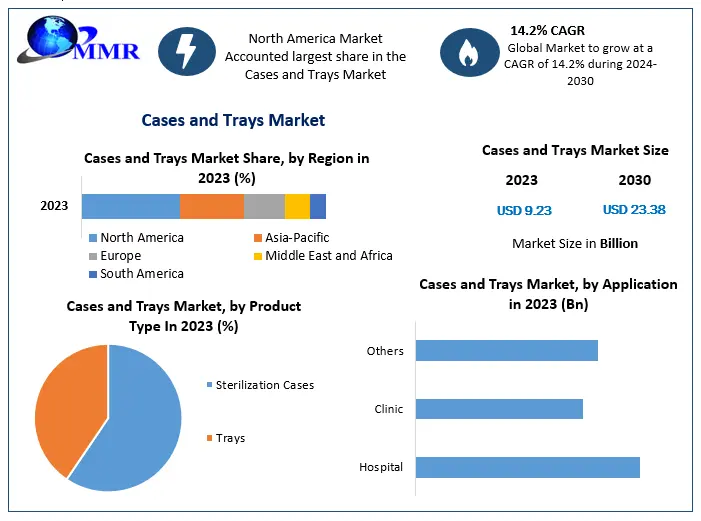
The global cases and trays market achieved a valuation of USD 9.23 billion in 2023, creating a firm capital baseline for heavy industrial and specialized clinical containment systems.
Total revenue is projected to hit USD 23.38 billion by 2030, expanding at a compound annual growth rate (CAGR) of 14.2% across the 2024 to 2030 forecast window.
Electric cases and trays operate as vital protection cabinets, preventing catastrophic asset failures caused by electromagnetic interference, power dissipation, and electric breakdown.
The hospital application segment holds a dominant position, commanding more than 50% of the total market share to support high-stakes surgery departments and operation rooms.
North America remains the leading regional revenue contributor, capturing a dominant 44.59% of the global market share in 2023, driven by strict regulatory mandates and mature infrastructure networks.
Persistent structural limitations, specifically seal leakage risks and intense price competition, continue to impact corporate profit margins and hardware field longevity.
Why This Matters Now
The accelerating deployment of automated industrial equipment and heavy infrastructure grids has turned specialized hardware containment from a minor operational expense into a primary risk-mitigation standard. Industrial operators face intense regulatory pressure to install robust, fire-resistant enclosures that prevent severe structural failure in high-risk environments like power generation facilities, chemical plants, and coal mines. Concurrently, the rise of interconnected smart cities requires durable, weather-protected housings capable of surviving extreme flooding and lightning strikes without disrupting regional electrical grids. In the medical sector, the push to eliminate hospital-acquired infections requires highly standardized, pre-packaged procedural trays that cut down on loose inventory and speed up hospital operations. Capital allocators are rapidly shifting investments to manufacturers that master advanced automated stamping, high-performance seals, and specialized metallurgy to secure long-term utility supply contracts.
Market Overview
The global cases and trays market achieved a valuation of USD 9.23 billion in 2023, establishing a critical foundation for heavy industrial asset protection and clinical containment systems. Driven by infrastructure upgrades and safety mandates, the market is on track to reach USD 23.38 billion by 2030. This growth trajectory reflects a clear 14.2% CAGR over the seven-year forecast period running from 2024 to 2030.
This rapid growth highlights a structural shift as global supply chains invest in more durable assets to reduce equipment failures and unexpected operational downtime. Industrial operations are moving past low-cost plastic options to adopt precision-engineered stainless steel and specialized clinical-grade plastic configurations designed to withstand harsh operating conditions. As a result, the market is transforming into a sophisticated engineering sector focused on systemic asset protection, high-performance containment, and regulatory compliance.
Key Trends Driving Growth
A primary catalyst driving global growth is the heavy investment in power and energy infrastructure, along with the rollout of connected city networks in developing nations. Electric cases and trays operate as secure structural cabinets that shield sensitive electronic parts from external physical threats, while protecting nearby technicians from severe electrical shocks. The rising incidence of electronic system issues, such as electromagnetic interference, power dissipation, and sudden electric breakdown, has forced engineers to prioritize high-performance enclosures. These containment systems are critical in high-risk zones facing explosion or fire hazards, such as modern power plants, chemical refineries, and coal mines, where they contain combustible gases and ignitable dust.
Concurrently, severe weather disruptions have forced utility operators to procure specialized protective enclosures designed for environments prone to floods and lightning strikes. In the clinical sector, the rising frequency of complex surgeries and an aging global demographic are driving significant demand for robust sterilization systems. Perforated cleansing trays are carefully designed to let high-temperature steam pass through, maximizing sterilization effectiveness. Additionally, the shift toward pre-designed, pre-packaged custom procedural trays helps hospitals cut down on individual component tracking, smooth out inventory management, and lower infection risks in operating rooms.
However, ongoing manufacturing issues, including seal leakage and aggressive price competition, continue to challenge market players. Defective seals expose sensitive components to moisture and dust, leading to costly equipment failures and liability risks. To protect their market position, manufacturers are focused on upgrading automated cleaning technologies and improving structural welding to protect their global credibility.
Segment Insights
Dominant Segment: Sterilization cases represent the leading product category, driven by the increasing volume of complex surgeries and a growing global geriatric population requiring advanced hospital care. These systems provide crucial protection and structural support for reusable medical tools during harsh high-pressure sterilization cycles.
Fastest-Growing Segment: Industrial electric cases and trays are expanding rapidly as the fastest-growing functional category. This growth is driven by the rapid expansion of smart city infrastructure, clean energy grids, and strict safety mandates across high-voltage industrial zones.
Application Dominance: The hospital segment holds a dominant position, commanding more than 50% of the total market share to support high-stakes surgery departments and operation rooms. Clean supplies for medical procedures and disinfecting of instruments are vital for avoiding clinic-related diseases.
Regional Growth Story
North America secured the largest regional share in 2023, capturing 44.59% of the global market as the clear industry leader. This regional dominance is driven by strict government rules focused on reducing healthcare infections and upgrading industrial grids, along with the presence of top tier manufacturers in the United States, Canada, and Mexico. High public awareness of health safety and major investments in advanced infrastructure ensure a steady demand for premium containment solutions.
Europe remains the second-largest regional market, supported by strict workplace safety regulations and highly automated industrial zones across major manufacturing nations. At the same time, the Asia-Pacific region is set to grow rapidly through 2030. This acceleration is powered by expanding urban networks, rising investments in new product development, and growing demand for advanced power infrastructure in fast-growing developing economies.
Competitive Landscape
The competitive space features intense engineering competition among top global players, including General Electric Company, ABB Ltd., Axygen, Inc., and CELLTREAT Scientific Products LLC. Other prominent companies like Smith & Nephew, Eaton Corporation, Emerson Electric Co., and Rittal GmbH & Co. Kg. are actively defending their market positions through product innovation and specialized designs. Schneider Electric and specialized suppliers like Labcon North America, Guangzhou Jet Bio-Filtration Co., Ltd., and SEOH Corporation are also key players driving the market forward.
To maintain pricing power and outpace competitors, these industry leaders are pursuing strategic acquisitions and direct supply-chain investments. This consolidation allows firms to eliminate third-party logistics costs, optimize raw material expenses, and improve delivery speeds for custom enclosure orders. Traditional market leaders are investing heavily in automated production and high-durability alloys to protect their market share against low-cost, uncertified manufacturers.
Recent Developments
Expanded production of advanced electrical enclosures by companies like Rittal and Schneider Electric has improved protection against electromagnetic interference across smart factories.
Industrial power sector rollouts by Eaton Corporation and Emerson Electric Co. have introduced ruggedized containment cabinets designed for high-risk, explosion-prone environments.
The development of high-capacity pre-packaged surgical trays by medical suppliers has helped hospitals streamline their inventory management and lower operational costs.
Next-generation material rollouts by laboratory suppliers, including Axygen and Labcon, have introduced lightweight, chemical-resistant trays built for automated research environments.
The implementation of automated quality control lines by major players has helped reduce seal leakage defects, extending the field lifespan of heavy industrial cases.
Strategic Implications
For component suppliers and heavy equipment OEMs, the steady shift toward high-performance enclosures requires immediate changes in product development. Designing reliable, long-lasting seals for environments prone to floods and high temperatures demands advanced polymer science and precise manufacturing tolerances. Suppliers who fail to deliver verified protection ratings risk losing large utility contracts to agile competitors moving quickly into the smart city infrastructure space.
Furthermore, the rising demand for custom procedure trays requires manufacturers to optimize their logistics and assembly lines. Companies must build tight partnerships with end-users to design application-specific layouts that reduce component counts and simplify handling. This customization allows manufacturers to protect their profit margins from raw material price swings and build long-term, highly resilient customer relationships.
Future Outlook
The global cases and trays market will continue its transition toward high-durability, standardized protective systems through 2030. The integration of advanced sealing systems and fire-resistant materials will directly address current performance challenges, reducing unexpected equipment failures in the field. Companies that successfully combine high-volume production efficiency with verified safety certifications will capture major market opportunities across expanding global industrial hubs.
Ultimately, the competitive structure will separate manufacturers into two clear camps based on technical execution and protection ratings. Market dominance will belong to agile suppliers that secure high-durability material access and deploy certified explosion-proof casings, while lagging producers reliant on baseline, uncertified components will face rapid obsolescence as safety mandates tighten globally.
Analyst Perspective
“The global cases and trays market has reached a critical turning point as industrial electrification and strict safety mandates change product requirements,” notes Tejaswini Kakade, Research Analyst at Maximize Market Research. “The clear surge in demand across both high-voltage power grids and sterile clinical settings creates valuable opportunities for manufacturers who can consistently deliver certified, high-performance containment systems that survive extreme environments.”
About Maximize Market Research
Maximize Market Research Pvt. Ltd. (MMR) is a global market research and consulting company that provides reliable, data-focused, and practical business insights. The firm serves a wide range of industries, including healthcare, pharmaceuticals, technology, automotive, electronics, chemicals, personal care, and consumer goods. Through market forecasts, competitive analysis, strategic consulting, and industry impact assessments, MMR helps organizations understand changing market conditions, identify growth opportunities, and make informed business decisions for long-term success.
2nd Floor, Navale IT Park Phase 3
Pune Banglore Highway, Narhe
Pune, Maharashtra 411041, India
+91 9607365656
sales@maximizemarketresearch.com
