Key Highlights
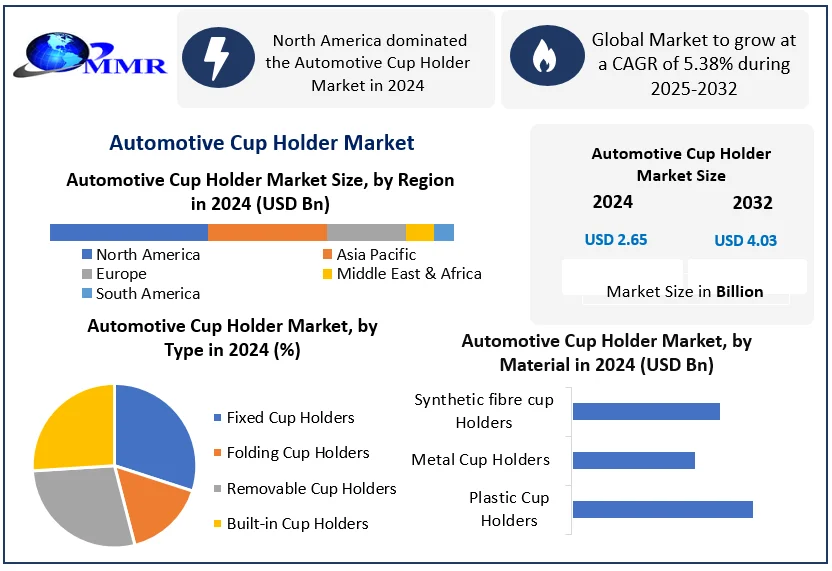
- The Global Automotive Cup Holder Market Size was valued at USD 2.65 Billion in 2024, demonstrating growing investment in premium vehicle interior components.
- The market is expected to reach USD 4.03 Billion by 2032, creating new opportunities for automotive interior suppliers and OEMs focused on cabin innovation.
- The industry is projected to expand at a CAGR of 5.38%, reflecting increasing consumer demand for convenience, comfort, and intelligent interior features.
- Premium vehicle demand and smart interior technologies are driving product innovation across passenger vehicle segments.
- Automotive manufacturers are integrating multifunctional interior components that enhance user experience while supporting connected and software-defined vehicle architectures.
Why This Matters Now
The automotive industry’s competitive advantage is shifting from horsepower to passenger experience. As electric vehicles, autonomous technologies, and software-defined platforms become mainstream, consumers increasingly evaluate vehicles based on interior comfort, convenience, and intelligent cabin design.
The Automotive Cup Holder Market Size, valued at USD 2.65 Billion in 2024, illustrates how even traditionally simple components have become strategic differentiators. Its projected expansion to USD 4.03 Billion by 2032 at a 5.38% CAGR signals growing investment in premium interiors that strengthen brand value, customer satisfaction, and long-term vehicle competitiveness.
Market Overview
Automotive cup holders have evolved from basic storage accessories into integrated interior components designed to improve convenience, ergonomics, and premium cabin aesthetics.
Modern vehicle interiors increasingly combine functional design with connected technologies. Cup holders now complement wireless charging systems, center consoles, intelligent storage solutions, and premium interior layouts that define next-generation mobility experiences.
The industry’s transformation is being accelerated by electric vehicles. Without traditional drivetrain packaging constraints, manufacturers have greater flexibility to redesign cabin layouts and optimize passenger comfort.
As consumer expectations continue rising, automotive interiors are becoming central to vehicle purchasing decisions, creating sustained opportunities for interior component manufacturers.
Key Trends Driving Growth
Luxury vehicle demand continues driving innovation in automotive interiors. Consumers increasingly expect premium materials, intelligent storage solutions, and refined cabin experiences across multiple vehicle segments.
Software-defined vehicles are changing how interior components are designed. Digital cockpits, connected ecosystems, and integrated cabin technologies require interior layouts that balance aesthetics with functionality.
Electrification also influences cabin architecture. EV platforms create additional flexibility for center console design, allowing manufacturers to integrate multifunctional cup holders alongside charging ports and digital interfaces.
Shared mobility and ride-hailing services are increasing the importance of passenger comfort. Interior convenience features contribute directly to customer satisfaction, particularly in vehicles designed for extended travel or commercial mobility services.
OEMs continue emphasizing modular interior platforms that simplify manufacturing while allowing greater product customization across vehicle models.
Smart features, including temperature-controlled or illuminated cup holders in premium vehicles, demonstrate how interior components are becoming value-added differentiators rather than commodity products.
Segment Insights
- Dominant Segment: Information available in the Maximize Market Research report.
- Fastest-Growing Segment: Information available in the Maximize Market Research report.
- Passenger vehicle applications continue driving demand for advanced interior convenience features.
- Premium and luxury vehicle categories remain key adopters of innovative cup holder technologies.
Regional Growth Story
The United States continues leading demand for larger vehicles and premium interior features. SUVs, pickup trucks, and luxury vehicles increasingly incorporate multifunctional cabin components designed to enhance customer experience.
Germany remains a global benchmark for premium automotive engineering. Luxury manufacturers continue integrating sophisticated interior technologies that combine functionality with premium design.
China represents one of the fastest-evolving automotive interior markets. Rising EV adoption and increasing consumer preference for technology-rich vehicles are encouraging manufacturers to invest in advanced cabin solutions.
Japan and South Korea continue emphasizing ergonomic vehicle design, manufacturing precision, and intelligent interior integration across both domestic and export markets.
India is emerging as an attractive market as rising disposable income, premium vehicle adoption, and expanding automotive production support demand for higher-quality interior components.
Across these automotive manufacturing hubs, interior innovation has become an increasingly important competitive strategy alongside electrification and digital mobility.
Competitive Landscape
Competition within the automotive cup holder industry increasingly centers on interior innovation rather than standalone component manufacturing.
OEMs now evaluate suppliers based on design flexibility, material quality, manufacturing precision, and integration capability with broader interior systems. Suppliers capable of supporting multiple vehicle platforms strengthen their long-term strategic value.
Technology investment reflects changing consumer priorities. Manufacturers are developing cup holders that integrate seamlessly with wireless charging systems, ambient lighting, intelligent storage solutions, and premium center consoles.
Automotive interior suppliers also compete through lightweight materials and sustainable manufacturing processes that align with vehicle efficiency objectives and environmental targets.
The competitive environment increasingly rewards companies capable of combining ergonomic design, manufacturing scalability, premium materials, and close collaboration with global automotive manufacturers.
Recent Developments
- Automotive manufacturers continue expanding premium interior offerings across multiple vehicle segments.
- Smart cabin technologies are increasingly influencing interior component design.
- EV platform development is enabling more flexible interior layouts and multifunctional storage solutions.
- Interior suppliers continue investing in lightweight materials and advanced manufacturing capabilities.
- OEMs are integrating convenience-focused features to strengthen customer experience and vehicle differentiation.
Strategic Implications
For OEMs, interior convenience features contribute directly to customer satisfaction, vehicle differentiation, and premium brand positioning. Components once viewed as secondary now influence purchasing decisions.
Tier-1 suppliers benefit from increasing demand for integrated interior systems rather than standalone products. Companies offering complete cabin solutions strengthen long-term partnerships with automotive manufacturers.
Electric vehicle manufacturers gain additional opportunities to redesign cabin architecture around passenger experience rather than conventional powertrain limitations.
Fleet operators, mobility providers, and premium ride-sharing services also benefit from improved passenger comfort, supporting customer retention and service differentiation.
Investors should recognize that automotive interiors represent one of the fastest-evolving segments within vehicle engineering. Consumer expectations for premium experiences continue expanding beyond luxury vehicles into mainstream automotive markets.
Future Outlook
The Automotive Cup Holder Market Size is projected to grow from USD 2.65 Billion in 2024 to USD 4.03 Billion by 2032, expanding at a CAGR of 5.38%. This growth demonstrates that interior innovation has become a strategic priority alongside electrification, connectivity, and autonomous mobility.
Future competition will extend beyond vehicle performance toward intelligent cabin ecosystems where convenience, personalization, and digital integration define customer value. Interior components will increasingly function as connected, multifunctional elements within software-defined vehicles.
As automotive manufacturers compete to deliver premium mobility experiences, companies transforming simple cabin accessories into integrated smart interior technologies will shape the next generation of vehicle design, while suppliers focused solely on conventional component manufacturing risk losing relevance in an increasingly experience-driven automotive market.
Analyst Perspective
“Automotive interiors are becoming powerful competitive differentiators as electrification and digital technologies reshape vehicle design. Companies that combine intelligent functionality, premium materials, and seamless OEM integration will capture the greatest opportunities in the Automotive Cup Holder Market,” says Tejaswini Kakade, Analyst, Maximize Market Research.
About Maximize Market Research
Maximize Market Research Pvt. Ltd. (MMR) is a global market research and consulting company that provides reliable, data-focused, and practical business insights. The firm serves a wide range of industries, including healthcare, pharmaceuticals, technology, automotive, electronics, chemicals, personal care, and consumer goods. Through market forecasts, competitive analysis, strategic consulting, and industry impact assessments, MMR helps organizations understand changing market conditions, identify growth opportunities, and make informed business decisions for long-term success.
2nd Floor, Navale IT Park Phase 3
Pune Banglore Highway, Narhe
Pune, Maharashtra 411041, India
+91 9607365656
sales@maximizemarketresearch.com
