Key Highlights
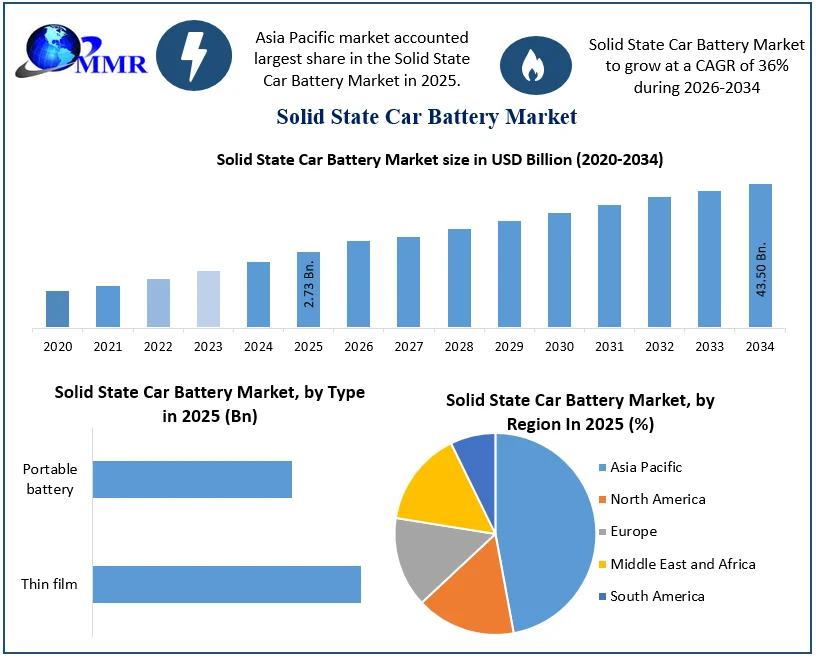
Market Scale: The market was valued at USD 2.73 billion in 2025 and is projected to reach USD 43.50 billion by 2034.
Growth Velocity: The sector is expanding at an aggressive CAGR of 36% through the 2026–2034 forecast period.
Dominant Segment: Asia-Pacific leads the global market, commanding 51.2% of the sector in 2025, driven by massive manufacturing hubs in China, Japan, and South Korea.
Technological Catalyst: Solid-state batteries (SSBs) offer theoretical energy densities significantly higher than traditional lithium-ion cells, potentially enabling electric ranges exceeding 600 miles.
Performance Advantage: By replacing flammable liquid electrolytes, SSBs provide superior thermal stability, drastically reducing fire risks and simplifying battery cooling systems.
Why This Matters Now
The electric vehicle (EV) industry is hitting a performance ceiling defined by the limitations of conventional lithium-ion chemistry. As consumer expectations for range and charging speed rise, the industry requires a fundamental leap in energy density and safety. Solid-state technology is no longer a research-lab concept; it is the strategic cornerstone for the next generation of high-performance electric mobility, offering a clear path to parity with—and eventual superiority over—internal combustion engine vehicles.
Market Overview
The Solid State Car Battery Market are engineered to replace the volatile liquid electrolyte found in current lithium-ion batteries with a solid counterpart. This change in physical state is a profound shift in power delivery. With a 2025 valuation of USD 2.73 billion, the market is currently in the early stages of industrialization, moving from pilot testing to specialized vehicle integration. For OEMs, this transition is the most effective way to eliminate range anxiety and reduce the weight of complex battery management systems, directly improving the efficiency of the vehicle platform.
Key Trends Driving Growth
The primary trend accelerating this market is the pursuit of “energy density breakthroughs.” Current lithium-ion technology is approaching its practical limit; SSBs offer a solution that can store double the energy within a similar physical footprint. Furthermore, the industry is seeing a shift in focus toward manufacturing scalability. Innovations in thin-film deposition and ceramic electrolyte synthesis are reducing production bottlenecks. As automotive manufacturers integrate these batteries, they are also standardizing safety protocols, effectively setting a new bar for what a “safe” battery means in the context of mass-market EV adoption.
Segment Insights
Dominant Segment (By Type): Thin-Film Batteries. Due to their versatile application scope and reduced environmental impact, these units are currently the most prominent form factor.
Fastest-Growing Segment: Below 20mAh Capacity. This sub-segment is projected to grow at the highest rate, fueled by the integration of solid-state tech into specialized automotive sensors, wireless modules, and auxiliary power management systems.
Regional Growth Story
Asia-Pacific currently dominates the landscape, holding over half of the global market share. This dominance is not accidental; it is the result of decades of strategic government funding in Japan, South Korea, and China, which has created a self-sustaining ecosystem of gigafactories and advanced material research labs. While North America and Europe are rapidly investing to bridge the gap, the current concentration of production capacity and technical expertise ensures that the Asia-Pacific region will remain the heartbeat of solid-state innovation for the foreseeable future.
Competitive Landscape
The market is currently a high-stakes arena where legacy automotive powerhouses are competing directly with venture-backed innovators. Companies like Toyota Motor Corporation are leveraging their vast manufacturing experience to bring SSBs to market, signaling a commitment to deep vertical integration. Simultaneously, startups like QuantumScape and Solid Power are disrupting the space by securing high-profile partnerships with major OEMs, proving that technical leadership in electrolyte materials is the new “gold standard” for supplier value.
This competition is a signal to the broader automotive industry: the era of the generic “battery supplier” is ending. Future winners will be those who control the intellectual property of the electrolyte-anode interface—the “secret sauce” that determines whether a battery is commercially viable or remains a lab prototype. Investors are increasingly favoring firms that demonstrate not just high-energy density in testing, but also the ability to manufacture these materials at an industrial scale without the “premium pricing” that has historically hampered early-stage battery tech.
Recent Developments
Manufacturing Scale-up: Global players are rapidly pivoting from small-batch prototypes to pilot-line production, targeting mid-2020s mass-market entry points.
Strategic Partnerships: Joint ventures between OEMs and battery innovators are becoming the industry norm, intended to secure supply chains for rare ceramic and sulfide-based electrolytes.
Performance Benchmarks: Major announcements regarding 500+ mile range prototypes have shifted the narrative from “if” solid-state batteries will arrive, to “how quickly” they can be deployed across luxury and high-performance segments.
Strategic Implications
For OEMs and Tier-1 suppliers, solid-state technology is the ultimate “de-risking” move. By eliminating the fire hazards and thermal management complexities of liquid-based packs, companies can significantly reduce the engineering overhead of their vehicle architectures. The strategic imperative is clear: companies that wait for the technology to fully mature before investing risk being locked out of the next generation of battery supply contracts. The leaders of the next decade will be those currently building the relationships—and the supply chains—necessary to pivot to solid-state chemistry the moment cost-parity is reached.
Future Outlook
The automotive industry is fast approaching a competitive inflection point where the transition to solid-state batteries will distinguish the market leaders from the laggards. We are entering an era where the vehicle’s driving range and thermal safety are no longer negotiable features, but baseline expectations. The firms that successfully master the transition to solid-state power will command the future of mobility, while those tethered to legacy liquid-electrolyte technologies will find their vehicles increasingly relegated to price-sensitive, low-performance niches.
Analyst Perspective
“Solid-state technology is the missing piece of the electrification puzzle,” notes Tejaswini Kakade, Analyst at Maximize Market Research. “By delivering on the promise of higher energy density and improved safety, this technology provides the final push needed to transition the global automotive market away from combustion engines for good.”
About Maximize Market Research
Maximize Market Research Pvt. Ltd. (MMR) is a global market research and consulting company that provides reliable, data-focused, and practical business insights. The firm serves a wide range of industries, including healthcare, pharmaceuticals, technology, automotive, electronics, chemicals, personal care, and consumer goods. Through market forecasts, competitive analysis, strategic consulting, and industry impact assessments, MMR helps organizations understand changing market conditions, identify growth opportunities, and make informed business decisions for long-term success.
2nd Floor, Navale IT Park Phase 3
Pune Banglore Highway, Narhe
Pune, Maharashtra 411041, India
+91 9607365656
sales@maximizemarketresearch.com
