Key Highlights
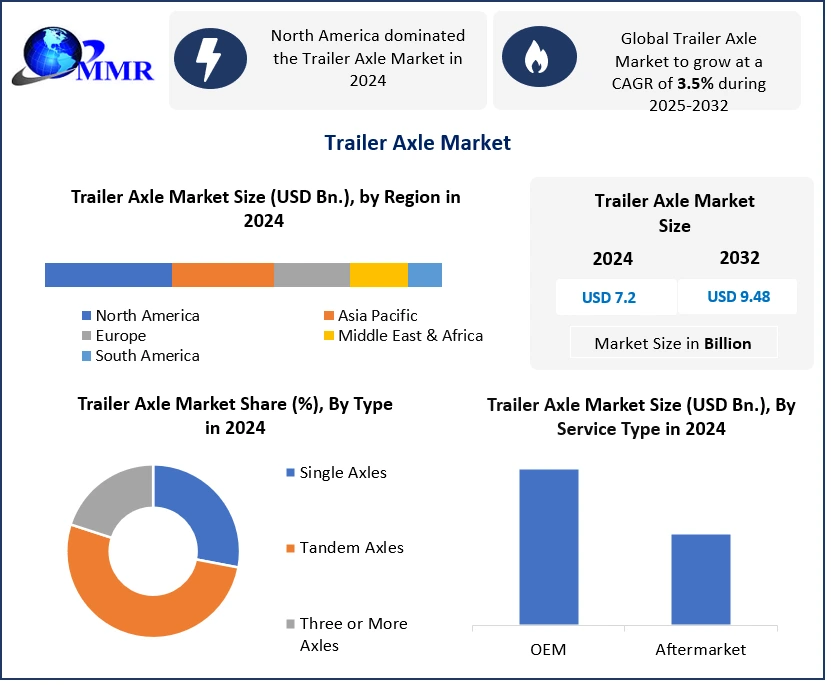
Market Scale: The market is valued at USD 8.8 billion in 2025 and is projected to reach USD 12.4 billion by 2032.
Growth Velocity: The industry is expanding at a CAGR of 5.1% over the 2025–2032 forecast period.
Dominant Segment: Spring axles currently hold the largest market share due to their proven durability and cost-effectiveness in heavy-duty cargo applications.
Fastest-Growing Segment: The 8,000–15,000 lbs capacity segment is witnessing the most rapid expansion, fueled by demand in agricultural and mid-weight commercial freight.
Strategic Driver: The emergence of e-axles and telematics-integrated systems is shifting trailer axles from passive mechanical supports to active, energy-regenerating logistics assets.
Why This Matters Now
The global supply chain is demanding more than just durability from its hardware—it is demanding intelligence and efficiency. For fleet operators and logistics strategists, the trailer axle is no longer a “fit-and-forget” component; it is becoming a critical data point in the quest to reduce fuel consumption and optimize vehicle uptime. As regulatory pressure on carbon emissions intensifies, the shift toward e-axles and lightweight materials represents a massive opportunity for manufacturers to redefine their role in the heavy-duty transportation ecosystem.
Market Overview
The Trailer Axles Market serve as the structural and mechanical bedrock for global freight. Valued at USD 8.8 billion in 2025, the market is navigating a transition from traditional rigid steel designs to sophisticated, sensor-laden systems. This change is being driven by the need to increase payload capacity while reducing the total weight of the trailer—a “tare weight” reduction that directly translates into lower fuel costs for fleet managers. By 2032, the market is expected to hit USD 12.4 billion as the demand for specialized, high-capacity transport grows in tandem with global trade.
Key Trends Driving Growth
The most disruptive trend is the rise of the “e-axle.” By integrating electric motors directly into the axle, manufacturers are providing trailers with the capability to assist in propulsion or recover energy during braking—effectively turning the trailer into a semi-autonomous power unit. Coupled with the integration of IoT and telematics, fleet operators can now monitor axle load, bearing temperature, and vibration in real-time. This predictive maintenance capability allows companies to prevent catastrophic breakdowns before they happen, slashing operational downtime and maintenance costs.
Segment Insights
Dominant Segment: Spring Axles. These units remain the industry benchmark for heavy-duty freight due to their robust design and lower initial cost, making them the default choice for the majority of standard cargo trailers globally.
Fastest-Growing Segment: 8,000–15,000 lbs Capacity. This mid-weight category is outpacing others as logistics providers invest in more versatile, agile trailers that can navigate the increasing frequency of “last-mile” urban distribution and mid-range regional delivery.
Regional Growth Story
North America currently leads the global trailer axle market, with an estimated 37.3% market share in 2025. This dominance is anchored by an exceptionally mature logistics infrastructure and early adoption of innovative suspension and telematics systems. Conversely, the Asia-Pacific region is the market’s primary engine of growth. China and India are undergoing massive industrial infrastructure projects that require heavy-duty transport, and their massive localized manufacturing capabilities for axles are keeping costs down while enabling rapid fleet modernization.
Competitive Landscape
The market is highly consolidated, with the top five players—including giants like SAF-HOLLAND, Hendrickson, Meritor, and Dexter—collectively holding nearly 60% of the market share. This high level of concentration creates a landscape where scale and R&D capability are the primary tools of competition. Market leaders are moving beyond hardware sales, forming strategic joint ventures with regional players to capture the fast-growing demand in the Asia-Pacific construction and mining sectors.
These competitive maneuvers signal a broader shift in OEM-supplier dynamics: the “axle provider” of the future must be a systems integrator. Companies that offer fully automated, braking-integrated, and telematics-ready axle assemblies are gaining significant pricing power. Those still focused on bulk sales of traditional, passive axles face increasing pressure from lower-cost manufacturers, forcing a focus on specialized, high-performance niches to maintain margins.
Recent Developments
Local Production Expansion: Major players like Dana Incorporated have recently committed tens of millions to expand manufacturing lines in India, specifically targeting heavy-duty commercial demand in Asia-Pacific.
Lightweight Material Adoption: New composite and high-strength alloy axle designs are entering the market to allow for higher payload weights without increasing fuel burn.
E-Axle Pilots: Several major trailer OEMs are currently running large-scale pilot programs for regenerative e-axles, aimed at reducing the load on the primary tractor unit’s fuel systems.
Strategic Implications
For procurement leaders, the primary risk is no longer the component cost, but the cost of obsolescence. Investing in a trailer fleet today without considering e-axle readiness or telematics capability could lead to higher TCO (Total Cost of Ownership) over the vehicle’s ten-year lifespan. Suppliers must prioritize modularity—designing axles that can be upgraded from passive to smart-sensing without a complete overhaul. The winners of the next decade will be the firms that facilitate this seamless technology upgrade path for the logistics giants.
Future Outlook
The trailer axle market is transitioning from a mechanical necessity into a critical node of the digital supply chain. We expect a decisive shift in the next five years: the market will polarize between “commodity” suppliers struggling with price volatility and “intelligent system” providers who dominate the high-margin logistics infrastructure. Future market leaders will be the firms that successfully embed energy-recovery and health-monitoring intelligence into the axle, while those stuck in the “passive-steel” paradigm will be systematically excluded from the high-performance freight networks of the future.
Analyst Perspective
“The trailer axle market is at the start of a digital and electrical renaissance,” states Tejaswini Kakade, Analyst at Maximize Market Research. “The convergence of e-axles and predictive analytics is turning a simple rotating shaft into a profit-generating asset, fundamentally changing how logistics providers calculate efficiency and long-term fleet value.”
About Maximize Market Research
Maximize Market Research Pvt. Ltd. (MMR) is a global market research and consulting company that provides reliable, data-focused, and practical business insights. The firm serves a wide range of industries, including healthcare, pharmaceuticals, technology, automotive, electronics, chemicals, personal care, and consumer goods. Through market forecasts, competitive analysis, strategic consulting, and industry impact assessments, MMR helps organizations understand changing market conditions, identify growth opportunities, and make informed business decisions for long-term success.
2nd Floor, Navale IT Park Phase 3
Pune Banglore Highway, Narhe
Pune, Maharashtra 411041, India
+91 9607365656
sales@maximizemarketresearch.com
