Key Highlights
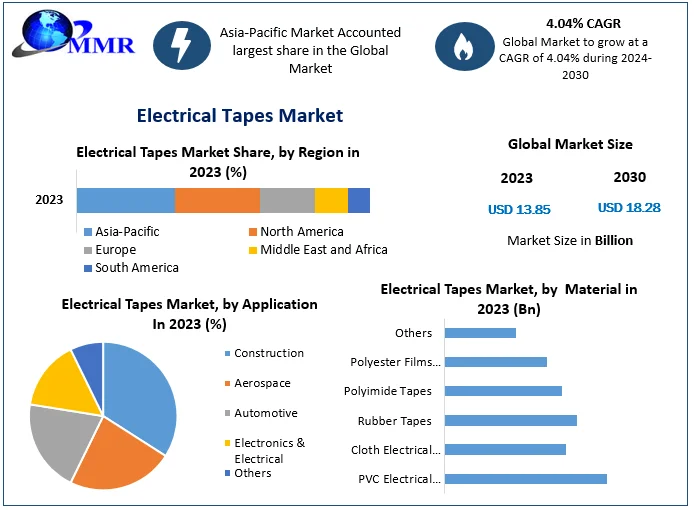
Market Valuation: The market was valued at USD 13.85 billion in 2023 and is projected to reach USD 18.28 billion by 2030.
Expansion Rate: The industry is growing at a CAGR of 4.04% during the 2024–2030 forecast period.
Dominant Segment: PVC electrical tapes continue to lead in revenue share due to their cost-effectiveness and superior moisture resistance.
Primary Growth Catalyst: The automotive sector, particularly the rapid adoption of electric vehicles, is driving demand for heat-resistant and high-dielectric insulation.
Regional Engine: Asia-Pacific accounts for more than 60% of the regional market share, with China and India serving as the primary drivers of infrastructure and electronics manufacturing.
Why This Matters Now
Modern vehicles are essentially high-compute, high-voltage data centers on wheels. In this new architecture, a single failure in a wire harness—caused by thermal degradation or electrical shorting—can compromise an entire powertrain or safety system. For automotive OEMs and Tier-1 suppliers, the selection of insulation tape is no longer a procurement footnote; it is a design imperative. The industry is currently moving away from general-purpose PVC toward specialized, flame-retardant, and low-VOC (volatile organic compound) tapes that can withstand the unique stresses of EV battery management and high-speed data transmission.
Market Overview
The Electrical Tapes Market are now essential for insulating and shielding components across a vast range of industrial applications, with the automotive segment emerging as the fastest-growing end-user. The market’s current valuation of USD 13.85 billion reflects its critical role in modern infrastructure and consumer electronics. As electronic components continue to shrink in size, the tapes themselves are evolving to provide higher dielectric strength in thinner, more flexible profiles, allowing for efficient bundling in increasingly cramped vehicle wire harnesses.
Key Trends Driving Growth
The most disruptive force in the market is the shift toward sustainable, halogen-free, and flame-retardant materials. Regulatory bodies in Europe and North America are enforcing stricter safety standards, compelling manufacturers to abandon legacy additives in favor of environmentally safe, pressure-sensitive materials. Simultaneously, the rise of the software-defined vehicle (SDV) requires tapes that do not interfere with electromagnetic sensitivity, pushing R&D efforts toward specialized shielding properties that protect delicate connectivity signals from external interference.
Segment Insights
Dominant Segment: PVC Electrical Tape. This material remains the revenue leader, holding nearly half of the market share. Its inherent cost-effectiveness, combined with reliable moisture and abrasion resistance, makes it the baseline for most industrial and automotive wiring.
Fastest-Growing Segment: Automotive Wiring Harness Protection. This application is seeing a rapid increase in demand, driven by the shift toward electrification where higher currents and temperatures demand more robust, specialized insulation tapes.
Regional Growth Story
Asia-Pacific commands the global landscape, generating over USD 7 billion in recent annual revenue. This dominance is built on the region’s status as a global electronics and automotive manufacturing powerhouse. China’s extensive industrial footprint alone contributes to over 60% of the region’s market share. In India, the rapid expansion of the domestic automotive sector and massive infrastructure development are providing a steady demand floor, ensuring that Asia-Pacific remains the primary theater for both production capacity additions and market innovation.
Competitive Landscape
The market is characterized by a mix of massive global players and agile, regionally focused manufacturers. Industry leaders such as 3M, Nitto Denko, Avery Dennison, and HellermannTyton are leveraging their massive R&D budgets to dominate the “specialty” tape segment, particularly for EV battery applications. This signals a clear market shift: while general-purpose PVC remains a commodity, the high-margin growth is found in tapes that offer multi-functional properties—such as heat-sink capabilities, chemical resistance, and high-tensile strength for robotic assembly lines.
Strategic acquisitions in the space, particularly those integrating adhesive technology with advanced substrate engineering, indicate that large chemical firms are consolidating their grip on the “insulation stack.” For industrial buyers, this concentration means that supplier reliability and supply-chain transparency are becoming as important as the tape’s technical performance. Manufacturers who can provide a global, consistent supply of flame-retardant, high-dielectric tapes will command the pricing power in the coming decade.
Recent Developments
Sustainable Product Launches: Major market players are rolling out halogen-free, flame-retardant tapes to meet the new EU environmental directives.
EV-Specific Insulation: New product lines specifically designed for high-voltage battery modules are now hitting the market, emphasizing long-term thermal stability in confined spaces.
Regional Manufacturing Hubs: Increased investment in domestic manufacturing in India and Southeast Asia is shortening supply chains and reducing dependence on long-haul logistics for automotive assembly lines.
Strategic Implications
For procurement leaders, the transition to high-performance tapes is not merely a material change—it is a risk-mitigation strategy. Utilizing certified, high-grade insulation prevents fire hazards and long-term electrical degradation, which are significant liabilities in the EV age. OEMs should prioritize suppliers that demonstrate clear compliance with international safety standards and have robust, localized manufacturing footprints. Integrating these suppliers into the early R&D phases of vehicle development will be critical to ensuring that the wiring harness design can survive the harsh thermal environment of the next generation of electric powertrains.
Future Outlook
The electrical tapes market is moving toward a future defined by smart insulation—materials that not only protect but also provide diagnostic feedback on the state of an electrical connection. We expect the gap to widen between winners, who invest in proprietary, multi-functional insulation materials, and losers, who remain tethered to the commodity-PVC cycle. The automotive manufacturers that dominate the EV transition will be those who demand higher specifications for their wiring harness protection, effectively forcing the entire supply chain to raise its standards for safety and operational longevity.
Analyst Perspective
“The global electrical tapes market is evolving from a supporting utility into a core component of vehicle safety and efficiency,” says Tejaswini Kakade, Analyst at Maximize Market Research. “As we advance toward 2030, the ability to deliver high-dielectric, flame-retardant, and sustainable insulation solutions will be the primary driver of value in the increasingly complex automotive wiring ecosystem.”
About Maximize Market Research
Maximize Market Research Pvt. Ltd. (MMR) is a global market research and consulting company that provides reliable, data-focused, and practical business insights. The firm serves a wide range of industries, including healthcare, pharmaceuticals, technology, automotive, electronics, chemicals, personal care, and consumer goods. Through market forecasts, competitive analysis, strategic consulting, and industry impact assessments, MMR helps organizations understand changing market conditions, identify growth opportunities, and make informed business decisions for long-term success.
2nd Floor, Navale IT Park Phase 3
Pune Banglore Highway, Narhe
Pune, Maharashtra 411041, India
+91 9607365656
sales@maximizemarketresearch.com
