Key Highlights
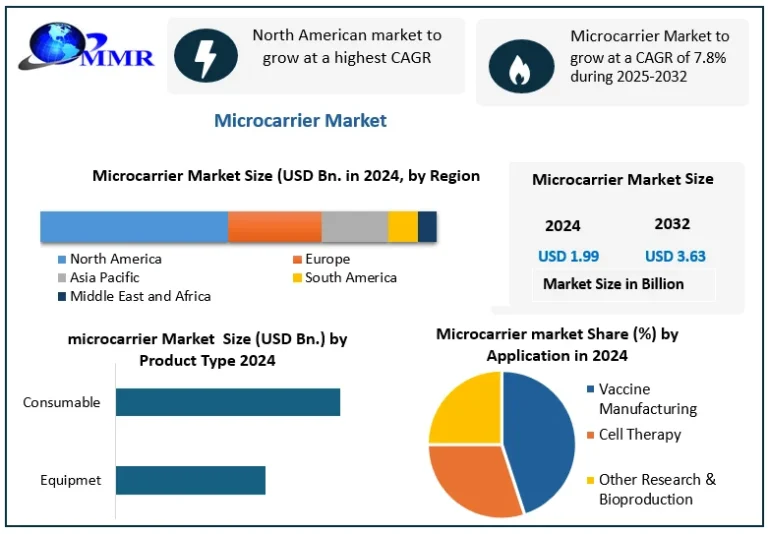
- Microcarrier Market size was valued at USD 1.99 Bn. in 2024.
- The market is expected to reach nearly USD 3.63 Bn. by 2032.
- Revenue is projected to grow at a CAGR of 7.8% from 2025 to 2032.
- Growing demand for cell therapy and regenerative medicine is strengthening market opportunities.
- Biopharmaceutical manufacturers are increasing investments in advanced cell expansion technologies.
- Continuous innovation in microcarrier materials is supporting higher production efficiency.
Market Overview
The Microcarrier Market is evolving into an essential part of modern biopharmaceutical manufacturing as companies seek efficient solutions for large-scale cell expansion. The market was valued at USD 1.99 Bn. in 2024 and is expected to reach nearly USD 3.63 Bn. by 2032, growing at a CAGR of 7.8% during the forecast period. This steady expansion reflects increasing investments in biologics production, which creates long-term opportunities for equipment suppliers, raw material manufacturers, and biotechnology companies.
Growing adoption of advanced manufacturing technologies is changing production strategies across pharmaceutical facilities. As demand for personalized medicine and regenerative therapies increases, manufacturers are prioritizing scalable cell culture systems that improve consistency while reducing production complexity.
Why This Market Matters Now
The Microcarrier Market is gaining importance because healthcare innovation is moving beyond conventional drug development toward advanced biologics, stem cell therapies, and tissue engineering. These applications require efficient cell cultivation methods capable of supporting commercial-scale production without compromising quality.
The increasing number of clinical research programs involving cell-based therapies is encouraging manufacturers to modernize production facilities. Organizations that invest in advanced microcarrier technologies today are better positioned to meet future regulatory requirements and growing commercial demand, creating competitive advantages across global healthcare supply chains.
Key Trends Driving Growth
Technology innovation remains one of the strongest drivers transforming the Microcarrier Market. Manufacturers are introducing improved surface coatings, biodegradable materials, and specialized carrier designs that enhance cell attachment and growth while simplifying downstream processing.
Another significant trend is the expansion of 3D cell culture applications. Researchers increasingly prefer microcarrier-based systems because they closely replicate natural biological environments, improving research outcomes and accelerating therapeutic development.
Automation is also reshaping production workflows. Integrated bioreactor systems combined with advanced microcarrier technologies enable manufacturers to improve productivity, reduce contamination risks, and optimize manufacturing costs. These developments benefit pharmaceutical companies seeking reliable and scalable production platforms for commercial biologics.
Market Growth Outlook
The Microcarrier Market is expected to maintain healthy growth through 2032 as investments in biotechnology continue expanding worldwide. Rising demand for vaccines, monoclonal antibodies, stem cell therapies, and regenerative medicine creates sustained opportunities across both research and commercial manufacturing environments.
Increasing collaborations between biotechnology firms, research institutions, and pharmaceutical companies are accelerating product development. These partnerships encourage innovation while supporting faster commercialization of advanced therapies. As manufacturing capacity expands globally, suppliers offering high-performance microcarrier solutions are expected to benefit from broader adoption across multiple therapeutic applications.
Access an Exclusive Market Research Sample Report
Market Segmentation
The Microcarrier Market serves diverse applications across pharmaceutical manufacturing, biotechnology research, vaccine production, tissue engineering, and regenerative medicine. Each application requires specialized cell expansion capabilities, encouraging continuous product innovation.
Different material technologies and surface modifications allow manufacturers to address varying production requirements. Pharmaceutical companies prioritize microcarriers that deliver high cell yields, reproducibility, and compatibility with automated manufacturing systems. Meanwhile, research laboratories increasingly demand flexible products suitable for experimental and clinical development projects.
End users include biotechnology companies, pharmaceutical manufacturers, academic research institutes, and contract research organizations, all contributing to sustained market demand through expanding research and commercial activities.
Regional Growth Story
North America continues to represent a significant growth region for the Microcarrier Market due to its advanced biotechnology ecosystem, strong research infrastructure, and substantial investments in innovative therapies. The region benefits from continuous product development and increasing commercialization of cell-based treatments.
Europe also maintains steady market expansion through supportive research initiatives and growing pharmaceutical innovation. Meanwhile, Asia-Pacific is emerging as an attractive growth destination as governments increase healthcare investments and biotechnology manufacturing capabilities. Expanding production facilities and rising research activities across developing economies are creating new opportunities for global suppliers looking to strengthen regional market presence.
Competitive Landscape
Competition within the Microcarrier Market is centered on innovation, product quality, manufacturing efficiency, and strategic partnerships. Companies are investing in research and development to introduce advanced microcarrier technologies that improve cell growth performance while supporting regulatory compliance.
Manufacturers are also expanding production capabilities to meet increasing customer demand across pharmaceutical and biotechnology sectors. Strategic collaborations with research organizations and healthcare companies continue strengthening product portfolios while enabling faster adoption of next-generation cell culture technologies in commercial manufacturing.
Recent Developments
- Companies continue investing in advanced microcarrier material technologies.
- Strategic collaborations are supporting innovation in cell culture solutions.
- Manufacturers are expanding production capabilities to address rising global demand.
- Growing focus on scalable bioprocessing solutions is driving new product development.
- Research investments are accelerating innovation in regenerative medicine applications.
Strategic Implications
The Microcarrier Market is becoming a strategic investment area for organizations participating in biologics manufacturing and advanced healthcare technologies. Businesses that prioritize scalable production platforms, automation, and innovation will be better prepared to meet growing demand for cell-based therapies.
For investors, the market’s projected growth signals expanding commercial opportunities supported by increasing healthcare investments and biotechnology innovation. Procurement leaders can also benefit by securing partnerships with technology providers capable of delivering reliable, high-quality cell culture solutions that enhance operational efficiency and future manufacturing resilience.
Analyst Perspective
“The Microcarrier Market is entering a new phase where manufacturing scalability and innovation will determine competitive leadership. Organizations investing in advanced cell culture technologies today are positioning themselves to capitalize on the rapid expansion of biologics, regenerative medicine, and next-generation therapeutic manufacturing over the coming years.” — Komal Patil, Analyst
About Maximize Market Research
Maximize Market Research Pvt. Ltd. (MMR) is a global market research and consulting company that provides reliable, data-focused, and practical business insights. The firm serves a wide range of industries, including healthcare, pharmaceuticals, technology, automotive, electronics, chemicals, personal care, and consumer goods. Through market forecasts, competitive analysis, strategic consulting, and industry impact assessments, MMR helps organizations understand changing market conditions, identify growth opportunities, and make informed business decisions for long-term success.
Contact Us
2nd Floor, Navale IT Park Phase 3
Pune Banglore Highway, Narhe
Pune, Maharashtra 411041, India
+91 9607365656
sales@maximizemarketresearch.com
