Key Highlights
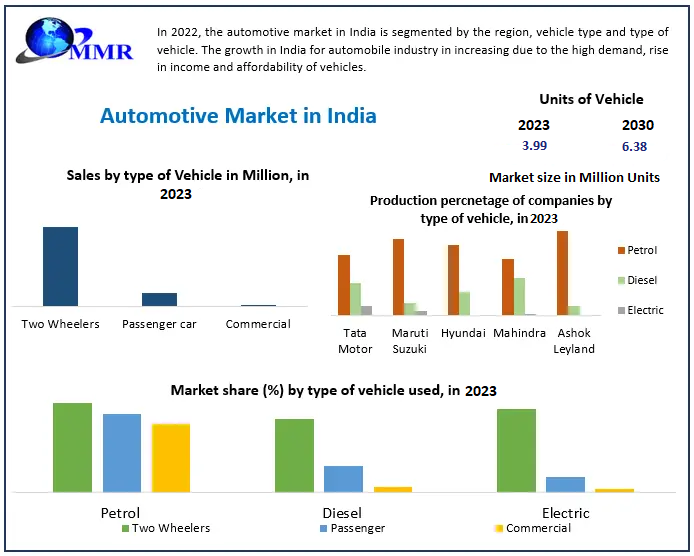
The Automotive Market in India recorded 3.99 million units in 2023, confirming its position as one of the world’s largest and fastest‑evolving vehicle arenas.
Unit volume is expected to reach 6.38 million by 2030, at a CAGR of 6.94%, creating headroom for new plants, platforms, and supplier footprints across segments.
Growth is driven by rising incomes, policy support, and expanding urban and regional mobility demand, but now plays out against a backdrop of electrification and software‑led disruption.
The market spans passenger vehicles, commercial vehicles, two‑wheelers, and three‑wheelers, turning India into a multi‑segment laboratory for EVs, alternative fuels, and connected services.
Policy initiatives around emissions, safety, localization, and EV adoption are reshaping capital allocation decisions from OEMs, Tier‑1s, fleets, and investors.
Why This Matters Now
A market that moves from 3.99 million to 6.38 million units by 2030 at 6.94% CAGR is not just growing; it is shifting the center of gravity for global automotive strategies. India’s growth now intersects with three deep transitions: electrification, software‑defined vehicles, and supply‑chain risk diversification away from single geographies.
For OEMs and Tier‑1s, India can no longer be a “follow market” that takes hand‑me‑down platforms. Decisions made now on product portfolios, plants, and local partners will determine who owns the profitable middle of the market when EVs, connected services, and ADAS move from niche to norm.
Market Overview
The Automotive Market in India, at 3.99 million units in 2023, sits on a broad base of passenger vehicles and commercial vehicles, with two‑ and three‑wheelers forming a parallel mass‑mobility universe. The forecast to 6.38 million units by 2030 reflects both replacement cycles and first‑time buyers in urban, peri‑urban, and rural areas.
This growth story is not uniform across powertrains and body types. Internal combustion remains dominant in the near term, but EV adoption, CNG penetration, and efficiency regulations are changing product economics and investment priorities. The 6.94% CAGR bakes in an expectation that India will continue modernizing its vehicle fleet while lifting per‑capita ownership and expanding organized logistics.
Key Trends Driving Growth
What changed first is policy ambition. Central and state governments have moved from purely volume‑driven industrial policy to a mix of Make in India localization, emissions reduction, and EV promotion. That shift encourages capacity additions, exports, and deeper R&D footprints, while pushing OEMs to plan for EV and advanced safety content in parallel with ICE volumes.
Second, mobility patterns are diversifying. Rising incomes and improving roads are driving demand for SUVs and higher‑content vehicles; at the same time, urban congestion and e‑commerce lift demand for small commercial vehicles, last‑mile trucks, and shared mobility solutions. This mix creates opportunities for both premium and cost‑optimized platforms, including EVs in high‑utilization duty cycles.
Third, software and connectivity are moving from optional to expected. Infotainment, telematics, OTA‑capable ECUs, and driver‑assist functions are becoming key purchase drivers, especially among younger and fleet buyers. This pushes the market toward software‑defined vehicles where value increasingly resides in code and services rather than only in hardware and displacement.
Request a Free Sample Copy or View Report Summary: https://www.maximizemarketresearch.com/request-sample/86126/
Segment Insights
Dominant Segment — Mass‑Market Passenger Vehicles and Two‑Wheelers
Compact cars, SUVs, and two‑wheelers continue to anchor volumes, given India’s income profile, urbanization, and road conditions. These segments define the scale for platforms, engines, and increasingly, entry‑level EVs.
For OEMs, winning here means balancing cost discipline with rising expectations on features, connectivity, and safety, while preparing to pivot portions of this base to electric or hybrid drivelines over time.
Fastest‑Growing Segment — SUVs, Small Commercial Vehicles, and Early EV Niches
SUV demand benefits from perceived safety, space, and road presence, while small commercial vehicles surge on last‑mile logistics and intra‑city freight. These pockets often see the earliest adoption of alternative powertrains when TCO math works.
Early EV growth in two‑wheelers, three‑wheelers, and select passenger and fleet use cases adds a new dimension, opening demand for batteries, power electronics, and charging solutions across cities and corridors.
Technology and Aftermarket Segments
ADAS, connected car services, and digital retail/aftermarket platforms are emerging as horizontal growth levers across body types.
As the parc grows, organized aftermarket and service chains gain importance, especially for fleets that need uptime, predictive maintenance, and integrated parts logistics.
Regional Growth Story
India is the focal geography, but the country’s automotive performance is intertwined with global demand, technology, and capital flows from the US, Europe, China, Japan, and South Korea. Global OEMs use India both as a domestic stronghold and an export base for compact vehicles, engines, and increasingly, EV and electronics content.
Within India, growth is broadening beyond traditional metro hubs. Tier‑2 and tier‑3 cities are driving demand for personal vehicles, while industrial and logistics corridors linking ports, dedicated freight routes, and highways boost commercial vehicle volumes. States with proactive EV and industrial policies are also emerging as magnets for new plants, vendor parks, and battery and component investments.
This regional mosaic matters for strategy. OEMs and suppliers that align capacity and product mix with high‑growth corridors—be it for PVs, CVs, or EVs—will enjoy better asset utilization and logistics economics than those with scattered, reactive footprints.
Competitive Landscape
Competition in India is shifting from pure price to a three‑way contest on product, technology, and ecosystem. Established Indian and global OEMs are defending share with new SUV lines, refreshed compact cars, and more capable CVs, while also seeding EV offerings in select segments. Their choices on platform reuse, electrification timelines, and connected features will define brand positioning through 2030.
Tier‑1 suppliers face a similar fork. Some double down on ICE‑centric portfolios, banking on long tails in engines, exhaust, and fuel systems. Others are allocating capital to EV components, ADAS sensors, power electronics, lightweight materials, and software, betting that India’s volume and policy direction will reward early movers. These bets will decide who keeps pricing power as content per vehicle shifts.
New entrants—start‑ups in EVs, software, and mobility services—are attacking niches that incumbents often underserved, from electric two‑wheelers and three‑wheelers to digital‑first sales, subscriptions, and fleet management platforms. Their traction forces legacy players to either partner, acquire, or risk ceding profitable slices of the future market.
Recent Developments
Expansion of model portfolios, especially in compact and mid‑size SUVs, to capture growing demand and protect margins in a competitive field.
Widening of EV line‑ups in two‑wheelers, three‑wheelers, and select passenger segments, alongside pilots in electric buses and commercial fleets.
Capacity additions and modernization in key automotive clusters, often linked to localization mandates and export ambitions.
Greater integration of connected services, telematics, and app‑based interfaces, both for retail buyers and fleet operators.
Acceleration of digital channels in sales, financing, and aftermarket, with online booking, pricing transparency, and remote diagnostics becoming more common.
Strategic Implications
For OEMs, the 6.94% CAGR to 6.38 million units is both a cushion and a test. It gives space to fund EV and software investments off a growing ICE base—but also compresses timelines for portfolio clean‑up and platform consolidation. Those who cling to too many low‑margin variants risk starving future‑ready programs.
Tier‑1 suppliers must decide where to place their heaviest chips. India’s scale justifies local R&D, tooling, and plants for EV components, electronics, and advanced materials, but the window to secure anchor programs on next‑gen platforms is finite. As OEMs narrow supplier lists for critical systems, latecomers will find it hard to gain entry.
Fleet operators, financiers, and mobility platforms face a market where TCO, uptime, and digital integration matter more than nameplate alone. Choosing OEM and supplier partners with clear EV, ADAS, and connectivity roadmaps will reduce technology obsolescence risk and improve residual values over the decade.
Future Outlook
By 2030, an automotive market of 6.38 million units will anchor India’s role as both a consumption engine and a manufacturing hub across ICE, hybrid, and EV architectures. The landscape will likely feature a mix of affordable connected vehicles for mass buyers, electrified fleets in high‑utilization corridors, and increasingly software‑defined platforms that support new business models.
In that world, future leaders will be the companies that treat India as a core market for integrated hardware, software, and mobility services—aligning plants, platforms, and powertrains with a clear EV and digital roadmap—while laggards will be those that treat India as a dumping ground for legacy models in a market that has clearly moved on.
Related Reports
Global Automotive Communication Technology Market https://www.maximizemarketresearch.com/market-report/global-automotive-communication-technology-market/23850/
Automotive Sunroof Market https://www.maximizemarketresearch.com/market-report/automotive-sunroof-market/11522/
Autonomous Vehicle Market https://www.maximizemarketresearch.com/market-report/global-autonomous-vehicle-market/55398/
Analyst Perspective
“The Automotive Market in India growing from 3.99 million units in 2023 to 6.38 million units by 2030 at 6.94% CAGR changes the country’s role from opportunity to obligation in global strategies,” said Tejaswini Kakade, Analyst at Maximize Market Research. “Players that synchronize electrification, software, and localized manufacturing with this growth curve will capture value across the next decade of Indian mobility.”
About Maximize Market Research
Maximize Market Research Pvt. Ltd. (MMR) is a global market research and consulting company that provides reliable, data-focused, and practical business insights. The firm serves a wide range of industries, including healthcare, pharmaceuticals, technology, automotive, electronics, chemicals, personal care, and consumer goods. Through market forecasts, competitive analysis, strategic consulting, and industry impact assessments, MMR helps organizations understand changing market conditions, identify growth opportunities, and make informed business decisions for long-term success.
2nd Floor, Navale IT Park Phase 3
Pune Banglore Highway, Narhe
Pune, Maharashtra 411041, India
+91 9607365656
sales@maximizemarketresearch.com
