Key Highlights
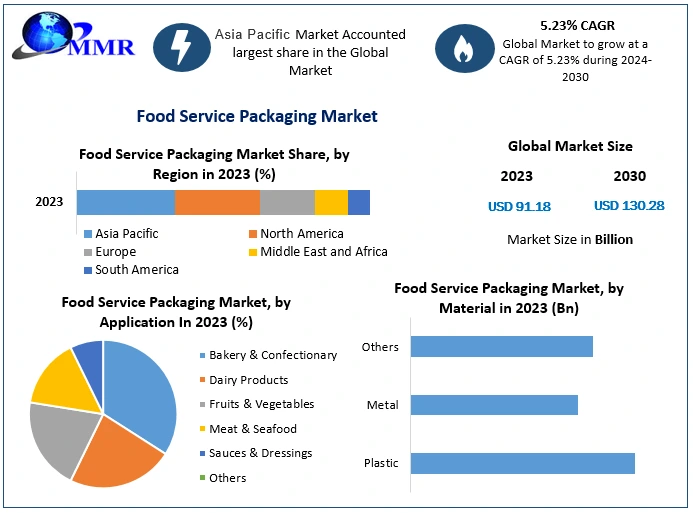
- Food Service Packaging Market valued at USD 91.18 billion in 2023.
- Market projected to reach USD 130.28 billion by 2030.
- Expected CAGR stands at 5.23% during 2024–2030.
- Asia Pacific remains the largest regional market.
- Flexible packaging dominates due to cost efficiency and versatility.
- Food delivery platforms continue to accelerate packaging demand.
- Sustainable and recyclable materials are reshaping product development.
- Regulatory compliance is driving innovation across packaging materials.
Why This Matters Now
Foodservice businesses are under pressure to balance convenience, sustainability, and regulatory compliance. Rising online food delivery volumes require packaging that protects food quality while reducing environmental impact. Manufacturers investing in recyclable materials, lightweight designs, and circular economy solutions are gaining competitive advantages as governments tighten packaging regulations and consumers increasingly favor environmentally responsible brands.
Market Overview
The Food Service Packaging Market covers packaging solutions used for restaurants, cafés, quick-service restaurants (QSRs), catering services, takeaway outlets, and online food delivery platforms. Products include flexible packaging, paper containers, rigid packaging, trays, cups, cartons, and specialty food-contact materials.
Market demand is being supported by higher consumption of prepared meals, increasing urbanization, and expanding digital food delivery ecosystems. Consumers increasingly prefer portable, hygienic, and sustainable packaging that preserves food quality during transportation.
Supply-side investments are shifting toward recyclable paper products, recycled plastics, and lightweight materials that lower transportation costs while meeting evolving environmental standards. Manufacturers are also improving packaging durability, leak resistance, insulation, and branding capabilities to meet restaurant requirements.
Macroeconomic trends including rising disposable incomes, growth in organized retail, expanding QSR chains, and digital commerce continue to strengthen packaging demand worldwide.
Key Trends Driving Growth
Sustainable Packaging Innovation
Manufacturers are replacing conventional packaging with recyclable paperboard, fiber-based packaging, recycled PET, and biodegradable alternatives. These innovations help brands comply with environmental regulations while improving corporate sustainability credentials.
Flexible Packaging Expansion
Flexible packaging continues to gain market share because it lowers logistics costs, reduces material usage, and extends shelf life. Businesses benefit from lower transportation expenses and improved operational efficiency.
Circular Economy Adoption
Food Service Packaging Association members continue supporting improved collection, recycling, and reuse systems. Circular packaging models reduce waste while increasing the value recovered from used packaging materials.
Regulatory Influence
Governments continue tightening regulations covering food-contact materials, labeling, recyclability, and plastic waste reduction. Compliance is encouraging manufacturers to redesign packaging with safer and more sustainable materials.
E-commerce and Delivery Growth
The rapid expansion of food delivery platforms has increased demand for tamper-evident, leak-resistant, and temperature-preserving packaging. Technology-enabled packaging featuring QR codes and smart labeling is also improving customer engagement.
Explore detailed analysis, insights, and growth opportunities
Segment Insights
Dominant Segment: Flexible Packaging
Flexible packaging held the leading market position in 2023.
Its lightweight construction, lower manufacturing cost, excellent printability, and extended shelf-life performance make it the preferred solution across foodservice applications. Restaurants benefit from reduced storage requirements and transportation costs, while consumers receive convenient and durable packaging for takeaway and home delivery.
The business impact is significant as operators improve operational efficiency while lowering packaging expenses without compromising food quality.
Fastest-Growing Segment: Paper & Paperboard Packaging
Paper and paperboard packaging continue gaining momentum as sustainability regulations become stricter and consumers increasingly prefer recyclable alternatives.
Brands adopting paper-based packaging strengthen environmental positioning while reducing dependence on conventional plastics. The shift also creates opportunities for suppliers specializing in renewable fiber technologies.
Additional Key Sub-segments
By Material
Plastic remains widely used because of affordability, durability, and moisture resistance. However, growing environmental concerns are gradually shifting investment toward recyclable and renewable alternatives.
By Application
Bakery & confectionery, dairy products, meat & seafood, fruits & vegetables, and sauces each require specialized packaging solutions. Food delivery has increased demand for insulated and leak-proof packaging that maintains product freshness during transportation.
Regional Growth Story
Asia Pacific
Asia Pacific dominates the global market due to rapid urbanization, expanding middle-class populations, rising disposable income, and the rapid growth of food delivery services. China, India, and Southeast Asian countries continue investing heavily in organized foodservice infrastructure, creating sustained packaging demand.
North America
North America remains a mature but innovation-driven market. Strong environmental regulations, widespread food delivery adoption, and advanced recycling infrastructure continue encouraging sustainable packaging investments.
Europe
European manufacturers remain focused on circular economy initiatives, recyclable packaging, and reducing single-use plastics. Regulatory leadership is accelerating innovation across fiber-based packaging solutions.
Middle East & Africa
Urban expansion, tourism growth, and increasing investment in hospitality are creating new opportunities for foodservice packaging suppliers, particularly within premium food delivery segments.
South America
The market is supported by expanding retail foodservice operations and growing adoption of modern packaging technologies across Brazil and Argentina.
Competitive Landscape
Competition remains highly consolidated among global packaging specialists with extensive manufacturing capabilities, broad product portfolios, and continuous investment in sustainable materials.
Amcor PLC has strengthened its competitive position through strategic acquisitions, sustainability investments, and partnerships focused on next-generation packaging technologies.
Huhtamaki Oyj, Berry Global Inc., Pactiv Evergreen Inc., Novolex Holdings LLC, Genpak LLC, Graphic Packaging International Inc., Sonoco Products Company, Ball Corporation, WestRock Company, Sabert Corporation, Amhil North America, Dart Container Corporation, Silgan Plastic Food Container, and B&R Plastics Inc. continue competing through innovation, geographic expansion, recyclable product development, and customized foodservice solutions.
The competitive landscape increasingly favors companies capable of delivering sustainable packaging while maintaining cost efficiency and regulatory compliance across global markets.
Recent Developments
- March 2022: Amcor PLC partnered with the Alliance to End Plastic Waste to strengthen global plastic waste management initiatives.
- November 2022: Amcor invested in PulPac fiber technology to accelerate commercialization of fiber-based sustainable packaging solutions.
- May 2023: Amcor acquired Moda Systems, expanding its modular vacuum packaging capabilities for meat, poultry, and dairy applications.
- Companies across the market continue expanding R&D investments focused on recyclable materials, lightweight packaging, and circular economy solutions.
Analyst Perspective – Siddhi Dole
The Food Service Packaging Market is entering a structural transformation where sustainability is becoming a competitive requirement rather than a product differentiator. Companies investing in recyclable materials, fiber-based technologies, smart packaging, and food delivery optimization will capture the strongest long-term value, while businesses slow to adapt to tightening environmental regulations risk losing both market share and customer trust.
Future Outlook
Manufacturers that combine sustainable material innovation with scalable food delivery packaging solutions will emerge as the primary winners as environmental regulations and digital foodservice continue reshaping the global Food Service Packaging Market.
About Maximize Market Research
Maximize Market Research Pvt. Ltd. (MMR) is a global market research and consulting company that provides reliable, data-focused, and practical business insights. The firm serves a wide range of industries, including healthcare, pharmaceuticals, technology, automotive, electronics, chemicals, personal care, and consumer goods. Through market forecasts, competitive analysis, strategic consulting, and industry impact assessments, MMR helps organizations understand changing market conditions, identify growth opportunities, and make informed business decisions for long-term success.
Contact Us :
2nd Floor, Navale IT Park Phase 3
Pune Banglore Highway, Narhe
Pune, Maharashtra 411041, India
+91 9607365656
sales@maximizemarketresearch.com
