Key Highlights
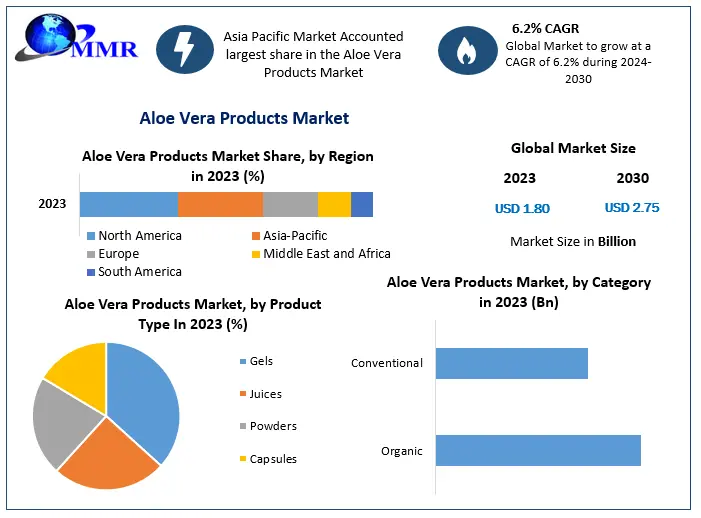
Global Aloe Vera Products Market expected to reach nearly USD 2.75 billion by 2030, up from USD 1.80 billion in 2023, at 6.2% CAGR, signalling a durable mid-single-digit growth pool for FMCG, food, pharma, and beauty players.
Aloe vera gel is the Dominant Segment, holding about 65% market share and growing at 16.2% CAGR, making it the core formulation battleground for cosmetic and healthcare brands.
Asia Pacific currently holds the largest regional share, driven by rising healthcare awareness, widespread herbal use, and high adoption of aloe-based juices and topicals.
Around 300 different aloe vera products are available in the market, with consumption by almost 85% of the population in key Asia Pacific markets, indicating near-mainstream penetration.
Demand is being pulled by topical allergy and sunburn treatments as well as internal use for diabetes and digestive issues, positioning aloe vera at the intersection of skincare and preventive healthcare.
High manufacturing and processing costs remain a structural headwind, pushing players to scale, optimize extraction, and differentiate on value rather than price alone.
Why This Matters Now
A category growing at 6.2% annually to USD 2.75 billion by 2030 is too large for FMCG and F&B leaders to ignore, especially when it cuts across skincare, beverages, and healthcare. Aloe vera products move with long-term health and natural-ingredient trends, giving incumbents and challengers a live test bed for clean-label, herbal innovation.
For CPG portfolios under pressure, aloe-linked lines offer a way to premiumize, stretch into adjacent categories, and capture spend from consumers trading up to “better-for-you” choices. The strategic risk now is not over-investment, but late entry into segments already being consolidated by agile herbal and ayurvedic brands.
Market Overview
The Aloe Vera Products Market spans gels, juices, powders, capsules, whole leaf extracts, and finished aloe vera products, served through both organic and conventional offerings. Demand comes from food, pharmaceutical, and cosmetics end-users, creating multiple routes-to-market and cross-category branding opportunities.
Growth is powered by rising healthcare awareness and the broad use of aloe in treating rashes, sunburn, itching, and other topical allergies. At the same time, use in managing diabetes and digestive issues is driving pull from healthcare and wellness channels, positioning aloe as both a functional ingredient and a consumer-facing claim.
Key Trends Driving Growth
Growing demand for organic products is enlarging the addressable aloe vera market, as consumers scrutinize ingredient lists and favor plant-based formulations. For FMCG and F&B brands, this supports premium pricing, while also raising the bar on sourcing transparency and certification.
Aloe vera products benefit from ease of availability and day-to-day relevance; consumers widely use gels for sun exposure, rashes, and pollution-related irritation. This high-frequency usage anchors repeat purchase and justifies investment in brand-building and omnichannel distribution.
In internal health, aloe vera gels and extracts are used for diabetes and digestive problems, reinforcing their role in preventive healthcare rather than episodic treatment. That opens collaboration potential with pharmaceutical companies and nutraceutical brands, as well as cross-claims in functional food and beverage.
Herbal and ayurvedic players are shaping category expectations; for example, Patanjali aloe vera gel is highlighted as a trending herbal skincare product that addresses rashes, dark spots, pigmentation, and post-bleach redness. This shows how local champions can define price points, textures, and “efficacy narratives” that global brands must match or exceed.
Request a Free Sample Copy or View Report Summary: https://www.maximizemarketresearch.com/request-sample/54182/
Segment Insights
Dominant Segment – Aloe Vera Gel: Holds about 65% market share and is growing at an expected 16.2% CAGR, driven by strong adoption in cosmetic and healthcare applications where gels serve as the primary delivery format.
Gels are colorless transparent liquids consisting of about 99% water and 1% solids, a profile that makes them easy to integrate into creams, serums, and leave-on treatments.
Aloe vera juices, powders, capsules, whole leaf extract, and finished aloe vera products collectively form the remaining share, catering to beverage, supplement, and specialty health niches.
Distribution spans store-based channels such as hypermarkets, supermarkets, and convenience stores, alongside non-store-based models, allowing brands to build both mass and niche presence.
End-user industries include food, pharmaceuticals, and cosmetics, giving ingredient suppliers multiple downstream demand streams and hedges against category-specific slowdowns.
Regional Growth Story
Asia Pacific currently holds the largest share of the Aloe Vera Products Market and is expected to maintain steady growth through 2030. Rising healthcare awareness and a cultural familiarity with herbal remedies support both mass adoption and premiumization.
Aloe vera juice is flagged as a high-growth product in the region, regarded as an effective remedy for acidity and burning sensations. With acidity-related cases documented at high levels in Asia Pacific, this creates a large, recurring-use health segment that overlaps with the F&B portfolio.
Around 300 different aloe vera products are available, consumed by almost 85% of the population in key markets, indicating near-saturation by awareness but not by sophistication or brand consolidation. Pharmaceutical companies are increasingly interested in investing in aloe-based products, signalling stronger R&D pipelines and more clinically framed claims entering the consumer domain.
Competitive Landscape
The market hosts a mix of ingredient suppliers, beverage and juice specialists, herbal brands, and global personal care players, including Terry Laboratories, RITA, Houssy Global, OKF, Grace Foods, Simplee Aloe, Suja Life, Aloe Farms, Fruit of the Earth, Aloecorp, Lily of the Desert, Forever Living Products, and others. This fragmentation means no single player can dictate standards, but it also means any company that scales quality, branding, and distribution can quickly set competitive benchmarks.
The presence of brands like Patanjali and Forever Living Products shows how herbal and MLM-driven models can grow meaningful share in aloe, particularly in emerging markets. For multinational FMCG and beauty companies, this signals the need to either partner with such players, acquire capabilities, or risk losing ground in the fastest-moving herbal formats.
Ingredient-focused companies such as Aloecorp and HuaTai Bio-fine chemical indicate that upstream processing and extraction know-how is a key competitive lever. Rivals that secure cost-efficient, high-purity supply will be better positioned to manage the high processing cost barrier that currently constrains some market expansion.
Recent Developments
Increasing interest from pharmaceutical companies in aloe-based product investments, pointing to a more science-backed, regulated wave of launches in the next cycle.
Strong performance of ayurvedic and herbal brands, exemplified by Patanjali aloe vera gel’s popularity and multipurpose use for rashes, pigmentation, and post-bleach redness.
Expansion of aloe vera-based products into diverse SKUs, with approximately 300 variants in market and mass consumption across a large share of the population in Asia Pacific.
Rising demand for herbal and organic products in key markets, encouraging both established and new companies to add aloe SKUs to their FMCG, F&B, and personal care portfolios.
Strategic Implications
For FMCG, F&B, and cosmetics leaders, aloe vera is now a core ingredient platform, not a side-line. A portfolio without aloe-based options in sun care, daily moisturizers, digestive beverages, or soothing treatments risks looking outdated in high-growth markets.
The dominance and rapid growth of aloe vera gel make it the priority for R&D and brand storytelling, particularly around sensitive-skin claims and post-exposure repair. However, high processing costs require scale and operational excellence; players who cannot reach efficient volumes should consider partnerships or contract manufacturing rather than building capacity alone.
Asia Pacific deserves focused attention as both a demand center and an innovation lab for herbal blends, aloe juices, and combination remedies. Success here will likely determine which brands can export credible aloe propositions to Europe, North America, and the Middle East.
Future Outlook
From 2024 to 2030, the Aloe Vera Products Market is set to grow steadily at 6.2% CAGR, reaching nearly USD 2.75 billion. As herbal, organic, and preventive-health narratives deepen, aloe vera products will embed further into everyday personal care and diet routines.
Expect greater convergence between food, pharma, and cosmetics as brands co-develop products that move between topical and ingestible formats. In this environment, winners will be companies that treat aloe vera as a strategic platform with disciplined innovation and supply-chain control, while losers will be those that treat it as a short-term trend and arrive after category rules are already written.
Related Reports
Global Flushing Systems Market https://www.maximizemarketresearch.com/market-report/global-flushing-systems-market/22309/
Global Water Free/Waterless Urinals Market https://www.maximizemarketresearch.com/market-report/global-water-free-waterless-urinals-market/44934/
Elliptical Market https://www.maximizemarketresearch.com/market-report/global-elliptical-market/86812/
Analyst Perspective
“The Aloe Vera Products Market is shifting from niche herbal shelves to mainstream FMCG, food, and pharmaceutical portfolios,” said Siddhi Dole, analyst at Maximize Market Research. “With aloe vera gel commanding 65% share and growing rapidly, the next six years will favor companies that integrate aloe deeply into their product architectures and secure efficient processing capabilities rather than chasing one-off SKUs.”
About Maximize Market Research
Maximize Market Research Pvt. Ltd. (MMR) is a global market research and consulting company that provides reliable, data-focused, and practical business insights. The firm serves a wide range of industries, including healthcare, pharmaceuticals, technology, automotive, electronics, chemicals, personal care, and consumer goods. Through market forecasts, competitive analysis, strategic consulting, and industry impact assessments, MMR helps organizations understand changing market conditions, identify growth opportunities, and make informed business decisions for long-term success.
2nd Floor, Navale IT Park Phase 3
Pune Banglore Highway, Narhe
Pune, Maharashtra 411041, India
+91 9607365656
sales@maximizemarketresearch.com
