The US Bioplastics Market is gaining strong momentum as businesses and policymakers push for alternatives to conventional plastics. Bioplastics—derived wholly or partly from renewable resources such as corn starch, sugarcane, and cellulose—offer reduced carbon footprints and, in many cases, biodegradability or compostability.
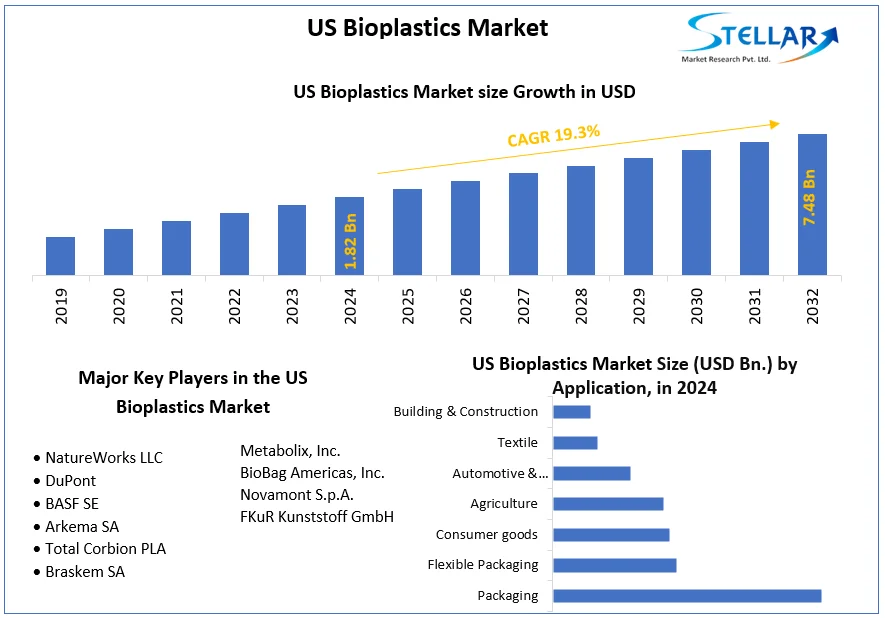
US Bioplastics Market size was valued at USD 1.82 Bn. in 2024 and the total US Bioplastics revenue is expected to grow at a CAGR of 19.3% from 2025 to 2032, reaching nearly USD 7.48 Bn. in 2032.
Driven by environmental concerns, regulatory pressure, and corporate sustainability goals, the US is emerging as a key hub for bioplastic adoption and innovation.
A Market Driven by Sustainability and Circular Economy Goals
A defining trend in the US bioplastics market is the shift toward low-carbon, circular material systems. Brands across food, beverage, retail, and consumer goods are redesigning packaging to meet recyclability or compostability targets.
Regulations at state and city levels—combined with extended producer responsibility (EPR) initiatives—are accelerating the transition to bio-based materials.
Key Market Insights
- Bioplastics are produced from renewable feedstocks.
- Strong demand in packaging, food service, agriculture, and consumer goods.
- Rapid growth of compostable and bio-based polymers.
- Increasing use of PLA, PHA, and bio-PET materials.
- Expansion of industrial composting and recycling infrastructure.
- Rising corporate commitments to sustainability targets.
- Innovation in performance parity with conventional plastics.
Market Drivers Accelerating Growth
1. Environmental Regulations and Plastic Bans
Restrictions on single-use plastics are pushing adoption of alternatives.
2. Corporate Sustainability Commitments
Major brands are pledging to reduce plastic waste and emissions.
3. Consumer Demand for Eco-Friendly Products
Sustainability is influencing purchasing decisions across demographics.
Market Challenges and Restraints
1. Higher Production Costs
Bioplastics often cost more than conventional plastics.
2. Infrastructure Gaps
Limited composting and recycling systems can hinder end-of-life management.
Technology and Innovation Trends
Innovation is reshaping the US bioplastics market through advances in polymer chemistry, feedstock diversification, and processing technologies.
Next-generation materials are improving heat resistance, barrier properties, and durability, enabling broader applications—from rigid containers to flexible films. Biotechnology and fermentation processes are enhancing yields and lowering costs.
There is growing interest in non-food feedstocks (e.g., agricultural residues, algae) to avoid competition with food supply. Companies are also integrating design-for-recycling principles and developing drop-in bioplastics compatible with existing recycling streams.
Digital tools and lifecycle analytics are helping brands measure carbon impact and optimize material choices.
Visual Snapshot: Bioplastics in Action
Regional Insights: State-Level Momentum and Industry Hubs
- West Coast (California, Washington): Leading due to strict environmental policies and composting programs.
- Midwest: Strong feedstock base (corn, biomass) supporting production.
- Northeast: Growing adoption driven by retail and food service sectors.
Major metros like Los Angeles, San Francisco, Chicago, and New York are early adopters across packaging and food service.
Recent Industry Developments
- NatureWorks (2025): Expanded PLA production capacity in North America.
- Danimer Scientific (2024): Advanced PHA-based biodegradable plastics.
- Braskem (2025): Scaled bio-based polyethylene offerings.
- BASF (2024): Enhanced compostable polymer portfolio.
- US Environmental Protection Agency (2025): Promoted circular materials and waste reduction initiatives.
Competitive Landscape
The US bioplastics market is competitive, with chemical majors, specialized biopolymer firms, and startups innovating across the value chain.
Players compete on material performance, cost optimization, certifications (compostable/recyclable), and partnerships with brands and converters.
Analyst Perspective
A senior market analyst notes:
“Bioplastics are moving from niche to mainstream as regulation and brand commitments align. Performance improvements and cost reductions will unlock the next phase of growth.”
Future Outlook
The US Bioplastics Market is poised for strong growth as sustainability becomes a core business priority. Expansion of composting and recycling infrastructure, coupled with advances in materials science, will improve adoption across sectors.
The rise of drop-in bioplastics, non-food feedstocks, and circular design will further accelerate market maturity. As costs decline and performance improves, bioplastics are expected to capture a larger share of the overall plastics market.
Overall, the market offers significant opportunities for manufacturers, converters, brands, and investors focused on sustainable materials and circular economy solutions.
