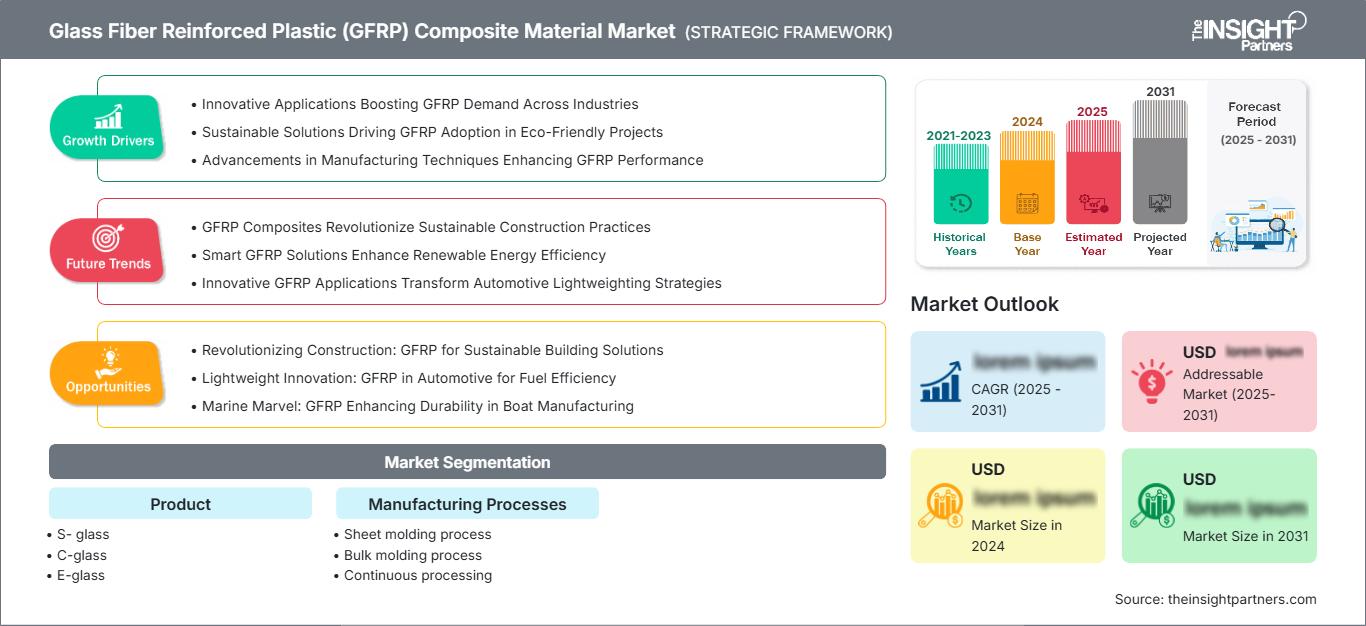
Modern engineering keeps demanding materials that are strong yet light. Aircraft, wind turbines and cars all need parts that hold up under stress without adding unnecessary weight. The market was valued at US$ 22.05 Billion in 2025 and is projected to reach US$ 46.23 Billion by 2034, expanding at a CAGR of 8.57% during 2026–2034. This rapid growth reflects how widely the Glass Fiber Reinforced Plastic Composite Material Market is being adopted across industries seeking strength without added weight.
What Is Glass Fiber Reinforced Plastic?
Glass fiber reinforced plastic combines glass fibres with a polymer resin to create a composite material that is both strong and lightweight. Manufacturers use it in place of metal wherever weight savings matter without giving up structural strength.
Market Drivers
Automakers are under constant pressure to cut vehicle weight without sacrificing safety. Glass fiber reinforced plastic delivers strength close to metal at a fraction of the weight, helping manufacturers meet fuel efficiency and emissions targets. This trend is accelerating fastest in electric vehicles, where every kilogram saved extends driving range.
Request a Sample Copy of the Report: https://www.theinsightpartners.com/sample/TIPRE00016179
Wind energy is another major growth driver. Turbine blades keep getting longer to capture more wind at greater heights, and glass fiber composites remain the material of choice for these massive structures. Their strength-to-weight ratio allows blades to flex under load without breaking, which is critical for long-term turbine performance.
Construction is contributing steady demand too. Builders use glass fiber composites for structural panels, reinforcement bars and cladding, since the material resists corrosion far better than steel. This is not just a cost benefit, it is becoming essential for coastal and chemical-exposed structures where metal corrodes quickly.
What is pushing manufacturing innovation forward right now? Faster processing methods. Continuous processing and resin transfer molding are cutting production time significantly compared to older methods, letting manufacturers scale output to meet rising demand across automotive and construction sectors alike.
Segmentation Overview
Segments Covered
By Product:
E-glass leads the market by a wide margin, valued for its balance of cost and mechanical performance. S-glass follows, chosen for high-strength aerospace and defence applications. C-glass serves chemical-resistant applications, while other glass types address specialised performance needs.
By Manufacturing Process:
Continuous Processing holds a strong share, favoured for high-volume production runs. Resin Transfer Molding is growing fast, valued for precision in complex part shapes. Sheet Molding and Bulk Molding processes serve automotive and industrial parts, while Spray-Up and other processes support smaller-scale or custom projects.
By Geography:
North America, Europe, Asia Pacific, and South and Central America each show distinct growth patterns, shaped by automotive, wind energy and construction activity.
Key Market Players
- The Fibreglass Company
- AGY Holding Corp.
- Changzhou Pengyu FRP Pressure Vessel Co., Ltd.
- Delkom Group
- Gurit Holding AG
- Jushi Co., Ltd.
- Nitto Boseki Co., Ltd.
- PPG Industries, Inc.
- Saint-Gobain Vetrotex
- Taiwan Glass Industry Corporation
These companies are expanding fibre production capacity to meet growing wind energy and automotive demand. Several are investing in faster, more automated moulding technology to improve output consistency. Partnerships with turbine and vehicle manufacturers are also becoming more common, as producers work to develop application-specific composite formulations.
Sustainability and Innovation Trends
Recycling remains a challenge for glass fiber composites, since the resin and fibre are difficult to separate once cured. Manufacturers are investing in new recycling methods, including chemical breakdown processes that recover usable glass fibre from end-of-life parts. Bio-based resin systems are also drawing research interest, aimed at cutting the material’s reliance on petroleum feedstocks. Lightweighting research continues too, as producers look for ways to reduce material use while maintaining structural performance.
Buy Premium Report: https://www.theinsightpartners.com/buy/TIPRE00016179
Regional Outlook
Asia Pacific leads the market, driven by large-scale automotive and wind turbine manufacturing in China and India. North America follows, supported by strong aerospace and construction demand. Europe grows steadily too, backed by ambitious wind energy targets and vehicle lightweighting regulations. South and Central America remains a smaller market, though renewable energy investment is creating fresh opportunities.
Related Reports:
Fiber Reinforced Polymer (FRP) Panels and Sheets Market
Thermoplastic Vulcanizate (TPV) Market
About The Insight Partners
The Insight Partners is among the leading market research and consulting firms in the world. We take pride in delivering exclusive reports along with sophisticated strategic and tactical insights into the industry. Reports are generated through a combination of primary and secondary research, solely aimed at giving our clientele a knowledge-based insight into the market and domain. This is done to assist clients in making wiser business decisions. A holistic perspective in every study undertaken forms an integral part of our research methodology and makes the report unique and reliable.
Contact Us:
If you have any queries about this report or if you would like further information, please contact us:
Phone: +1-646-491-9876
E-mail: sales@theinsightpartners.com
Also Available in: Korean | German | Japanese | French | Chinese | Italian | Spanish
