Key Highlights
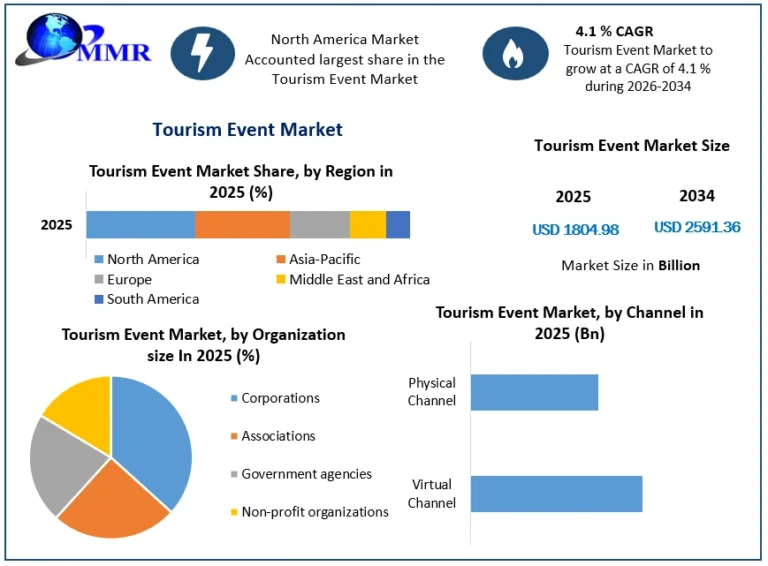
Market Growth: Valued at USD 1,804.98 billion in 2025; projected to reach USD 2,391.26 billion by 2032.
Growth Velocity: Registering a compound annual growth rate (CAGR) of 4.1% during the forecast period.
Dominant Segment: Cultural & Festival Event Tourism (Event Type); Physical Channel.
Strategic Driver: Rising international travel, destination branding initiatives, and increasing consumer demand for immersive cultural, sports, business, and entertainment experiences.
Market Constraint: Economic uncertainties, high event management costs, geopolitical disruptions, and seasonal fluctuations affecting international travel demand.
Why This Matters Now
Tourism events have become powerful economic engines that extend far beyond entertainment. Governments, destination management organizations, and private event organizers are increasingly leveraging festivals, exhibitions, sporting events, and business conferences to attract international visitors, stimulate local economies, and strengthen destination branding. As experiential travel continues to reshape global tourism, event-based travel has emerged as one of the industry’s fastest-growing opportunity segments.
Market Overview
The Tourism Event Market is undergoing significant transformation as travelers increasingly seek memorable experiences instead of traditional sightseeing. Expanding from USD 1,804.98 billion in 2025 to an estimated USD 2,391.26 billion by 2032, the market is being driven by growing disposable incomes, expanding global connectivity, and increasing investments in tourism infrastructure.
Governments and tourism authorities are investing heavily in international festivals, trade exhibitions, sporting competitions, cultural celebrations, and business conventions to attract visitors while boosting regional economic development. At the same time, digital marketing, social media promotion, and online ticketing platforms are helping event organizers reach broader global audiences than ever before.
Key Trends Driving Growth
Experiential tourism continues to redefine consumer travel behavior. Modern travelers increasingly prioritize authentic cultural festivals, music concerts, sporting championships, culinary experiences, and business networking events that create lasting memories beyond traditional vacations.
Technology is also transforming event tourism through digital ticketing, AI-powered marketing campaigns, virtual event previews, mobile event applications, and personalized travel experiences. These innovations improve visitor engagement while helping organizers maximize attendance and operational efficiency.
Sustainability has become another defining trend, with organizers implementing eco-friendly event management practices, supporting local communities, reducing environmental impact, and promoting responsible tourism to attract environmentally conscious travelers.
Segment Insights
Dominant Segment (Event Type): Cultural and Festival Event Tourism continues to lead the market by attracting millions of domestic and international visitors seeking authentic cultural experiences, heritage celebrations, and local traditions.
Dominant Segment (Channel): Physical events remain the primary revenue generator as travelers continue to value face-to-face experiences, networking opportunities, and destination immersion despite the growth of virtual alternatives.
Emerging Competitive Segment: Hybrid and virtual event platforms are rapidly gaining popularity by expanding audience reach, improving accessibility, and creating additional revenue opportunities for organizers while complementing traditional in-person experiences.
Regional Growth Story
Europe continues to represent one of the largest Tourism Event Markets due to its rich cultural heritage, internationally recognized festivals, world-class sporting events, and extensive tourism infrastructure. Meanwhile, Asia Pacific is expected to witness the fastest growth, supported by expanding middle-class populations, government tourism initiatives, increasing international connectivity, and rising investments in destination development across countries such as China, India, Japan, and Southeast Asia.
North America also remains a major contributor, driven by large-scale business conferences, entertainment events, exhibitions, and international sporting competitions that attract millions of global visitors annually.
Competitive Landscape
The Tourism Event Market is highly competitive, with leading event organizers focusing on strategic partnerships, digital transformation, international expansion, and innovative visitor experiences.
Companies are investing in advanced event technologies, destination marketing strategies, sustainable event management, and hybrid event formats to strengthen their competitive position.
Key players include:
- Reed Exhibitions
- Informa Markets
- Messe Frankfurt
- Clarion Events
- Emerald Expositions
- ITE Group
- Tarsus Group
- GL Events
- Comexposium
- Messe München
- Fiera Milano
- Koelnmesse
- Messe Düsseldorf
- Easyfairs
- Deutsche Messe
- Messe Berlin
- U.S. Sports Congress
- International Association of Exhibitions and Events (IAEE)
- Professional Convention Management Association (PCMA)
Recent Developments
- Increased investment in hybrid event platforms combining physical and virtual participation.
- Growing partnerships between tourism boards, airlines, hotels, and event organizers to strengthen destination marketing.
- Rising adoption of AI-powered digital marketing and personalized visitor engagement technologies.
- Greater emphasis on sustainable event management practices, including waste reduction, local sourcing, and carbon footprint minimization.
Strategic Implications
Future market success will depend on creating immersive visitor experiences while integrating digital innovation and sustainable tourism practices. Event organizers that successfully combine destination branding, advanced technology, strategic partnerships, and environmentally responsible operations will strengthen their competitive advantage. Diversifying revenue streams through sponsorships, online registrations, and hybrid event formats will further enhance long-term resilience.
Future Outlook
The Tourism Event Market is expected to maintain steady growth through 2032 as experiential travel, international tourism recovery, and digital event innovation continue to reshape the global industry. Organizations investing in smart event technologies, sustainable destination development, and personalized visitor experiences will be well positioned to capitalize on long-term market opportunities.
Analyst Perspective
“The Tourism Event Market is rapidly evolving as travelers increasingly seek authentic, experience-driven journeys that combine culture, entertainment, business, and community engagement. Organizations that embrace digital innovation, sustainable event management, and strategic destination partnerships will be best positioned to capitalize on the growing global demand for immersive tourism experiences through 2032,” says Siddhi Dole, Analyst at Maximize Market Research.
About Maximize Market Research
Maximize Market Research Pvt. Ltd. (MMR) is a global market research and consulting company that provides reliable, data-focused, and practical business insights. The firm serves a wide range of industries, including healthcare, pharmaceuticals, technology, automotive, electronics, chemicals, personal care, and consumer goods. Through market forecasts, competitive analysis, strategic consulting, and industry impact assessments, MMR helps organizations understand changing market conditions, identify growth opportunities, and make informed business decisions for long-term success.
2nd Floor, Navale IT Park Phase 3
Pune Bangalore Highway, Narhe
Pune, Maharashtra 411041, India
+91 9607365656
sales@maximizemarketresearch.com
