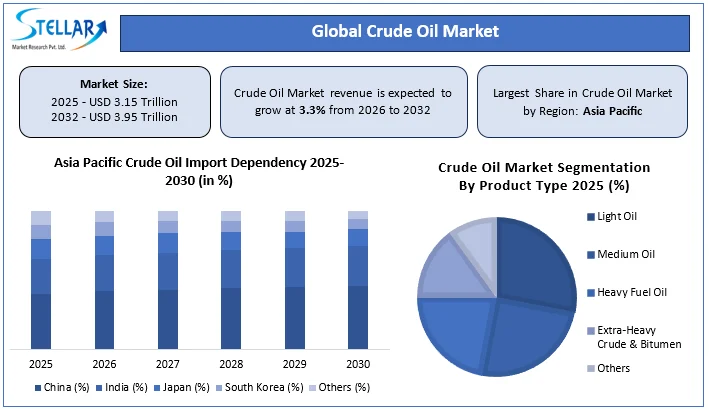
Crude Oil Market is projected to grow from USD 3.15 trillion in 2025 to USD 3.95 trillion by 2032 at a CAGR of 3.3%.
The Crude Oil Market remains a cornerstone of the global energy ecosystem as industries, transportation networks, and economies continue relying on petroleum products for power generation, mobility, and manufacturing. Despite accelerating renewable energy adoption and electric vehicle expansion, crude oil continues to play a critical role in meeting global energy demand, particularly across emerging economies. Changing supply chains, geopolitical developments, refinery investments, and evolving energy policies are reshaping the future outlook of the industry. According to Stellar Market Research, the Crude Oil Market is expected to witness continued transformation during the forecast period, driven by energy security priorities, technological advancements, and shifting consumption patterns. Global oil markets are currently undergoing structural changes as supply growth, demand trends, and investment strategies evolve.
𝐃𝐨𝐰𝐧𝐥𝐨𝐚𝐝 𝐅𝐫𝐞𝐞 𝐏𝐃𝐅 𝐁𝐫𝐨𝐜𝐡𝐮𝐫𝐞: https://www.stellarmr.com/report/req_sample/crude-oil-market/2903
Understanding the Crude Oil Market
Crude oil is a naturally occurring fossil fuel extracted from underground reservoirs and processed into various petroleum products, including gasoline, diesel, jet fuel, lubricants, petrochemicals, and industrial fuels. It remains one of the most traded commodities globally and serves as a fundamental input for transportation, chemicals, manufacturing, and energy production.
The crude oil industry includes exploration, extraction, refining, transportation, storage, and distribution activities. Market performance is influenced by multiple factors such as global economic growth, production levels, geopolitical conditions, technological developments, environmental regulations, and energy transition strategies.
Although renewable energy sources are gaining momentum, crude oil continues to maintain strategic importance due to its extensive infrastructure, established supply chains, and widespread industrial applications. Emerging economies with expanding transportation networks and industrial sectors continue generating significant oil demand. (IEA)
Key Factors Driving Crude Oil Market Growth
Rising Energy Demand from Emerging Economies
Growing industrialization, urbanization, and economic development in emerging markets continue supporting crude oil demand.
Countries across Asia Pacific, the Middle East, and Africa are witnessing increased energy consumption due to expanding manufacturing activities, infrastructure development, transportation growth, and rising living standards.
Rapid growth in aviation, logistics, and commercial transportation is also contributing to continued petroleum consumption, particularly in regions where alternative energy infrastructure is still developing.
Expanding Petrochemical Industry Applications
Beyond transportation fuels, crude oil serves as a major feedstock for petrochemical production.
Increasing demand for plastics, synthetic materials, fertilizers, chemicals, packaging materials, and industrial products is supporting crude oil consumption. Petrochemical demand is becoming an increasingly important growth driver as fuel efficiency improvements and electrification influence traditional transportation fuel demand.
According to global energy assessments, petrochemical feedstocks are expected to represent a growing share of future oil consumption as industrial applications continue expanding. (IEA)
Energy Security and Strategic Oil Investments
Energy security remains a major priority for governments and industries worldwide.
Countries are investing in domestic exploration, strategic petroleum reserves, refinery modernization, and diversified supply chains to reduce vulnerability to supply disruptions.
Recent geopolitical uncertainties have highlighted the importance of stable oil supply networks and resilient energy infrastructure.
Crude Oil Market Segmentation
The Crude Oil Market can be segmented based on product type, source, application, and region.
By Product Type
Major crude oil categories include:
Light Crude Oil
Medium Crude Oil
Heavy Crude Oil
Light Crude Oil Maintains Strong Demand
Light crude oil remains highly preferred due to its lower sulfur content, easier refining process, and suitability for producing transportation fuels such as gasoline and diesel.
However, heavy crude oil continues playing an important role in regions with large reserves and established refining capabilities.
By Source
The market includes:
Conventional Oil
Unconventional Oil
Conventional Oil Dominates Production
Conventional crude oil continues accounting for a significant share of global production due to mature infrastructure and established extraction technologies.
However, unconventional sources, including shale oil, are gaining importance, particularly in North America, due to advancements in hydraulic fracturing and horizontal drilling technologies.
Technology Trends Transforming the Oil Industry
Digital Oilfields and Artificial Intelligence
Digital transformation is reshaping oil exploration and production activities.
Companies are adopting artificial intelligence, machine learning, sensors, and data analytics to improve reservoir management, optimize drilling operations, reduce downtime, and enhance safety.
Digital oilfield technologies enable real-time monitoring and predictive maintenance, improving operational efficiency across upstream activities.
Advanced Exploration Technologies
Modern seismic imaging, automation, and remote monitoring systems are improving the accuracy of oil exploration.
These technologies allow companies to identify reserves more efficiently while reducing exploration risks and operational costs.
Carbon Management and Cleaner Production
Oil companies are increasingly investing in carbon capture, utilization and storage (CCUS), methane reduction technologies, and energy-efficient operations.
These initiatives aim to reduce environmental impact while maintaining the economic importance of oil resources during the global energy transition.
Sustainability and Regulatory Landscape
The crude oil industry is undergoing significant regulatory transformation due to climate commitments and environmental concerns.
Governments are introducing stricter emissions standards, carbon pricing mechanisms, methane reduction policies, and sustainability reporting requirements.
Oil producers are responding by investing in cleaner production methods, renewable energy integration, emissions monitoring systems, and carbon reduction technologies.
The energy transition is encouraging companies to balance traditional oil production with investments in low-carbon technologies and diversified energy portfolios.
Regional Market Outlook
Middle East
The Middle East remains one of the most influential regions in the global crude oil market due to extensive reserves, large-scale production capacity, and established export infrastructure.
Countries such as Saudi Arabia, the United Arab Emirates, and Iraq continue investing in production expansion, refinery development, and energy diversification strategies.
North America
North America remains a major contributor to global oil production, supported by advanced shale extraction technologies and significant upstream investments.
The United States continues playing a key role in global supply growth through unconventional oil production.
Asia Pacific
Asia Pacific represents one of the largest crude oil consumption regions due to rapid industrial growth, transportation expansion, and rising energy demand.
China and India remain major oil consumers, although increasing electric mobility adoption and renewable energy deployment are gradually influencing long-term demand patterns.
Market Challenges
Despite continued importance, the Crude Oil Market faces several challenges:
Volatile crude oil prices
Geopolitical supply disruptions
Increasing environmental regulations
Competition from renewable energy
Growing electric vehicle adoption
Price fluctuations caused by supply-demand imbalances, production decisions, and geopolitical events continue creating uncertainty for producers and investors.
Additionally, global decarbonization efforts are encouraging industries to reduce dependence on fossil fuels over the long term.
Competitive Landscape
The Crude Oil Market includes major integrated energy companies, national oil companies, and independent producers competing through production expansion, technology adoption, and operational efficiency.
Key industry participants include:
Saudi Aramco
ExxonMobil
Chevron Corporation
Shell plc
BP plc
TotalEnergies
PetroChina
Rosneft
Equinor
ConocoPhillips
Leading companies are focusing on improving production efficiency, expanding refining capacity, investing in digital technologies, and developing lower-carbon energy solutions.
𝐃𝐨𝐰𝐧𝐥𝐨𝐚𝐝 𝐅𝐫𝐞𝐞 𝐏𝐃𝐅 𝐁𝐫𝐨𝐜𝐡𝐮𝐫𝐞: https://www.stellarmr.com/report/req_sample/crude-oil-market/2903
Future Outlook
The Crude Oil Market is expected to remain strategically important throughout the forecast period as global economies continue balancing energy security, affordability, and sustainability objectives.
Future market growth will depend on evolving demand patterns, production strategies, technological innovation, and the pace of global energy transition. While renewable energy and electrification will gradually reshape consumption trends, crude oil will continue supporting transportation, petrochemicals, and industrial applications.
Companies that successfully integrate advanced technologies, improve operational efficiency, and adopt sustainable practices will be better positioned to navigate the changing global energy landscape.
Media Contact
Stellar Market Research
Website: Stellar Market Research – Global Research Reports & Consulting
Email: sales@stellarmr.com
