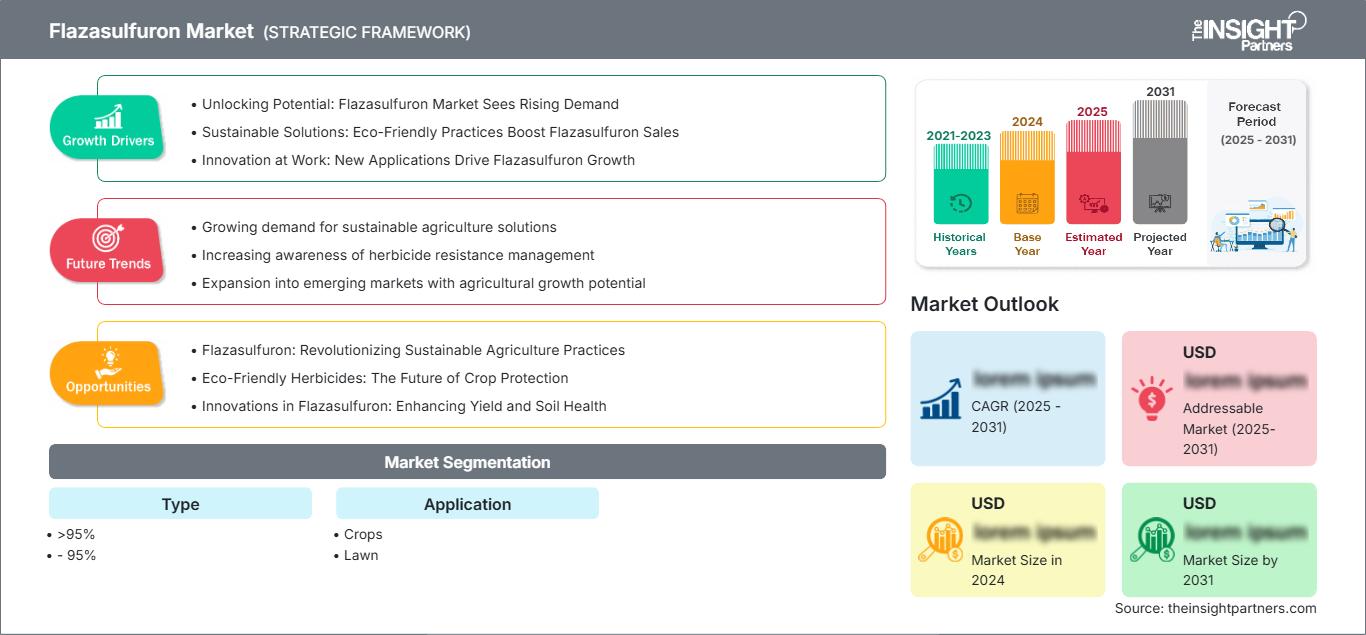
A single weed can choke out a season’s yield. Farmers know this, and so do golf course managers fighting stubborn turf grass. That pressure keeps demand steady for one sulfonylurea herbicide. The Flazasulfuron Market is expected to reach US$ 269.45 Million by 2034, up from US$ 163.74 Million in 2025. The market is set to grow at a CAGR of 5.69% from 2026 to 2034. That growth rate outpaces many older herbicide categories, and there is a clear reason why.
What Is Flazasulfuron?
Flazasulfuron is a selective herbicide from the sulfonylurea family. It targets grassy and broadleaf weeds at very low application rates. Farmers and turf managers use it because small doses go a long way.
What Is Driving Demand for Flazasulfuron?
Weed resistance is reshaping how farmers choose herbicides. Many older active ingredients no longer work as well as they once did. Flazasulfuron offers a fresh mode of action, so it fits neatly into resistance management programmes. Agronomists now rotate it with other chemistries to slow resistance buildup, and that rotation strategy is fuelling steady purchase volumes.
Request a Sample Copy of the Report: https://www.theinsightpartners.com/sample/TIPRE00016605
Turf management is another strong pull. Golf courses, sports fields, and municipal lawns need weed control that will not scar fine grass species. Flazasulfuron handles this well, clearing invasive grasses like bermudagrass without harming desirable turf. As golf course budgets recover and sports infrastructure expands across Asia, this segment keeps climbing.
Crop protection remains the largest overall application. Vineyards, orchards, and row crops use flazasulfuron for pre- and post-emergence control. What makes this particularly significant is the shift toward precision application. Farmers now use lower doses with better targeting equipment, so total volume grows even as per-hectare use holds steady or falls.
Regulatory pressure cuts both ways here. Some regions are tightening approval for older herbicide chemistries, which pushes buyers toward newer, more targeted options. Flazasulfuron benefits from that shift, though manufacturers still face registration hurdles in a handful of markets. Beyond regulation, rising input costs for farmers are pushing interest toward products that deliver strong results at low application rates. That efficiency argument sits at the centre of flazasulfuron’s growth story.
Segments Covered
By Type:
- 95%
- <95%
By Application:
- Crops
- Lawn
- Others
The higher-purity grade, above 95%, dominates sales because it suits large-scale crop protection formulations where consistency matters most. The lower-purity grade still holds a place in cost-sensitive regional markets. On application, crops lead by a wide margin, though lawn and turf use is growing at a noticeably faster pace.
Key Market Players
- HISUN
- ISK
- Nanjing Red Sun
- REPONT
This is a concentrated market. A small group of manufacturers, mostly based in Asia, controls most global supply. ISK, a Japanese firm, originally developed the compound and still holds strong technical credibility. Chinese producers like HISUN and Nanjing Red Sun have scaled up capacity fast, pushing prices down and widening access for smaller distributors worldwide.
Buy Premium Report: https://www.theinsightpartners.com/buy/TIPRE00016605
Sustainability and Innovation Trends
Low-dose herbicides are gaining favour for a simple reason. They cut chemical load per hectare, which appeals to both regulators and environmentally conscious growers. Flazasulfuron’s efficacy at gram-level doses puts it ahead of bulkier alternatives on this front.
Manufacturers are also investing in improved formulations, including water-dispersible granules that reduce drift and improve handler safety. Some players are exploring combination products that pair flazasulfuron with complementary active ingredients, extending weed control spectrum while keeping total chemical volume in check.
Regional Outlook
Asia Pacific leads production and consumption, driven by China’s dominant manufacturing base and expanding vineyard and orchard acreage across the region. Europe follows, where strict pesticide regulation has actually pushed some growers toward flazasulfuron as an approved, lower-dose alternative. North America shows steady demand from turf management and specialty crop segments, particularly in golf-heavy states. South and Central America remain a smaller but promising market, with vineyard expansion in countries like Chile creating fresh opportunities.
Related Reports:
Agricultural Biologicals Market
About The Insight Partners
The Insight Partners is among the leading market research and consulting firms in the world. We take pride in delivering exclusive reports along with sophisticated strategic and tactical insights into the industry. Reports are generated through a combination of primary and secondary research, solely aimed at giving our clientele a knowledge-based insight into the market and domain. This is done to assist clients in making wiser business decisions. A holistic perspective in every study undertaken forms an integral part of our research methodology and makes the report unique and reliable.
Contact Us:
If you have any queries about this report or if you would like further information, please contact us:
Phone: +1-646-491-9876
E-mail: sales@theinsightpartners.com
Also Available in: Korean | German | Japanese | French | Chinese | Italian | Spanish
