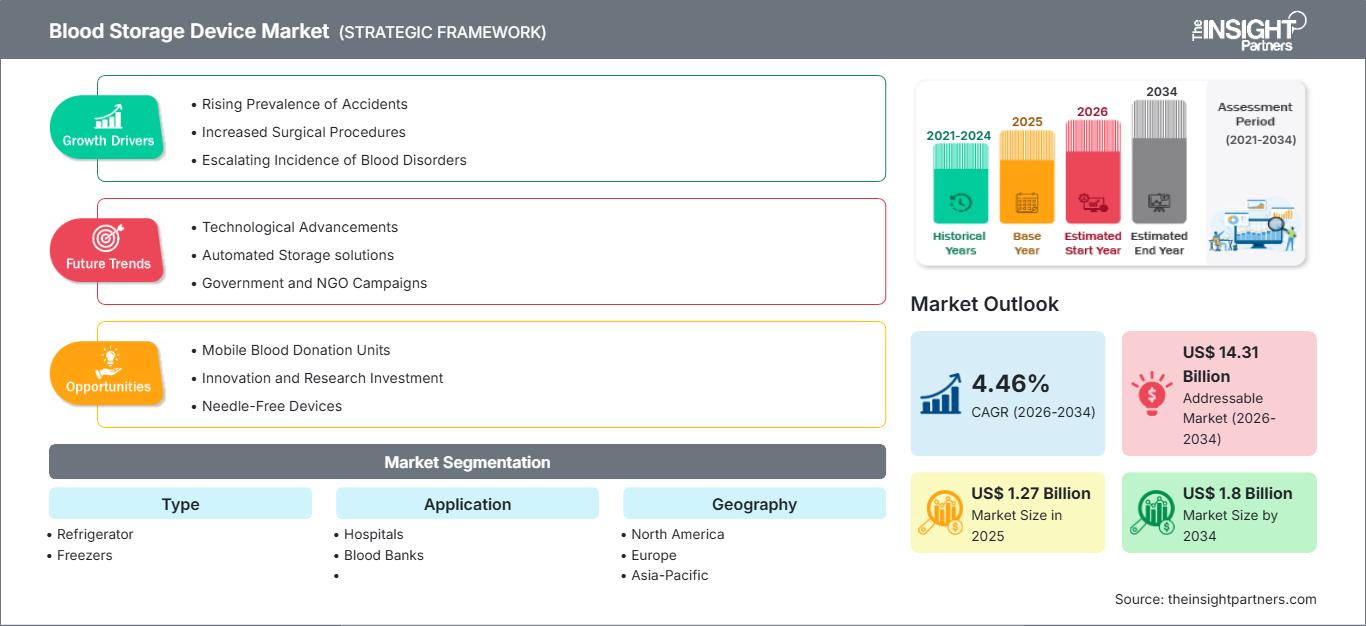
The Blood Storage Device Market size is forecasted to increase from US$ 1.27 Billion in 2025 to reach US$ 1.8 Billion in 2034 at a CAGR of 4.46% between 2026 and 2034.
Blood storage devices are designed to maintain controlled conditions for blood, plasma, and other blood components until they are required for transfusion or related applications. The market includes equipment used by blood banks, hospitals, diagnostic facilities, and other healthcare settings. Growing attention toward safe blood handling and preservation is creating sustained demand for specialized storage equipment.
Get Sample PDF – https://www.theinsightpartners.com/sample/TIPRE00022294
Increasing Need for Safe Blood Storage
Blood and blood components require carefully controlled storage conditions to maintain their quality and suitability for use. Temperature fluctuations and improper storage can compromise blood products, making reliable refrigeration and monitoring equipment essential for healthcare facilities.
As blood banks and hospitals manage inventories of different blood components, dependable storage infrastructure becomes increasingly important. The need to preserve stored products for appropriate periods while maintaining required environmental conditions is supporting investments in dedicated blood storage equipment.
Rising Demand for Blood Transfusions
The demand for blood storage solutions is closely connected with the need for blood transfusions in healthcare systems. Blood products are used in a range of medical situations, creating an ongoing requirement for appropriate storage capacity and temperature-controlled equipment.
Hospitals and blood banks need reliable systems to store collected blood and components before distribution or transfusion. As healthcare providers strengthen their blood-management infrastructure, demand for specialized storage devices is expected to remain steady. Efficient storage also supports inventory management by helping facilities organize and maintain blood products according to their respective storage requirements.
Technological Advancements in Storage Equipment
Technological developments are improving the functionality of blood storage devices. Modern equipment can incorporate temperature control, monitoring systems, alarms, and other features designed to support safe storage conditions. These capabilities can help healthcare professionals identify deviations from required conditions and respond appropriately.
Temperature monitoring is particularly important because maintaining appropriate conditions is essential for preserving blood products. Manufacturers are therefore focusing on equipment that provides consistent temperature control and improved monitoring capabilities. The integration of advanced monitoring technologies can further support operational efficiency in blood banks and healthcare facilities.
Growing Importance of Blood Bank Infrastructure
Blood banks represent an important end-user environment for specialized storage devices. These facilities require reliable refrigeration and controlled storage solutions to manage blood inventories efficiently. Improvements in healthcare infrastructure and the development of blood collection and transfusion services are contributing to demand for dedicated storage equipment.
Hospitals also require appropriate storage capacity to ensure blood products are readily available when needed. Expansion of healthcare facilities and modernization of existing infrastructure can create opportunities for manufacturers supplying blood storage equipment.
Focus on Quality and Regulatory Compliance
Maintaining the quality of stored blood products is a major consideration for healthcare organizations. Blood storage devices must provide dependable environmental conditions to minimize risks associated with inappropriate storage. This focus is encouraging healthcare facilities to select specialized equipment designed for blood storage rather than relying on conventional refrigeration systems.
Monitoring and alarm capabilities can also support quality-management practices by providing notifications when storage conditions move outside predefined parameters. Such features can help healthcare professionals take timely corrective action and maintain appropriate storage conditions.
Competitive Landscape and Top Players
The blood storage device market includes established healthcare, laboratory equipment, and refrigeration technology companies. Key players include:
- Thermo Fisher Scientific Inc.
- Blue Star Limited
- Helmer Scientific Inc.
- Vestfrost Solutions A/S
- Philipp Kirsch GmbH
- Zhongke Meiling Cryogenics Company Limited
- LEC Medical
- Qingdao Haier Biomedical Co., Ltd.
- Abbott Diagnostics Inc.
- Beckman Coulter, Inc.
These companies compete through product development, temperature-control technologies, monitoring capabilities, equipment reliability, and expansion of solutions designed for healthcare and laboratory environments.
Demand for Reliable Temperature Control
Temperature control remains a central requirement for blood storage. Storage equipment must maintain appropriate conditions consistently to help preserve blood products during the required storage period. As healthcare providers focus on improving blood-management practices, demand for reliable temperature-controlled systems is expected to continue.
Advanced monitoring can also provide healthcare workers with greater visibility into storage conditions. Equipment equipped with alarms and monitoring functions can support proactive management and help facilities respond to potential temperature deviations. These capabilities are increasingly relevant as healthcare organizations seek to strengthen quality and safety across blood storage processes.
Opportunities from Healthcare Infrastructure Development
Expansion and modernization of healthcare infrastructure can provide additional opportunities for the market. Developing healthcare systems require investments in equipment that supports blood collection, storage, distribution, and transfusion services. New hospitals, diagnostic facilities, and blood banks can therefore contribute to demand for specialized storage solutions.
Get Full Copy of This Report @ https://www.theinsightpartners.com/buy/TIPRE00022294
At the same time, replacement of older equipment with modern systems can create opportunities in established healthcare markets. Facilities may upgrade their storage infrastructure to obtain improved temperature management, monitoring, energy efficiency, and operational reliability.
Future Outlook
The future of the blood storage device market is expected to be shaped by continued demand for safe blood management, improvements in healthcare infrastructure, and technological advancements in temperature-controlled storage. Blood banks and hospitals will continue to require dependable equipment capable of maintaining appropriate storage conditions and supporting effective inventory management.
The adoption of advanced monitoring and alarm technologies is expected to remain an important area of development. Manufacturers that focus on reliable temperature control, monitoring capabilities, equipment performance, and solutions suited to evolving healthcare requirements can find opportunities for continued expansion. With the market forecast to reach US$ 1.8 billion by 2034, ongoing investment in blood storage infrastructure is expected to support steady market development through the forecast period.
Related Reports @
Blood Bank Refrigerators Market Growth, Size & Forecast by 2034
Blood Banking Devices Market Statistics, Trends, Size, Share, Analysis, Key Players by 2031
About Us –
The Insight Partners provides comprehensive syndicated and tailored market research services in the healthcare, technology, and industrial domains. Renowned for delivering strategic intelligence and practical insights, the firm empowers businesses to remain competitive in ever-evolving global markets.
Contact Us:
Contact Person: Ankit Mathur
E-mail: ankit.mathur@theinsightpartners.com
Phone: +1-646-491-9876
Also Available in : Korean German Japanese French Chinese Italian Spanish
