Key Highlights
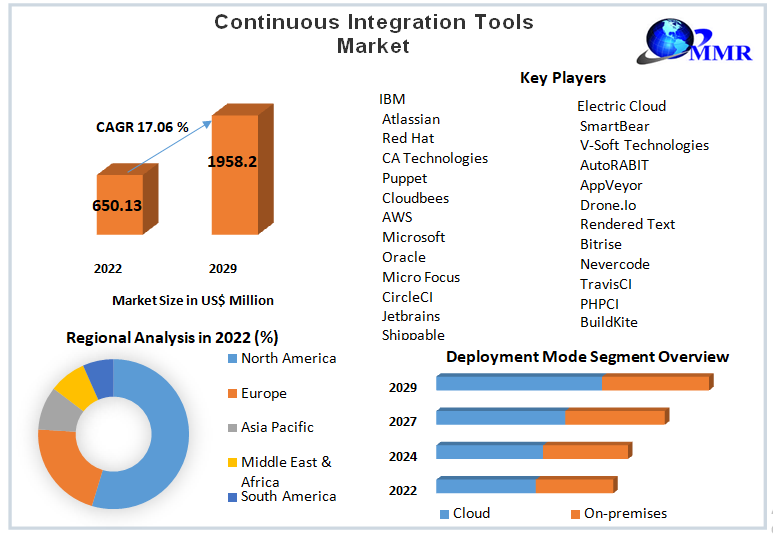
- The Global Continuous Integration Tools Market was valued at USD 1,072.5 Mn in 2025.
- The market is projected to reach USD 5,017.12 Mn by 2034.
- Revenue is expected to grow at a CAGR of 18.7% between 2026 and 2034.
- AI-powered software development is accelerating enterprise adoption of Continuous Integration platforms.
- Cloud-native application development continues to reshape enterprise software delivery.
- DevOps automation is becoming a strategic technology investment across industries.
Why This Matters Now
Artificial intelligence is changing software development faster than most enterprise technology roadmaps anticipated. Organizations are under pressure to release secure applications more frequently while reducing operational complexity, making Continuous Integration tools a strategic capability rather than simply a developer productivity solution.
The Continuous Integration Tools Market Size reflects this transition. Valued at USD 1,072.5 Mn in 2025, the market is expected to reach USD 5,017.12 Mn by 2034, expanding at a CAGR of 18.7% from 2026 to 2034. That growth signals rising enterprise investment in automated software delivery, cloud-native development, and AI-enabled engineering workflows.
Market Overview
Continuous Integration tools automate the process of integrating code changes, running tests, identifying defects, and preparing applications for deployment. They form the operational foundation of modern DevOps practices by enabling development teams to deliver software more rapidly while maintaining quality and security.
The market’s projected increase from USD 1,072.5 Mn in 2025 to USD 5,017.12 Mn in 2034 represents more than software spending growth. It demonstrates how enterprises are redesigning software engineering around automation, continuous testing, cloud infrastructure, and increasingly AI-assisted development.
Technology leaders are now evaluating CI platforms not only on build speed but also on integration with cloud services, developer experience, cybersecurity workflows, API ecosystems, and AI-driven automation capabilities.
Key Trends Driving Growth
Artificial intelligence is becoming deeply integrated into software engineering workflows. Development teams increasingly use AI-assisted coding, automated testing, and intelligent code analysis, creating stronger demand for Continuous Integration platforms capable of managing higher development velocity.
Cloud migration remains another major catalyst. Enterprises modernizing legacy applications are adopting cloud-native architectures that require automated build, testing, and deployment pipelines. Continuous Integration platforms simplify this transition by supporting standardized workflows across distributed development environments.
Digital transformation initiatives continue expanding across financial services, healthcare, manufacturing, retail, telecommunications, and public sector organizations. Software has become central to customer engagement, operational efficiency, and digital service delivery, increasing the strategic importance of rapid software release cycles.
Cybersecurity has also become integrated into software delivery. Organizations increasingly incorporate security validation within development pipelines to identify vulnerabilities earlier in the software lifecycle. This shift supports broader DevSecOps adoption and strengthens demand for enterprise-grade CI platforms.
Automation is equally reshaping enterprise software operations. Organizations seek to eliminate manual deployment processes, reduce release risks, and improve engineering productivity. Continuous Integration technologies enable these objectives while supporting scalable software modernization strategies.
Segment Insights
- Dominant Segment: The report identifies the dominant market segment, highlighting its leadership in enterprise adoption and revenue contribution.
- Fastest-Growing Segment: The report identifies the fastest-growing segment, reflecting accelerating demand driven by modern software delivery requirements.
- Continuous Integration adoption continues expanding across organizations pursuing digital transformation initiatives.
- Enterprise demand is increasingly centered on cloud-native application development, automation platforms, and integrated DevOps ecosystems.
- AI-enabled development environments are creating new opportunities for Continuous Integration solution providers to differentiate through intelligent automation.
Regional Growth Story
North America continues to benefit from mature cloud adoption, extensive enterprise software investment, advanced DevOps implementation, and significant AI innovation. Technology companies across the United States remain among the earliest adopters of Continuous Integration automation, supporting sustained market leadership.
Europe continues investing in enterprise software modernization alongside increasing emphasis on cybersecurity, digital sovereignty, and cloud adoption. Germany and the United Kingdom remain important markets as enterprises modernize mission-critical applications while strengthening software governance.
Asia-Pacific represents one of the most dynamic technology investment environments. China, India, Japan, and South Korea continue expanding digital infrastructure, enterprise cloud deployment, software engineering capabilities, and AI implementation. These investments create favorable conditions for broader adoption of Continuous Integration technologies.
Emerging economies are also expanding software development ecosystems as organizations accelerate digital transformation initiatives across financial services, telecommunications, manufacturing, healthcare, and government sectors.
Competitive Landscape
Competition within the Continuous Integration Tools Market increasingly reflects a broader platform battle rather than isolated software functionality. Vendors are positioning Continuous Integration as part of comprehensive DevOps ecosystems that combine automation, cloud management, security integration, AI capabilities, and software lifecycle management.
Platform integration has become a major competitive advantage. Organizations increasingly prefer vendors capable of connecting Continuous Integration with source code management, automated testing, deployment automation, infrastructure orchestration, monitoring, and security platforms. This strengthens customer retention while expanding ecosystem value.
Artificial intelligence is becoming another critical competitive differentiator. Vendors investing in intelligent testing, predictive analytics, automated troubleshooting, and AI-assisted development workflows are positioning themselves for the next phase of enterprise software engineering.
Cloud providers also influence competitive dynamics. As enterprises adopt hybrid cloud and multi-cloud strategies, Continuous Integration vendors that deliver seamless interoperability across cloud environments improve their strategic relevance.
The competitive landscape therefore signals an industry shifting toward integrated software engineering platforms where automation, intelligence, security, and developer productivity increasingly determine long-term market leadership.
Recent Developments
- AI capabilities continue expanding across enterprise software development workflows.
- Organizations are accelerating DevOps adoption to improve software delivery efficiency.
- Cloud-native application development continues driving demand for automated CI/CD platforms.
- Enterprise software modernization remains a major investment priority.
- Automation and DevSecOps integration continue strengthening Continuous Integration platform adoption.
Strategic Implications
Technology executives increasingly recognize that software delivery speed directly influences business competitiveness. Continuous Integration has evolved from a developer productivity tool into enterprise digital infrastructure supporting innovation, customer experience, cybersecurity resilience, and operational efficiency.
For investors, sustained double-digit market growth reflects structural demand rather than temporary technology adoption cycles. Organizations across industries continue increasing software investments as digital services become central to competitive differentiation.
Cloud providers, enterprise software vendors, and telecommunications companies also benefit from stronger Continuous Integration adoption because automated software delivery accelerates platform innovation while improving service reliability.
Technology suppliers capable of integrating AI, security, automation, and cloud-native capabilities within unified DevOps ecosystems are likely to strengthen competitive positioning as enterprise software environments become increasingly complex.
Future Outlook
The next decade will be defined by intelligent software engineering rather than simply faster software development. AI-assisted coding, automated quality assurance, cloud-native deployment, cybersecurity integration, and platform-based DevOps will reshape enterprise technology investment priorities.
As organizations scale digital transformation initiatives, Continuous Integration platforms will become foundational components of enterprise software strategy. Their value will increasingly extend beyond development teams into broader business resilience, operational agility, customer experience, and innovation capacity.
The organizations that combine AI-powered Continuous Integration with cloud-native automation and integrated DevSecOps will define the next generation of digital leadership, while those relying on fragmented manual development processes risk falling permanently behind.
Analyst Perspective
“The Continuous Integration Tools Market is entering a phase where AI, cloud-native development, and enterprise automation are converging into a single software delivery ecosystem. Organizations investing in intelligent DevOps platforms today will be better positioned to accelerate innovation, strengthen cybersecurity resilience, and compete in increasingly software-defined industries.” — Yash Ghosalkar, Analyst
About Maximize Market Research
Maximize Market Research Pvt. Ltd. (MMR) is a global market research and consulting company that provides reliable, data-focused, and practical business insights. The firm serves a wide range of industries, including healthcare, pharmaceuticals, technology, automotive, electronics, chemicals, personal care, and consumer goods. Through market forecasts, competitive analysis, strategic consulting, and industry impact assessments, MMR helps organizations understand changing market conditions, identify growth opportunities, and make informed business decisions for long-term success.
2nd Floor, Navale IT Park Phase 3
Pune Banglore Highway, Narhe
Pune, Maharashtra 411041, India
+91 9607365656
sales@maximizemarketresearch.com
