Key Highlights
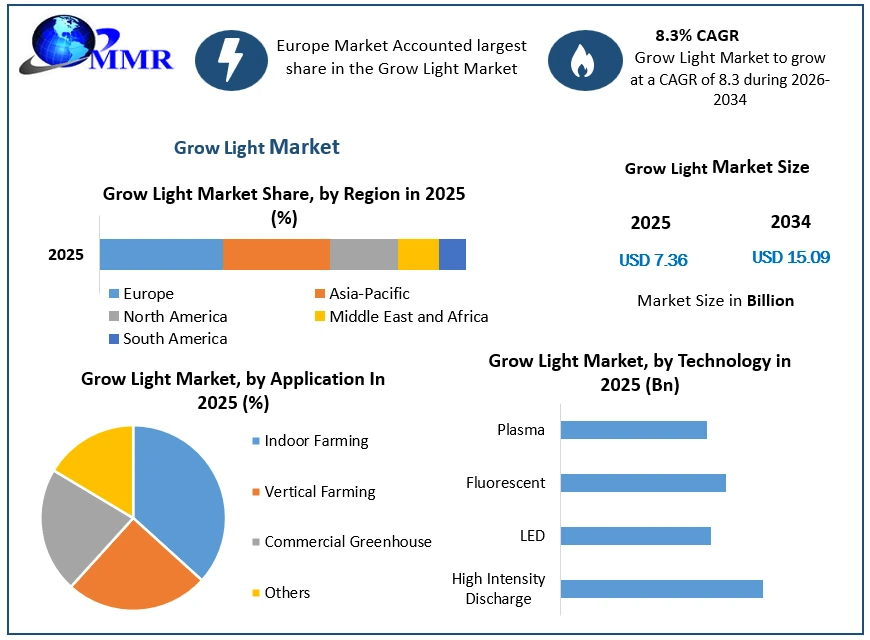
Rapid Expansion: The global market valuation is expected to double from USD 7.36 billion in 2025 to USD 15.09 billion by 2034, reflecting an 8.3% CAGR.
LED Dominance: Light Emitting Diode (LED) systems have surpassed legacy High-Intensity Discharge (HID) and Fluorescent (FL) fixtures as the primary technology choice due to a 50,000-hour operational life and custom spectrum tuning.
Low-Wattage Dominance: The under-300-watt segment leads the market, favored by small-scale urban cultivators and vertical farming shelf setups for its lower thermal output and reduced initial capital requirements.
Cannabis Legalization: Policy shifts and commercial decriminalization of cannabis cultivation across North America and parts of Europe have accelerated the demand for high-precision, low-heat indoor lighting arrays.
Why This Matters Now
Industrial food production faces a critical inflection point as the depletion of fertile topsoil and unpredictable climate patterns disrupt open-field agriculture. Commercial agricultural operators, real estate developers, and utility providers must recognize that artificial lighting is no longer just a seasonal supplement, but rather the foundational infrastructure for year-round food security.
With urban populations projected to grow rapidly, the transition to dense vertical farming systems requires immediate capital investment in high-efficiency solid-state lighting. For chemical and electronics manufacturers, this structural pivot translates to a massive, sustained demand for advanced optical-grade polymers, high-performance thermal interface materials, and specialized semiconductor substrates.
Market Overview
The Grow Light Market transition toward controlled environment agriculture (CEA) is reshaping the global agribusiness landscape. Traditional outdoor farming remains highly vulnerable to extreme weather events, pest outbreaks, and freshwater scarcity.
To mitigate these supply chain risks, commercial growers are rapidly adopting vertical farms and automated greenhouses. These facilities rely entirely on artificial light sources to trigger and sustain photosynthesis, extending photoperiods and maximizing crop yields per square meter.
High-intensity discharge (HID) lamps, such as high-pressure sodium (HPS) and metal-halide (MH) systems, long served as the industry benchmark due to low initial purchase costs. However, their high power consumption and intense thermal radiation create severe operational inefficiencies.
Growers must run high-capacity heating, ventilation, and air conditioning (HVAC) systems to dissipate the heat generated by HID lamps, which significantly drives up utility costs. This operational burden is driving a massive industry-wide migration toward solid-state LED systems, which convert electricity into usable photosynthetically active radiation (PAR) with minimal heat waste.
Key Trends Driving Growth
The primary driver of modern grow light adoption is the commercial scaling of vertical farming. By stacking cultivation trays vertically in repurposed warehouses, shipping containers, or high-rise urban structures, growers can achieve up to ten times the yield of traditional flat-acre farming.
This spatial optimization is impossible without low-profile, low-heat illumination systems that can be positioned inches from the plant canopy without burning the foliage.
Furthermore, the legal cannabis sector represents a major growth catalyst. In regions where cultivation has been commercialized, such as the United States and Canada, growers are aggressively investing in premium, full-spectrum LED fixtures.
These advanced lighting systems allow operators to precisely adjust blue and red light ratios at different growth phases, directly boosting THC and CBD yields. The resulting drop in production costs per pound has made energy-efficient lighting a core competitive requirement in the cannabis sector.
However, the market faces a significant hurdle in high upfront capital costs. A commercial-grade, full-spectrum LED system can cost between USD 2,000 and USD 3,000 per fixture, compared to just USD 100 to USD 150 for a standard 1,000-watt HPS setup.
This high initial investment often prevents smaller, cash-constrained farming operations from upgrading to more energy-efficient technologies. Additionally, the lack of standardized testing protocols for product lifespans in emerging markets allows some manufacturers to make exaggerated performance claims, which can erode buyer confidence.
Segment Insights
Dominant and Fastest-Growing Technology Segment: Light Emitting Diode (LED). LED systems lead the technology sector and are poised to maintain this position through 2034. Their dominance is fueled by a 30,000 to 50,000-hour operational lifespan, precise spectral customization, and low thermal emissions. These features help commercial greenhouse operators significantly reduce HVAC cooling loads and overall energy costs.
Dominant Product Segment: Under-300-Watt Systems. This category holds the largest market share due to its widespread use in urban micro-farms, home-based hobby gardens, and multi-tier vertical farming racks. These lower-wattage fixtures offer highly cost-effective thermal management and are easy to integrate into tight, stacked growing spaces.
Fastest-Growing Application Segment: Commercial Greenhouses and Vertical Farms. Driven by the rising demand for fresh, pesticide-free local produce in urban areas, commercial-scale operations are expanding rapidly, leading to high-volume procurement of advanced lighting arrays.
Regional Growth Story
North America holds a leading position in the global grow light market, driven by early investments in commercial vertical farming infrastructure and the widespread legalization of cannabis across several US states and Canada.
To lower high local energy costs, regional operators are quickly replacing legacy HPS fixtures with high-efficiency LED systems. This shift is supported by energy utility rebate programs that incentivize the installation of energy-saving horticultural equipment.
In Europe, nations like the Netherlands, Germany, and the United Kingdom are driving steady demand through large-scale commercial greenhouse operations. Dutch growers, who lead the world in high-yield export agriculture, rely heavily on hybrid lighting setups—combining existing HPS lamps with new LED toplighting—to maximize crop yields during low-light winter months.
Meanwhile, the Asia-Pacific region is experiencing the fastest growth, led by China, Japan, and South Korea. Rapidly growing urban populations and a scarcity of arable land are driving major government-backed vertical farming initiatives.
Chinese manufacturing hubs are also scaling up their domestic production of low-cost LED components, which is helping to lower global hardware prices and make advanced grow lights more accessible to emerging agricultural markets.
Competitive Landscape
The global grow light market is highly competitive and characterized by active consolidation and continuous product development. Key global players include Signify (formerly Royal Philips), General Electric Company, Gavita International B.V., LumiGrow, Inc., and Heliospectra AB.
To strengthen their market positions, these leading companies are shifting away from selling standalone fixtures to offering fully integrated, smart-control lighting solutions.
Major players are actively acquiring smaller, specialized software and sensor companies to build intelligent, closed-loop lighting platforms. These advanced systems automatically adjust spectrum outputs and light intensity in real time based on crop feedback and ambient greenhouse conditions.
By integrating sensors, wireless controllers, and cloud analytics, these companies are moving from hardware manufacturing into high-margin software-as-a-service (SaaS) models. This strategic shift helps lock in commercial growers and reduces their exposure to hardware copycats.
Recent Developments
Signify’s Greenpower Expansion: Signify expanded its Philips GreenPower LED toplighting lineup, delivering higher efficacy and integrated dimming controls to help commercial growers cut energy costs during peak tariff hours.
Heliospectra’s Smart Control Integration: Heliospectra introduced advanced wireless control modules for its commercial LED fixtures, allowing operators to run dynamic, automated light recipes tailored to specific plant growth stages.
Osram’s High-Power LED Focus: Osram upgraded its horticultural LED chip designs, improving electrical efficiency to help third-party fixture manufacturers reduce thermal management costs.
Strategic Implications
For chemical, polymer, and semiconductor manufacturers, the steady growth of the grow light market offers a valuable opportunity to supply high-performance materials. LED assemblies require specialty chemical solutions, including optical-grade polycarbonate lenses that can withstand intense UV and blue light exposure without yellowing or degrading.
At the same time, because LEDs run hot at the circuit board level, there is rising demand for advanced silicone-based thermal interface materials and high-conductivity thermal greases to safely dissipate heat and prevent premature component failure.
Additionally, the push for more sustainable and circular manufacturing processes is driving fixture designers to focus on eco-friendly product designs. Leading commercial operators are beginning to request grow lights made with recyclable aluminum housings and easily replaceable, modular LED driver boards.
This design approach prevents the need to discard an entire fixture if a single component fails. Suppliers who can offer circular, easy-to-recycle material solutions will be well-positioned to win long-term contracts with major commercial agricultural projects.
Future Outlook
The global grow light market is on track for steady, long-term growth as commercial farming operations continue to prioritize energy efficiency and automated crop management. As LED component costs fall and smart-control technologies become more accessible, the return on investment for upgrading legacy greenhouse lighting will become increasingly attractive.
The market’s future will be led by companies that can successfully combine highly efficient hardware with intelligent, data-driven software to help growers maximize crop yields with minimal energy use.
Analyst Perspective
“The transition from traditional gas-discharge lamps to solid-state LED systems is no longer just about energy conservation; it is now a strategic necessity for crop yield optimization. As global supply chains face growing climate-related pressures, indoor and vertical farming systems equipped with intelligent, spectrum-tunable grow lights will be crucial to ensuring reliable, year-round food security.”
— Ankita Kagwade, Lead Research Analyst, Maximize Market Research
About Maximize Market Research
Maximize Market Research Pvt. Ltd. (MMR) is a global market research and consulting company that provides reliable, data-focused, and practical business insights. The firm serves a wide range of industries, including healthcare, pharmaceuticals, technology, automotive, electronics, chemicals, personal care, and consumer goods. Through market forecasts, competitive analysis, strategic consulting, and industry impact assessments, MMR helps organizations understand changing market conditions, identify growth opportunities, and make informed business decisions for long-term success.
2nd Floor, Navale IT Park Phase 3
Pune Banglore Highway, Narhe
Pune, Maharashtra 411041, India
+91 9607365656
sales@maximizemarketresearch.com
