Key Highlights
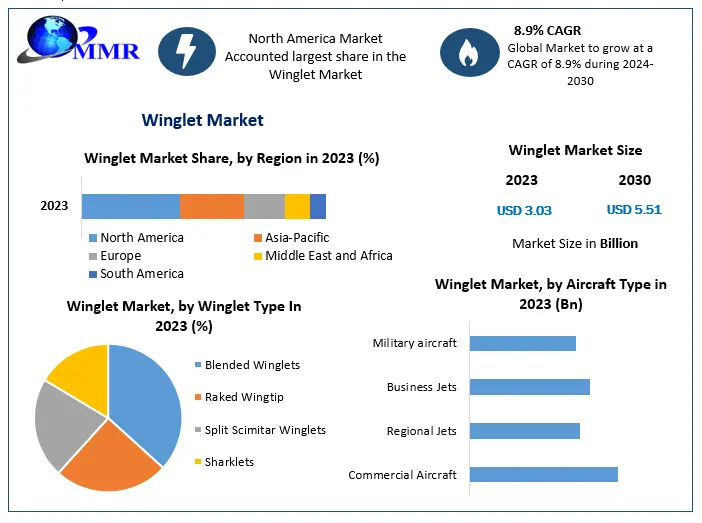
Market Valuation: Valued at USD 3.03 billion in 2023.
Growth Forecast: Projected to reach USD 5.51 billion by 2030.
CAGR: 8.9% during the 2024–2030 forecast period.
Dominant Segment: Narrow-body aircraft, accounting for over 50% of market revenue due to high utilization by low-cost carriers.
Market Driver: Stringent global carbon emission mandates and the urgent need to curtail rising fuel operational costs.
Regional Leader: North America, due to the presence of major assembly plants and a robust existing commercial fleet.
Why This Matters Now
Fuel remains the largest variable expense for any commercial airline, and the pressure to reduce carbon footprints has moved from a corporate initiative to a regulatory mandate. Aerospace OEMs, MRO operators, and procurement agencies must recognize that winglet technology has evolved from a performance “add-on” to a mission-critical component that determines the profitability and sustainability of modern aircraft fleets.
Market Overview
The Winglets Market are aerodynamic structures mounted at the wingtips of aircraft to mitigate wingtip vortices—energy-draining air currents that generate drag. By optimizing lift distribution and reducing induced drag, these devices significantly improve fuel economy and increase flight range. The current market is defined by the widespread adoption of advanced architectures, such as split scimitar and sharklet systems, which are increasingly being integrated into both new-build (line-fit) aircraft and aging fleets through intensive retrofit programs.
Key Trends Driving Growth
The aviation industry is aggressively pursuing efficiency to offset volatile fuel prices and environmental compliance costs. Modern aircraft families, such as the A320neo, have made advanced wingtip devices standard equipment, signaling a shift where aerodynamic optimization is essential for meeting certification performance guarantees. Furthermore, the rising awareness among fleet owners regarding the direct correlation between aerodynamic drag reduction and lower maintenance costs is accelerating the transition from legacy wingtip fences to high-performance, complex-geometry winglets.
Segment Insights
Dominant Segment: Narrow-Body Aircraft. These platforms account for more than half of the market share, driven by their prevalence in short-to-medium-haul routes where fuel burn optimization yields the highest operational returns.
Fastest-Growing Segment: Asia-Pacific Region. New commercial and regional aircraft orders, combined with the rapid expansion of passenger air traffic, are positioning this region to witness the highest growth in winglet adoption over the next five years.
Regional Growth Story
North America remains the largest market for winglet installations, anchored by its deep-rooted aerospace manufacturing ecosystem and the dominance of major OEMs like Boeing. However, the Asia-Pacific region is the clear growth leader. As domestic airlines across India and China continue to scale their narrow-body fleets, the demand for both line-fit winglet installations and comprehensive retrofit programs for existing aircraft is surging, making this region the primary focus for supply chain expansion.
Competitive Landscape
The market is characterized by high levels of technical innovation and close collaboration between airframe manufacturers and specialized aerostructure providers. Players such as Aviation Partners, Inc., GKN Aerospace, and FACC AG dominate the space, leveraging proprietary simulation and modeling technologies to refine winglet geometries. Recent contract wins and technology partnerships signal a broader market consolidation, where companies with a proven ability to deliver custom, lightweight composite solutions are becoming the preferred partners for major airline fleet renewal programs.
Recent Developments
Advanced Geometry Adoption: Increased utilization of Split Scimitar and Advanced Technology winglets, which offer superior drag reduction over traditional blended designs.
Retrofit Acceleration: Airlines are heavily investing in fleet-wide upgrades for mature aircraft, viewing winglets as an accessible, high-ROI method to extend the economic life of their current assets.
Composite Innovation: Shift toward advanced lightweight composite materials, which enhance durability under repeated flex-loading while reducing the overall weight penalty on the wing structure.
Strategic Implications
For MRO operators and fleet managers, winglet integration represents a low-risk, high-reward strategy for asset optimization. Procurement cycles now prioritize winglet-ready platforms as a standard, and the industry’s focus on sustainable aviation fuel (SAF) compatibility is only increasing the need for inherently efficient airframes. Organizations that delay aerodynamic modernization will face a widening competitive gap in operating margins compared to fleets that have optimized their drag profiles.
Future Outlook
The winglet market is transitioning toward a future where modular, performance-tailored aerodynamic upgrades will be the standard for all commercial and regional flight, separating sustainable industry leaders from operators tethered to the high-burn legacy of the past.
Analyst Perspective
“Winglet technology has become the most effective tool in the aviation industry’s kit for addressing the dual pressures of economic performance and environmental compliance,” says Rucha Deshpande, Analyst at Maximize Market Research. “As we look to 2030, the market’s trajectory will be defined by the integration of more sophisticated, geometry-optimized wingtip devices that push the boundaries of aerodynamic efficiency.”
About Maximize Market Research
Maximize Market Research Pvt. Ltd. (MMR) is a global market research and consulting company that provides reliable, data-focused, and practical business insights. The firm serves a wide range of industries, including healthcare, pharmaceuticals, technology, automotive, electronics, chemicals, personal care, and consumer goods. Through market forecasts, competitive analysis, strategic consulting, and industry impact assessments, MMR helps organizations understand changing market conditions, identify growth opportunities, and make informed business decisions for long-term success.
2nd Floor, Navale IT Park Phase 3
Pune Banglore Highway, Narhe
Pune, Maharashtra 411041, India
+91 9607365656
sales@maximizemarketresearch.com
