Key Highlights
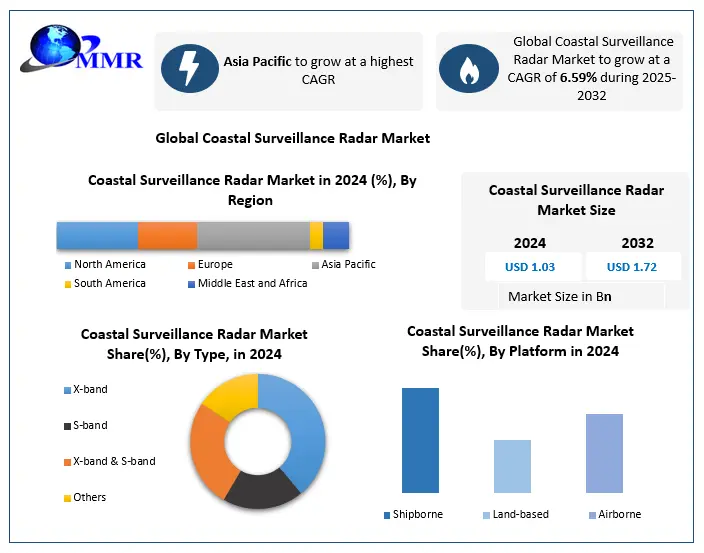
Market Valuation: Estimated at USD 0.74 billion in 2026.
Forecasted Value: Projected to reach USD 0.889 billion by 2035.
CAGR: 2.4% during the 2026–2035 forecast period.
Dominant Segment: X-band and S-band radar systems, favored for their balance of high-resolution imaging and long-range tracking.
Key Driver: Rising geopolitical friction and the need for proactive monitoring of territorial waters against illegal maritime activities.
Strategic Focus: Shift toward integrated surveillance frameworks, combining radar with electro-optical, infrared (EO/IR), and AI-driven analytics.
Why This Matters Now
The world’s coastlines have become the front line of modern geopolitical competition. For defense contractors and government strategists, the ability to maintain continuous, actionable maritime domain awareness is no longer a luxury; it is a critical defense requirement. As state and non-state actors increasingly utilize sophisticated, low-signature vessels and uncrewed surface vehicles, legacy surveillance networks are struggling to keep pace, creating an urgent market demand for high-fidelity, autonomous radar systems.
Market Overview
The Coastal Surveillance Radar Systems Market are the backbone of border security, providing real-time data on vessel movement, illegal smuggling, and territorial incursions. The current market is defined by a transition from standalone “detection-only” hardware to sophisticated, integrated “intelligence-gathering” architectures. These systems now routinely fuse radar inputs with data from Automatic Identification Systems (AIS), satellite imagery, and long-range EO/IR sensors to create a seamless operational picture for command centers.
Key Trends Driving Growth
Modernization is the primary market catalyst. Many nations are replacing Cold War-era radar infrastructure with modern, solid-state systems that offer higher reliability and lower maintenance footprints. A major technological trend is the integration of AI-driven behavioral analysis, which automatically flags suspicious vessel patterns, reducing the cognitive load on human operators. Additionally, the proliferation of unmanned maritime systems (UMSs) is forcing a redesign of coastal radar to provide higher update rates and finer range resolution, ensuring that small, fast-moving threats do not evade detection.
Segment Insights
Dominant Segment: X-Band & S-Band Systems. These technologies currently dominate the product landscape. X-band radars provide the high-frequency precision needed for detailed imaging in port and harbor security, while S-band radars offer the robust, long-range coverage essential for wide-area monitoring in all weather conditions.
Fastest-Growing Segment: Integrated Surveillance Suites. As governments look to consolidate data silos, the demand for platforms that seamlessly fuse radar, EO/IR, and satellite inputs is outpacing the growth of standalone radar hardware.
Regional Growth Story
North America and Europe currently represent the largest share of the market, driven by sustained investment in naval infrastructure and comprehensive maritime border protection. However, the Asia-Pacific region is experiencing the most significant tactical pressure, with nations like India, China, and Japan aggressively expanding their coastal radar networks to manage increasingly contested waterways. This regional shift is turning the Indo-Pacific into a primary hub for next-generation coastal defense procurement.
Competitive Landscape
The market features a consolidation of major aerospace and defense primes, such as RTX, Thales, and Saab, who leverage their dominance in sensor fusion and C2 (command and control) software. Competitive differentiation is no longer based on raw radar range alone, but on the ability to provide an “open architecture” system that can ingest data from diverse sensors and integrate with broader national security networks. This signals that supplier positioning is now tied to software agility—the ability to push firmware updates that enhance threat-detection algorithms over the system’s lifespan.
Recent Developments
AI-Enhanced Threat Detection: Integration of machine learning models into coastal radar processors to differentiate between legitimate commercial traffic and potential threats in real time.
Unmanned Systems Integration: Deployment of radars capable of tracking small, radar-cross-section-limited unmanned surface vessels (USVs), addressing a critical gap in contemporary coastal defense.
Predictive Maintenance: Move toward sensor-based health monitoring, allowing maintenance teams to anticipate and repair component failures before they impact border security operations.
Strategic Implications
For procurement agencies, the “total cost of ownership” is currently the most significant barrier to program expansion. Future radar investments are moving toward modular, scalable designs that allow for incremental upgrades rather than full-system replacements. Governments that prioritize flexible, software-defined radar platforms will be better equipped to adapt to the rapidly evolving tactical environment of the next decade, while those tethered to proprietary, “black-box” systems will face mounting obsolescence risks.
Future Outlook
The coastal surveillance radar market is separating into two distinct categories: commodity-level hardware providers and sophisticated systems-integrators who deliver actionable maritime intelligence, with the latter poised to capture the bulk of future government modernization budgets.
Analyst Perspective
“The era of the simple ‘rotating antenna’ is ending,” says Rucha Deshpande, Analyst at Maximize Market Research. “The next generation of coastal radar will be defined by its ability to act as an intelligent, autonomous node in a wider maritime security ecosystem, where AI-driven processing ensures that security teams are managing intelligence, not just data.”
About Maximize Market Research
Maximize Market Research Pvt. Ltd. (MMR) is a global market research and consulting company that provides reliable, data-focused, and practical business insights. The firm serves a wide range of industries, including healthcare, pharmaceuticals, technology, automotive, electronics, chemicals, personal care, and consumer goods. Through market forecasts, competitive analysis, strategic consulting, and industry impact assessments, MMR helps organizations understand changing market conditions, identify growth opportunities, and make informed business decisions for long-term success.
2nd Floor, Navale IT Park Phase 3
Pune Banglore Highway, Narhe
Pune, Maharashtra 411041, India
+91 9607365656
sales@maximizemarketresearch.com
