Key Highlights
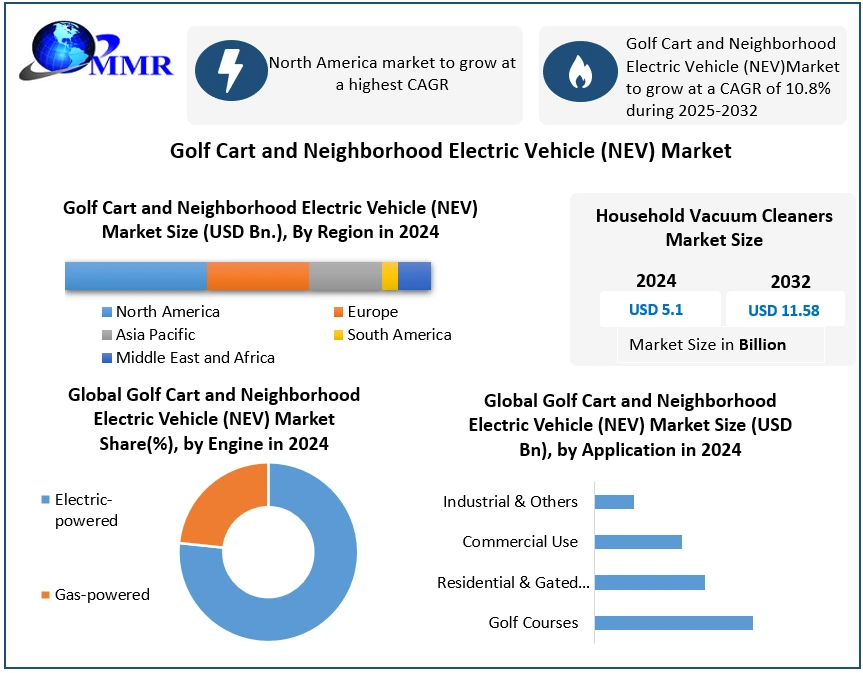
The global Golf Cart and Neighborhood Electric Vehicle (NEV) market size reached USD 5.1 billion in 2024 and is projected to expand to USD 11.58 billion by 2032.
The industry is experiencing a rapid trajectory, growing at a compounded annual growth rate (CAGR) of 10.8% from 2025 to 2032.
Electric-powered engines represent the dominant power configuration, controlling between 75% and 82% of the total global market share in 2024.
North America maintains the dominant market position due to high adoption rates in planned residential communities across states like Florida and California.
The Asia-Pacific (APAC) region is positioned to exhibit the highest CAGR during the forecast period, driven by expanding commercial spaces, resorts, and smart city developments.
Why This Matters Now
Fleet managers, municipal planners, and mobility investors must urgently reassess their short-distance transit strategies as urban emission codes restrict legacy internal combustion engines. Micro-mobility is no longer a niche recreational segment; it is transforming into a primary structural solution for last-mile public transport, gated residential zones, and vast corporate and industrial campuses. OEMs that fail to transition from legacy gas powertrains to integrated electric platforms risk immediate displacement by agile competitors capitalizing on local regulatory changes. The race to capture this expanding middle tier of low-speed mobility depends on deployment speed, regulatory navigation, and scalable charging ecosystems.
Market Overview
The global Golf Cart and Neighborhood Electric Vehicle (NEV) market covers low-speed vehicles generally limited to maximum speeds under 25 miles per hour (40 km/h). Originally restricted to sports facilities, these vehicles are experiencing massive structural re-allocation across gated communities, academic campuses, commercial airports, multi-modal transportation hubs, and luxury hospitality destinations. The primary driver behind this expansion is the growing demand for highly efficient, small-footprint urban transport options that bypass traditional automotive congestion. As global metropolitan layouts favor localized smart city networks, the industry is scaling away from seasonal recreational items to become permanent, year-round micro-transit infrastructure.
Key Trends Driving Growth
Accelerating environmental regulations and localized carbon targets are pushing commercial buyers away from fossil-fueled powertrains. Gated developments and university campuses are enforcing internal zero-emission mandates, effectively creating captive markets for electric micro-mobility options. Simultaneously, consumer shifts toward luxury, street-legal low-speed vehicles are altering the design priorities of top-tier OEMs. Users now expect traditional automotive safety and comfort standards from neighborhood runabouts.
Furthermore, digital marketplace innovations are completely altering traditional dealership networks. Customization platforms allow institutional buyers and retail consumers to pre-configure fleets online, streamlining trade flows and manufacturing turnarounds. The growing integration of digital platforms with vehicle telemetry gives fleet operators real-time data on battery health, usage patterns, and spatial positioning, optimizing operational runtimes.
Segment Insights
Electric-Powered Engines [Dominant Segment]: This segment captured an overwhelming 75% to 82% of the total global market share in 2024. The combination of minimal maintenance schedules, whisper-quiet operations, and aggressive corporate sustainability targets ensures that electric powertrains remain the standard choice for major procurement contracts.
Golf Carts [Fastest-Growing Segment]: Despite widespread diversification into urban NEVs, the specialized golf cart segment continues to expand at the highest CAGR. Demand is driven by new golf resort construction across emerging economies and the flexible off-road utility these platforms offer in industrial and airport environments.
Regional Growth Story
North America represents the largest regional market share, heavily anchored by master-planned retirement developments and residential communities in warm-weather hubs like Florida and California. The regional infrastructure is built to support street-legal NEVs, allowing low-speed electric platforms to safely share public neighborhood corridors. The presence of major domestic manufacturing giants further reinforces this regional dominance.
In contrast, the Asia-Pacific territory is expanding at the fastest pace globally. Escalating investments in high-end hospitality sectors, massive infrastructure layouts in China and India, and industrial park developments are opening significant whitespace for low-speed electric fleets. Western Europe shows stable, high-value demand as historical urban centers restrict passenger vehicle traffic, making small-footprint NEVs highly practical.
Competitive Landscape
The competitive space is defined by an intensifying technology race between traditional recreational vehicle manufacturers and specialized electric mobility providers. Pricing power is increasingly tied to electronic system features and advanced battery integration rather than mechanical structures. Major players are moving toward vertical integration, forming direct partnerships with battery cells suppliers to secure raw materials amid shifting supply chain dynamics.
To defend their market positions, legacy OEMs are expanding their product lines into specialized sub-segments, such as industrial heavy-duty utility carts and luxury multi-passenger street-legal passenger pods. Mid-tier participants face margin pressure unless they secure regional distribution agreements or develop proprietary technology, such as specialized software for corporate fleet management.
Recent Developments
Club Car, LLC launched its updated Tempo golf car lineup featuring an automated parking brake integrated into its proprietary StopSmart technology to improve operational safety.
Yamaha Golf-Car Company introduced its new five-seater G30E and G31EP electric models, utilizing specialized lithium-ion and Lithium Iron Phosphate (LFP) battery platforms designed completely in-house.
Yamaha expanded its North American market reach by securing exclusive distribution rights for Pilotcar-branded low-speed vehicles, targeting street-legal NEV applications.
Textron Inc. (E-Z-GO) rolled out its digital “Reserve Now” customization matrix, allowing commercial fleet operators to configure vehicle options directly online.
Strategic Implications
The transition from legacy internal combustion engines to electric-powered configurations requires Tier-1 suppliers to pivot toward specialized electric components. Drivetrain engineering must prioritize energy efficiency to maximize operational range from smaller, lightweight battery packs. At the same time, the ongoing industry-wide shift from lead-acid batteries to advanced lithium-ion and LFP platforms means suppliers must insulate themselves from global semiconductor and raw material volatility.
Furthermore, infrastructure deficiencies present a substantial hurdle that requires strategic corporate solutions. Because public charging grids for low-speed vehicles remain underdeveloped in semi-urban and developing territories, forward-thinking OEMs must develop integrated charging packages. Providing dedicated solar charging docks or standardized plug-and-play community systems will allow manufacturers to close major commercial fleet sales in regions lacking public infrastructure.
Future Outlook
The ultimate victory in this micro-mobility shift belongs to manufacturers that embed smart connectivity and advanced safety systems into standard low-speed configurations, while firms reliant on basic unnetworked mechanical platforms will be systematically phased out of modern urban transit networks.
Analyst Perspective
“The rapid expansion of the global Golf Cart and NEV market highlights a permanent change in how modern societies manage short-range mobility,” explains Dharati Raut, Research Analyst at Maximize Market Research. “By moving past traditional recreational applications and adopting advanced in-house lithium-ion chemistry alongside intelligent fleet telematics, manufacturers are transforming low-speed vehicles into an essential component of sustainable urban transportation infrastructure.”
About Maximize Market Research
Maximize Market Research Pvt. Ltd. (MMR) is a global market research and consulting company that provides reliable, data-focused, and practical business insights. The firm serves a wide range of industries, including healthcare, pharmaceuticals, technology, automotive, electronics, chemicals, personal care, and consumer goods. Through market forecasts, competitive analysis, strategic consulting, and industry impact assessments, MMR helps organizations understand changing market conditions, identify growth opportunities, and make informed business decisions for long-term success.
2nd Floor, Navale IT Park Phase 3
Pune Banglore Highway, Narhe
Pune, Maharashtra 411041, India
+91 9607365656
sales@maximizemarketresearch.com
